Twelve more defendants charged in Georgia’s so-called “peaceful overthrow” case linked to the October 4 protests have accepted plea agreements, under which they will serve one year in prison followed by three years of probation.
The deal differs from agreements previously reached with 22 other convicted individuals in the same case, who were released under different terms.
During a court hearing, Judge Tamar Makharoblidze asked each of the 12 defendants individually whether they admitted guilt and wished to enter into plea agreements. All answered in the affirmative.
One defendant, Manuchar Mikeladze, had initially been expected to join the plea deal but withdrew his consent before the hearing began. Following his decision, another defendant, Giorgi Kirvalidze, also attempted to withdraw from the agreement and shouted an insult directed at Bidzina Ivanishvili in the courtroom.
Kirvalidze was removed from the courtroom. However, the plea agreement remained valid because his remarks came after the judge had already approved the deal.
Mikeladze, who rejected the agreement, was sentenced to five years in prison.
“I am not guilty. The guilty one is the person who is depriving this country of its future. I will pay my debt to my country, and those who serve this system and act as its cogs should be ashamed. He is destroying your careers too and will sacrifice everyone, just as those arrested on corruption charges were sacrificed. Think about it,” Mikeladze told prosecutors before the verdict was announced.
Among the 12 defendants who accepted plea agreements, only Saba Kordzaia will spend more time in prison. Prosecutors say he had previously been sentenced in a separate case, meaning that part of his earlier sentence was added to the new one. As a result, Kordzaia will serve a total of one year and six months behind bars.
The other defendants who accepted plea deals are Simon Makharadze, Kakhaber Kvachantiradze, Gia Toloraia, Mikheil Toloraia, Avtandil Topchishvili, Yuri Lomidze, Davit Giunashvili, Giorgi Talakhadze, Beka Machavariani, Giorgi Kirvalidze and Koba Epitashvili.
Kirvalidze’s lawyer, Boris Chele kurua, described the plea agreements as a political move by the prosecution and questioned the basis on which the terms were offered.
“Anyone who still hopes to receive a fair decision from this court, may God help them. No one but God can help; a lawyer is powerless here. If someone thinks being in prison is worthwhile, they can easily end up there themselves in this country: committing a crime is not even necessary,” he said.
The lawyer also criticized the evidence presented by the prosecution, arguing that witness testimony and video footage failed to conclusively identify his client.
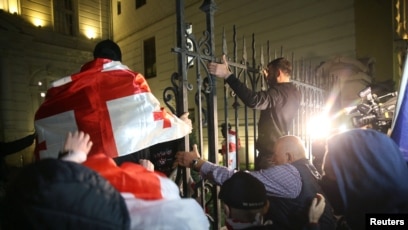
The criminal proceedings stem from events that unfolded during a large opposition protest in Tbilisi on October 4.
On that day, a significant portion of opposition parties and their supporters boycotted local elections and gathered at Liberty Square, calling for what they described as the “peaceful overthrow” of the government.
Following the mass rally, a group of demonstrators attempted to symbolically “take possession of the keys to the presidential palace.” The protest escalated when participants breached barriers near the presidential residence on Atoneli Street and clashed with riot police.
The Georgian authorities subsequently launched a large-scale criminal investigation, accusing participants of involvement in organized violence and actions aimed at overthrowing the constitutional order. Critics of the prosecution, including opposition figures and human rights advocates, have argued that the case is politically motivated and represents an attempt to suppress anti-government protests.
A total of 64 people were charged in connection with the October 4 events, making it one of the largest criminal cases arising from Georgia’s recent wave of political demonstrations.