By George Katcharava
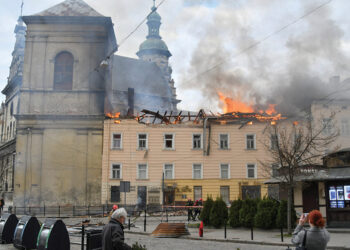
The horizon off the port of Ust-Luga, once the crown jewel of Moscow’s maritime infrastructure, now reflects a rhythmic, destructive frequency that no amount of Kremlin rhetoric can mask. In the icy reaches of the Baltic and the strategic depths of the Black Sea, the very architecture of the Russian oil export infrastructure is being systematically dismantled. This is no longer a localized conflict of territorial attrition; it has evolved into a high-stakes siege of the global energy market. Ukraine, a nation without a conventional blue-water navy, has effectively seized the throttle of Russia’s economic engine, imposing a “kinetic sanction” that physically achieves what years of Western diplomacy could not.
The economic fallout of this well calculated and executed campaign is catastrophic, striking at the heart of Russia’s “fortress economy.” For decades, the terminals at Primorsk and Novorossiysk served as the iron lungs of the state, breathing life into the Kremlin’s ambitions through a steady pulse of crude exports. Today, those lungs are gasping. By paralyzing roughly 40 per cent of Russia’s sea-borne export capacity, removing approximately two million barrels per day from the global ledger, Kyiv has punctured the primary artery of war finance. At a time when oil prices remain volatile, this massive disruption translates into a daily loss of hundreds of millions of dollars in potential revenue, money that can no longer be converted into the high-tech components for the military production or foreign mercenaries required to sustain a war of choice.
Beyond the immediate loss of export liquidity, the strikes might trigger a profound domestic crisis. With nearly 38 percent of the country’s refining capacity compromised last as a result of last year’s strikes, the world’s largest oil producer is paradoxically faces problems in terms of domestic fuel supply. This has ignited a “refining trap”: as distillation units are incinerated, Russia is forced to export raw crude at a steep discount while facing a 45 per cent surge in domestic gasoline prices. Over twenty regions have reported shortages not long ago, forcing the Kremlin into a politically perilous choice, divert fuel to the front lines in Ukraine and risk civilian unrest, or stabilize the domestic market and stall the military machine.
The political implications of this vulnerability are existential for Russia. For two decades, the social contract in Russia has rested on the state’s ability to provide stability funded by energy dominance. As smoke rises over the Baltic terminals, that contract is being shredded. The “shadow fleet,” the clandestine network of aging tankers used to bypass international sanctions and price caps, now finds its hubs turned into high-risk combat zones. This has driven insurance premiums to prohibitive levels and scared off all but the most desperate of trade partners, effectively delegitimizing Russia’s status as a reliable supplier and energy guarantor.
Furthermore, the destruction of specialized infrastructure exposes a critical flaw in Russia’s long-term resilience. These facilities were built using Western engineering and technologies with bespoke parts that are now strictly embargoed. Ukraine is not merely breaking Russia’s tools; it is breaking tools that the Kremlin cannot easily replace. This forced “de-industrialization” of the energy sector signals a permanent shift in the global order. By turning the Black Sea and the Baltic into contested corridors for Russia’s oil exports, Ukraine has demonstrated that sovereignty over an export economy belongs not to the one who owns the wells, but to the one who controls the exits. As the economic walls close in, the Kremlin faces a future where its primary source of geopolitical leverage has become its greatest strategic liability.
Author’s bio: George Katcharava is the founder of eurasiaanalyst.com , a geopolitical risk and advisory firm.