US President Donald Trump has said that American oversight of Venezuela could extend beyond a year and potentially last for years, based on remarks made in an interview with The New York Times.
Asked whether Washington planned to “control” Venezuela for only one year, Trump replied that it could be longer, adding that the US is in continuous contact with Venezuela’s interim leadership through Secretary of State Marco Rubio.
Trump also argued that the interim Venezuelan government is providing the US “everything it needs,” describing a plan in which Venezuelan oil would be used to lower prices, while Venezuela would receive much-needed funding.
Venezuela’s Vice President and Oil Minister Delcy Rodríguez was formally sworn in as interim president earlier this week, after former President Nicolás Maduro was captured in a US-led operation and later appeared in a New York court, according to Reuters.
Recent reporting indicates the US plans to control Venezuelan oil sales indefinitely, directing how proceeds are used and tying revenues to US supervision and commercial arrangements.
A Reuters report citing a CNBC account says Venezuelan oil sales to the US are expected to continue indefinitely, beginning with an initial tranche of more than 50 million barrels, alongside a plan to ease sanctions.
Venezuela’s state oil company PDVSA has said oil supply negotiations with the US are moving forward, signaling active talks as both sides seek to restart and stabilize flows.
Chevron is reported to be in talks with the US government to expand its Venezuela license so it can increase crude exports to its refineries and potentially sell to other buyers.
In the same interview, Trump described a plan to rebuild Venezuela “in a very profitable way” and said the US would use and manage Venezuelan oil as part of a broader recovery effort. He also indicated he planned to meet with executives from major oil firms to discuss restoring production.
Meanwhile, international reporting notes political uncertainty inside Venezuela, with Rodríguez publicly rejecting the notion that a “foreign agent” is running the country, even as US officials have offered limited clarity on the precise structure and timeline of Washington’s role.
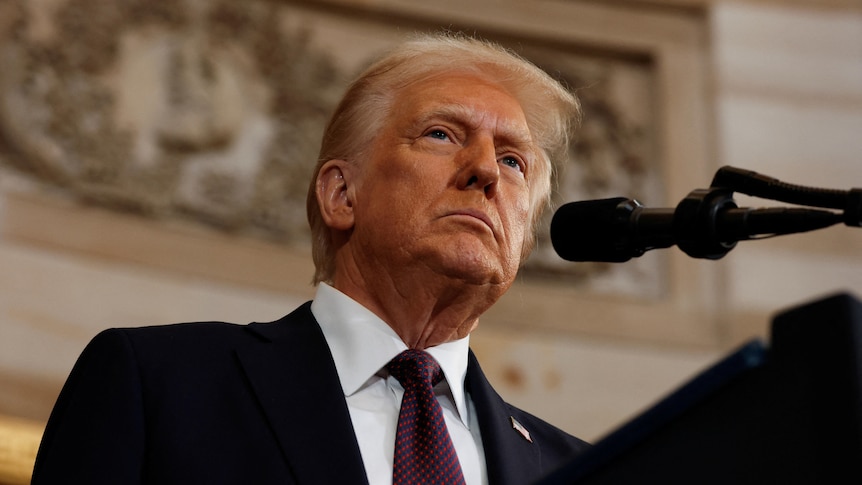
Image: Donald Trump gives his inaugural address inside the Capitol as he is sworn in for a second term as US president (Reuters: Chip Somodevilla)