By Jim Stenman for Caucasus Crossroads*
One year after Donald Trump hosted Armenian Prime Minister Nikol Pashinyan and Azerbaijani President Ilham Aliyev at the White House, where they signed a joint declaration and their foreign ministers initialed a peace agreement meant to end nearly four decades of conflict, both governments marked the anniversary with a joint statement touting the Nobel Peace Prize nomination they submitted together for the US president days after the summit.
The conflict they credit him with ending ran through three rounds of war over Nagorno-Karabakh, an ethnic Armenian enclave internationally recognized as Azerbaijani territory. The last round was Azerbaijan’s September 2023 offensive, which retook the territory, dissolved the self-proclaimed Republic of Artsakh and prompted the exodus of some 100,000 ethnic Armenians to Armenia.
“I was in disbelief, in a positive sense,” Matthew Bryza, the former US ambassador to Azerbaijan, told me. “The main thing was that the US president got so heavily involved, which had not happened since George W. Bush hosted the then leaders of Azerbaijan and Armenia in April of 2001.”
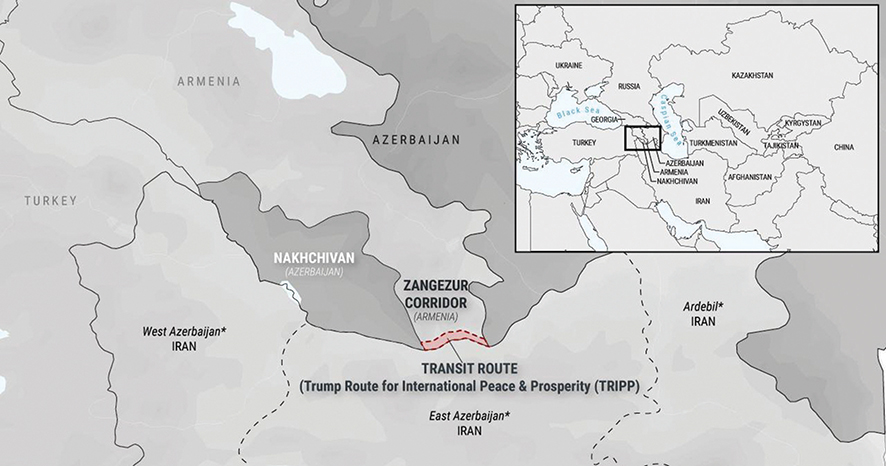
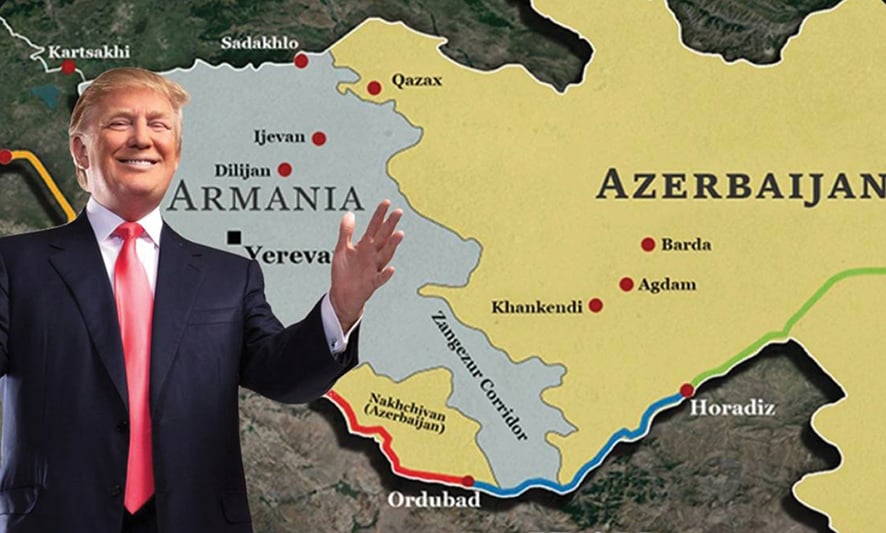
The route at the center of the deal carries his name: The Trump Route for International Peace and Prosperity, or TRIPP, a planned rail and road link through southern Armenia connecting mainland Azerbaijan to its Nakhchivan exclave, cut off since Soviet border-drawing in the early 1920s left a strip of Armenia in between. For decades, reaching it overland meant crossing Iran.
A year on, the peace treaty initialed in Washington remains unsigned, and the constitutional referendum Azerbaijan wants from Armenia before signing has no date.
What is moving, though, is the money.
The money is ahead of the treaty
On the anniversary, the State Department announced the Trans-Caspian Enterprise Fund, Washington’s vehicle to spur private investment along the route, is operational, with an elected board and $201 million in US government capital. Federal spending records tell a bigger story: USAspending.gov shows the State Department awarded the grant at $201 million in late January, then amended it on July 16 to double the commitment to $402 million, a change reported by the Armenian investigative outlet Hetq. The announcement described the smaller figure as paid-in capital and did not mention the larger one, and the gap measures how far Washington intends to go.
The corporate architecture is further along still: the TRIPP Development Company, a joint venture approved by the board of the US International Development Finance Corporation in July, will hold exclusive rights to develop and operate the corridor for an initial term of 49 years, extendable by another 50. Washington owns 74% of it and Armenia holds 26%, a stake that rises to 49% only if the arrangement is extended. Azerbaijan holds no equity: the links on its side of the border are its own state projects, and its rail line to the Armenian frontier is nearing completion. Engineering surveys are underway on Armenian ground.
The political track needs a referendum Pashinyan cannot yet call: amending the constitution, to drop preamble language Baku reads as a claim on its territory, requires two-thirds of parliament to open the process, and his party, for all its June election win, does not have two-thirds. On the commercial track sit a capitalized fund, a chartered company, a survey crew and a half-built railway. The infrastructure is being built first, on the bet that the peace will catch up with it.
The prize goes past cargo: a functioning TRIPP would anchor Armenia’s normalization with Azerbaijan and could unlock the reopening of its Turkish border, shut since 1993 in solidarity with Baku. Bryza considers that reopening all but inevitable on the current course, and it would leave the South Caucasus more connected than at any point since the Soviet collapse.
Why the freight business isn’t convinced
Bryza has watched this corridor from more seats than most: White House staffer, ambassador in Baku, co-chair of the mediation that spent years failing to settle it, and now an Istanbul-based risk advisor who says he hopes to take part in corridor-linked investments, an interest worth noting.
His verdict, delivered on my podcast, Global Power Shifts, is that the peace is real even if the paperwork is not. “The deal’s not really done,” he told me, and yet Aliyev keeps declaring the two countries in a de facto state of peace, wheat and fuel are moving, and the infrastructure spending is, in his words, “laying the foundation for economic growth and for economic cooperation, and hopefully therefore for a long-term peace.” The corridor itself he calls “promising, nascent, not yet in existence.”
Trump’s commitment he vouches for firsthand. “I was in Washington last week. I had meetings all over, including in the West Wing,” he said when we spoke in mid-August. “I heard unanimously that President Trump is extremely supportive of this corridor going forward, not only because the middle portion is named after him, but that doesn’t hurt.” His strategic ledger is just as blunt: the deal is “a gigantic strategic setback” for Russia, which policed this region for two centuries: “Russia is definitely not the main player. The US under President Trump is the main player now.”
The same road gets a different price from Lasha Amashukeli, a veteran Georgian logistics executive and former deputy CEO of freight operator Royal Express, recruited to become vice president of Lydeoil, an Omani oil products producer and trader, and now splits his time between Muscat and Georgia. Much of his cargo still moves through the Black Sea ports TRIPP would bypass, an interest that cuts against the route, and also why his read matters: he has spent decades moving freight through the corridor the new road proposes to compete with.
His advice to any shipper weighing routing plans around TRIPP: “too early, too uncertain.” “I guess sooner or later it will start working,” he told me. “I would not give it a very international role. More I would give it the role of trading between Azerbaijan and Turkey.” His case is an operator’s arithmetic: international cargo needs a sea port, from the new route the nearest is Trabzon, and by his reckoning that path runs roughly 400 kilometers longer than the existing Baku-to-Poti or Batumi runs, across mountain serpentines rather than flat ground, a penalty that lands directly on cost. “Sorry for my neighbors, but I’m not looking on this route very seriously.”
Reopening the Turkish-Armenia border would leave the South Caucasus more connected than at any point since the Soviet collapse
On one point, the diplomat and the operator converge, and the documents back both. Armenia has kept sovereignty over border control and customs under TRIPP, which Amashukeli calls the only real progress on paper, and also the route’s structural handicap. “If Armenia is not giving up its sovereignty on customs, then cargo from Azerbaijan to Turkey needs to pass the border and customs two times,” he said. “One entering and one on exit.” Bryza laid out the same standoff from both capitals’ mouths: “The Azerbaijanis say, ‘well, if we’re moving cargo from one part of Azerbaijan to another across Armenia, why should we be subject to Armenia’s customs checks’? Whereas the Armenians say, ‘wait a second, your cargo is transiting our territory. Of course we have a sovereign right to check on it.’” The implementation framework published in January confirms the Armenian position. Until that knot is cut, both men suggest, the corridor’s tonnage stays symbolic.
Georgia is still the main route
For Georgia, this trade’s land bridge for three decades, the question is whether TRIPP is a threat. Amashukeli’s answer is close to dismissive: “no one is thinking about it in Georgia” as a competitor. The numbers are his own: Georgian ports handled around 700,000 twenty-foot container units last year against roughly 90,000 through Baku, a gap that makes the existing route’s dominance look structural rather than incidental. Published figures back him: APM Terminals Poti alone reported more than 480,000 TEU in the first nine months of 2025, up 16%.
Tbilisi is hedging anyway, in capital. “We don’t think that this new route will be our competitor, but, cautiously, we are investing heavily, to be ready for any kind of competition,” Amashukeli said. The World Bank approved $372 million in June to upgrade Georgian rail and roads along the corridor, and the long-delayed Anaklia deep-sea port, as he puts it, “will change our ecosystem dramatically” if built, letting in vessel classes Georgia’s shallower ports turn away.
Rail is where his enthusiasm sits, and his diagnosis of its weakness is blunt: the network is fully state-owned, with no private operators allowed. “When the state has full ownership, sometimes it gets lazy,” he said. The government is now committing heavily to new locomotives and rolling stock just as the network needs them: since January, he says, commodities led by fertilizers have shifted onto the corridor in volumes only rail can carry. “Without good railway and good volume on railway, you can’t grow.”
Asked why Georgia holds the region’s logistics crown, he starts with geography and ends somewhere sturdier: “All governments, all political parties come and go, come and go, but all of them are investing in Georgian infrastructure.”
The politics reads harsher from outside, where Bryza argues Tbilisi has “played itself out of the European game,” citing the cancelled US-backed Anaklia port concession, though even he adds that “if and when there’s a new government that does reflect the desire of over 80% of Georgia’s electorate to integrate with Europe, then I think we’ll see things move very quickly.”
We don’t think that this new route will be our competitor, but, cautiously, we are investing heavily, to be ready for any kind of competition – Lasha Amashukeli
Emil Avdaliani, a professor of international relations at European University in Tbilisi and director of Middle East studies at the Geocase think tank, offers the view from inside. Georgia’s drift toward Moscow, as the West usually describes it, is in his reading “better understood as a strategic hedge” than a settled bet; part of Tbilisi restructuring a foreign policy that had been aimed almost entirely at Western integration. On Russia, he expects retrenchment: “Russia’s most likely response will be to try to preserve the existing status quo, because, for the moment, it does not have the political or military capacity to reconstruct the regional order it dominated before 2022.” In Armenia, he expects Moscow to work its remaining economic and information levers with one objective, “to make Armenia’s disengagement from Moscow highly expensive for Yerevan,” just as Yerevan moves closer to Brussels. Nor does he see the vacancy filled from elsewhere: “Neither China nor Iran is positioned or interested in replacing Russia as the South Caucasus’ key player.”
My read
Follow the sequence rather than the ceremony: a treaty usually comes first, then ratification, then financing, then construction. This peace is being built in reverse, the fund capitalized and the surveyors deployed while the legal settlement everything nominally rests on waits for a referendum that cannot yet be called. That order is not an accident, because money in the ground makes the arrangement expensive for anyone to unwind, Armenian voters included, before they are asked. Whether that reads as stabilizing or as a bet placed over the heads of the people who still get a vote depends on where you sit, and both readings are live in Yerevan.
Asked how Washington should make the route succeed, Amashukeli waved off the politics: “Investing and investing. The only chance it will be alive is if you invest and you make it attractive for any kind of cargo.”
Watch for: whether TRIPP construction breaks ground on Armenian territory before year-end, and any movement on the two-thirds the Armenian parliamentary arithmetic needs for the referendum. The customs regime is the sharper tell: once Baku and Yerevan settle the double-clearance question, the road stops being symbolic.
*Caucasus Crossroads, part of the Global Power Shifts network, tracks Capital, Corridors & Control across the South Caucasus.