Airports have become one of the most revealing indicators of a country’s ambitions. Once viewed simply as transport infrastructure, they are now expected to function simultaneously as business hubs, architectural statements, retail destinations and, increasingly, the first expression of a nation’s identity. From Singapore’s Changi to Istanbul’s new mega-airport, governments have come to understand that the passenger experience begins long before visitors reach a hotel or museum. Georgia is making a similar, if more modest, investment in that philosophy.
In July, TAV Georgia officially launched a $150 million expansion of Tbilisi International Airport, a project that will double the airport’s annual capacity from five to ten million passengers by 2028. The program includes ten passenger boarding bridges, seven additional remote aircraft stands, expanded passport control, new check-in facilities, upgraded baggage systems and larger retail, dining and business lounge areas. The project will also modernize operational infrastructure while increasing parking capacity around the terminal.
In July, TAV Georgia launched a $150 million expansion of Tbilisi International Airport that will double the airport’s annual capacity from five to ten million passengers by 2028
On paper, these are technical improvements. In practice, they represent something much broader. For much of the past decade, Georgia’s tourism strategy has focused on attracting visitors through culture, gastronomy, wine and dramatic landscapes. International campaigns promoted the country as a destination to be discovered rather than simply visited. That strategy has been remarkably successful.
Passenger traffic has grown steadily, with Tbilisi Airport serving more than 1.09 million passengers during the first quarter of 2026: an eight percent increase compared with the previous year. Across Georgia’s airports, passenger numbers continue to set new records.
Infrastructure inevitably has to catch up with that success. Anyone who has traveled through rapidly growing airports understands that capacity is about more than statistics. Congested passport control, overcrowded departure halls and limited aircraft stands affect not only convenience, but also a country’s international reputation. Airports shape first impressions with surprising force. Before visitors experience Georgian hospitality, architecture or cuisine, they experience immigration queues, baggage delivery and terminal design.
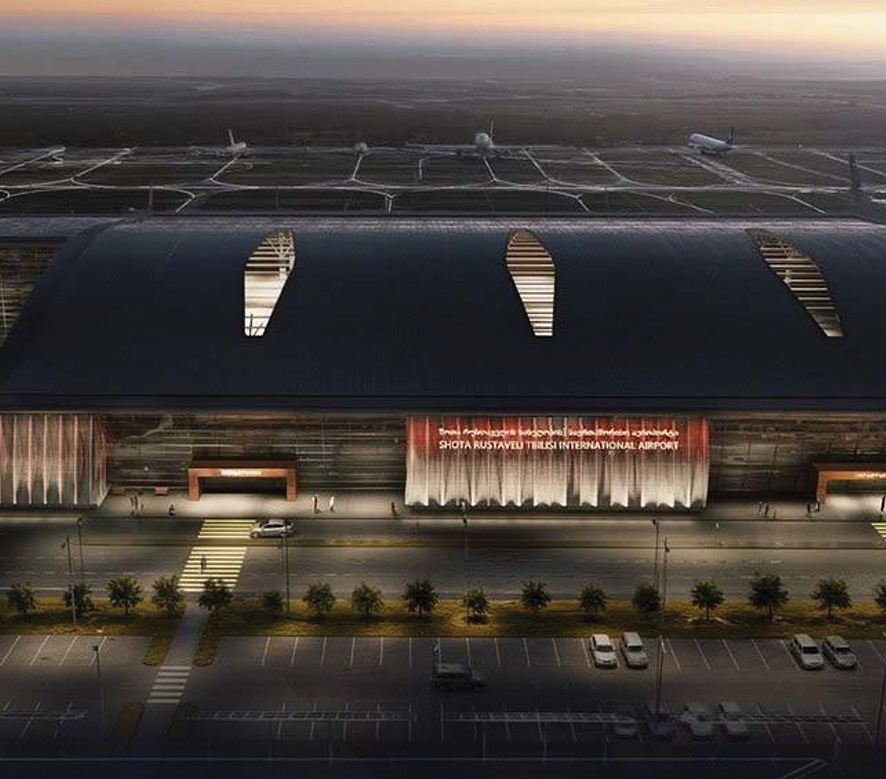
Perhaps the most interesting aspect of the project is not the engineering itself, but the decision to dedicate new commercial spaces to Georgian food and local products. Airports have increasingly become curated showcases of national identity. Helsinki presents Finnish design before travellers reach the city. Copenhagen introduces visitors to New Nordic cuisine almost immediately after arrival. Seoul integrates Korean cultural brands throughout Incheon Airport. Rather than filling terminals exclusively with international luxury chains, many successful airports now serve as introductions to local culture. Tbilisi appears to be moving in the same direction.
This reflects a transformation of aviation economics. Airports no longer earn revenue primarily through aircraft operations. Retail, restaurants, premium lounges and commercial services have become central to their financial model. In that environment, highlighting Georgian producers is not merely a cultural gesture; it is also an economic strategy that gives local businesses access to an international audience measured in millions.
As international airlines continue expanding their Georgian routes, airport capacity becomes an issue of national competitiveness rather than simple convenience
The investment also illustrates Georgia’s changing position within regional mobility networks. Over the past decade, Tbilisi has evolved into an increasingly important gateway between Europe, the South Caucasus and parts of Central Asia. As international airlines continue expanding their Georgian routes and tourism remains one of the country’s key economic sectors, airport capacity becomes an issue of national competitiveness rather than simple convenience.
Of course, expansion alone does not guarantee success. Around the world, impressive terminals have sometimes outpaced passenger demand, while smaller airports have succeeded through efficient operations rather than monumental architecture. The real measure of this project will be whether improved infrastructure translates into smoother passenger experience, stronger airline partnerships and continued growth without sacrificing service quality.
What distinguishes Tbilisi’s expansion is that it arrives not as a speculative megaproject, but as a response to sustained demand. The numbers already justify the investment. The challenge now is ensuring that the airport grows not only in size but also in character.
For many visitors, an airport is no longer simply the place where a journey begins. It is the first chapter of the story a country tells about itself. Georgia’s decision to invest in that story suggests confidence that many more people will soon be arriving to hear it.
By Ivan Nechaev