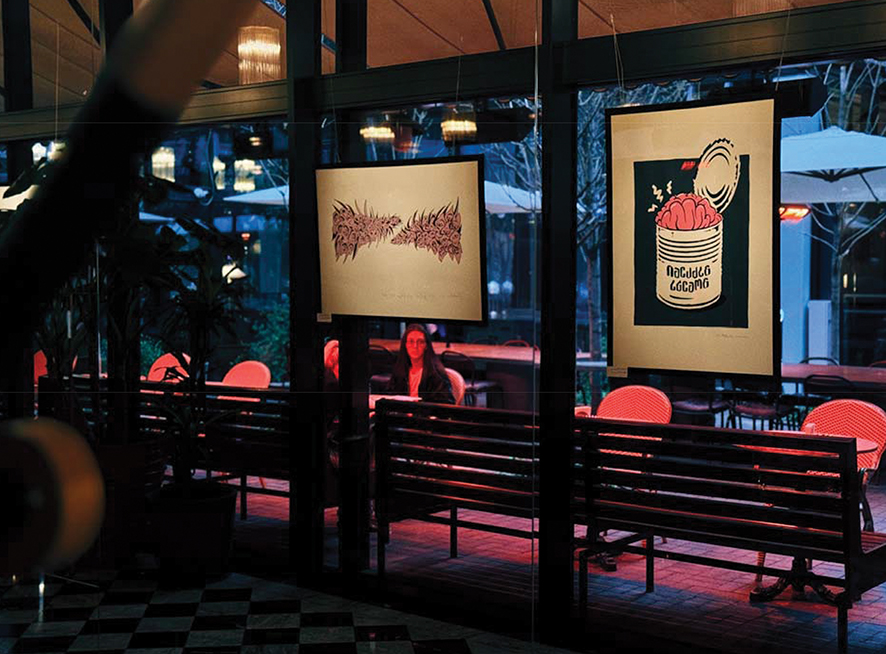
There’s a particular kind of exhibition that doesn’t announce itself as an event. It sits in the corner of your evening. You notice it between a sip of coffee and a message you probably shouldn’t be checking. “The Lovers,” currently on view at Artizan Design Hotel in collaboration with SLCT Gallery, belongs precisely to that category, and that is its quiet strength.

The premise sounds simple: a series of limited-edition serigraphs installed across the hotel’s interior, running from March 25 to April 22, free to enter. In practice, it feels less like entering an exhibition and more like brushing against one.
The first thing that happens is that you don’t really stop to look. The prints hang against glass walls that open onto the hotel’s courtyard. Outside, people are smoking, talking, scrolling. Inside, someone is waiting for a drink, someone else is pretending not to look at their phone. The images sit in between: caught in reflections, partially obscured by plants, cut through by the geometry of window frames. You rarely get a clean, frontal view. And after a while you realize: that’s the point. These works aren’t asking for full attention. They live in peripheral vision, like something you half-remember.

At the center of the show is The Lovers: two figures pressed into each other, though “embrace” feels like too gentle a word. Their bodies are broken into graphic fragments: stripes, marks, patches of color. A dense red shape sits between them; heart, wound, ornament, all at once. It’s a striking image, but also a slippery one. The longer you look, the less stable it becomes. Are they holding each other or collapsing into each other? Is that red shape tenderness or damage?
And then you notice variations across the exhibition, other prints where intimacy tips into something harsher. In one, two figures point guns at each other’s heads in perfect symmetry. It’s almost absurdly simple, almost comic. And then it lingers a bit too long. The show keeps circling the same idea: closeness as something slightly dangerous. Contact as something that leaves a mark.

Artizan is already a very “composed” space: carefully lit, visually controlled, a place where every surface seems aware of itself. Bringing art into it doesn’t disrupt that logic; it extends it. Which raises a quiet question: where does the exhibition end and the interior design begin? The serigraphs are crisp, bold, highly legible. They don’t resist the space: they slide into it. At times, they feel almost too comfortable there, like they’ve always belonged between the velvet seating and the polished glass. But something more interesting happens in that comfort. The works start to behave differently. They stop being objects you stand in front of and become part of the environment you move through. You don’t contemplate them. You register them.
The insistence on “limited edition serigraphy” hovers in the background. These are artworks, clearly. They are also multiples. They could exist elsewhere, on another wall, in another city, in someone’s apartment. That ambiguity, between artwork and image, between unique and repeatable, fits the exhibition almost too well. Nothing here insists on singularity. Everything feels like it could reappear.

And yet the framing, the lighting, the context restore a kind of value. The hotel does part of the work that a gallery usually does: it tells you that this matters, that this is worth looking at, even if you only glance. You don’t leave “The Lovers” with a clear narrative or a set of conclusions. What you carry instead are fragments. A red shape that won’t quite resolve into a symbol. A striped shoulder caught in reflection. Two figures locked in a gesture that could be affection or impact.
It’s a modest exhibition in scale, but it understands something essential about how we actually encounter images now. Rarely in silence, rarely with full attention, almost always alongside something else. And within that distracted, layered mode of looking, it finds its tone: intimate, slightly uneasy, and difficult to pin down in a single meaning. Which, for a show about lovers, feels exactly right.
By Ivan Nechaev