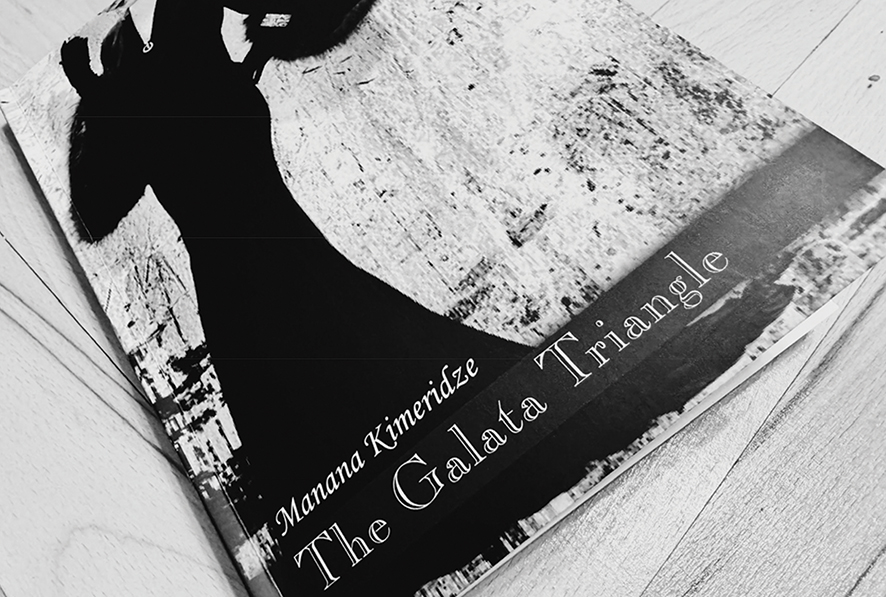
On February 16, 2026, from 18:00 to 21:00, Prospero’s Books on Rustaveli Avenue will host the launch of Manana Kimeridze’s novel The Galata Triangle, now available in English translation by Professor Lela Abdushelishvili. The setting is fitting. Prospero’s, that long-standing sanctuary for multilingual Tbilisi, has always been a place where empires, ideas, and exiles quietly coexist on adjacent shelves. Kimeridze’s novel belongs precisely in such a space.
Born in Tbilisi in 1969, a graduate of Ivane Javakhishvili State University’s Faculty of History, and a member of the Writers’ Union of Georgia, Kimeridze has authored eight novels and a collection of poems. Her literary trajectory, stretching from The White Station to Shadows in Angleterre and The Silent Twilight, reveals a persistent fascination with time as fracture, as echo, as moral test. The Galata Triangle refines this preoccupation into something architectonic: a historical novel that reads like a meditation on collapse.
The book unfolds across Tiflis and Constantinople in the aftermath of the First World War and the October Revolution. Its premise appears straightforward: the turbulence of epochal change as reflected in the lives of ordinary people. Yet Kimeridze’s ambition is larger. She constructs what she calls a “portrait of the epoch”—a term that suggests composition, framing, chiaroscuro. History in her hands becomes painterly, almost theatrical.
Aristocrats wander through narrow streets “wearing shabby and pallid coats and carrying suitcases.” Women with torn fur collars and sun-faded silk dresses shelter in station dining halls. The image recurs: the suitcase. Life compressed into portable fragments. Identity reduced to what one can physically carry.
There is an unmistakable cinematic quality to the prose. A century-old story appears in front of your eyes like a film shot. Streets tremble with wind. Closed shutters leak fading light. Tbilisi “was sleeping,” groaning as though freshly sobered from twilight. Constantinople, overburdened with emigrants, tries “to wake up and recover.” The old wooden clock locked within four walls can no longer sustain time itself; the new epoch tears at the window frame.
Time, in this novel, behaves like an unstable material. Kimeridze writes of it as something that “rips, shreds and wears out the perception of the essence of time.” Change resembles a stone rolling down a collapsed hillside: once set in motion, impossible to arrest. The metaphor resonates with unsettling clarity in our own moment, when political and social tremors across the region revive the sensation of living in a “transitory and transition age.”
What distinguishes The Galata Triangle from many historical novels is its moral quietude. There is no grand ideological proclamation, no didactic reconstruction of revolutionary fervor. Instead, Kimeridze focuses on alienation; alienation from one’s former values, from familiar streets, from the reassuring continuity of time. “Sometimes there comes the time when everything loses its essence, value and worth,” she writes. The sentence lands with disarming simplicity.
The triangle of the title operates on several levels. Geographically, it gestures toward Galata, that district of Istanbul historically shaped by migration, commerce, and layered sovereignties. Structurally, it suggests triangulation between cities: Tbilisi, Constantinople, memory. Psychologically, it evokes the unstable balance between past, present, and the imagined future. A triangle offers stability in architecture; in Kimeridze’s narrative, it becomes a shape of tension.
The English translation arrives at a meaningful juncture. Georgian prose of the late twentieth century often remains inaccessible to broader audiences. Bringing The Galata Triangle into English allows the novel to enter a wider conversation about exile literature and post-imperial memory. Its concerns echo those of Central European modernists and Russian émigré chroniclers, yet its tonal register remains distinctly Georgian: measured, introspective, haunted by the endurance of cities.
Reading the novel today, one feels its quiet warning. History repeats itself, the text suggests, because societies fail to interrogate the “essence” of upheaval. Similarities between eras blur; values are demolished “all at once.” The past does not vanish. It lingers in architecture, in abandoned dining halls, in clocks that continue tolling.
The forthcoming launch at Prospero’s is more than a ceremonial presentation. It marks the re-entry of a century-old anxiety into contemporary discourse. In a Tbilisi that once again negotiates questions of belonging, sovereignty, and direction, Kimeridze’s evocation of a city suspended between departure and arrival acquires renewed urgency.
The novel closes on an image of movement: days passing drop by drop, grain by grain. Time does not grant clarity on command. It accumulates, erodes, returns.
In that sense, The Galata Triangle is less a historical reconstruction than a meditation on recurrence. The past circles back. The suitcase waits by the door. The clock continues to strike.
On Monday evening, amid the shelves of Prospero’s, the conversation will begin again.
REVIEW BY IVAN NECHAEV