Georgia’s government this week unveiled a sweeping package of education reforms that will reshape school registration, classroom rules, curriculum standards, and the structure of general education. The announcements, led by Education Minister Givi Mikanadze and supported by the Prime Minister’s broader reform agenda, mark one of the most extensive overhauls of the system in more than a decade.
The first major change concerns school admissions. Mikanadze confirmed that a new preliminary registration stage will be introduced for families living in major cities, prioritizing enrollment based on residential address. This catchment-zone step will take place before the nationwide registration phase, and is intended to ensure that students are placed in the schools of their designated neighborhoods. The ministry expects the system to expand gradually after its initial rollout. Alongside this adjustment, rules on school-entry age will tighten: beginning next year, only children who turn six by September 15 will be eligible to enter first grade, replacing the current December 31 cutoff.
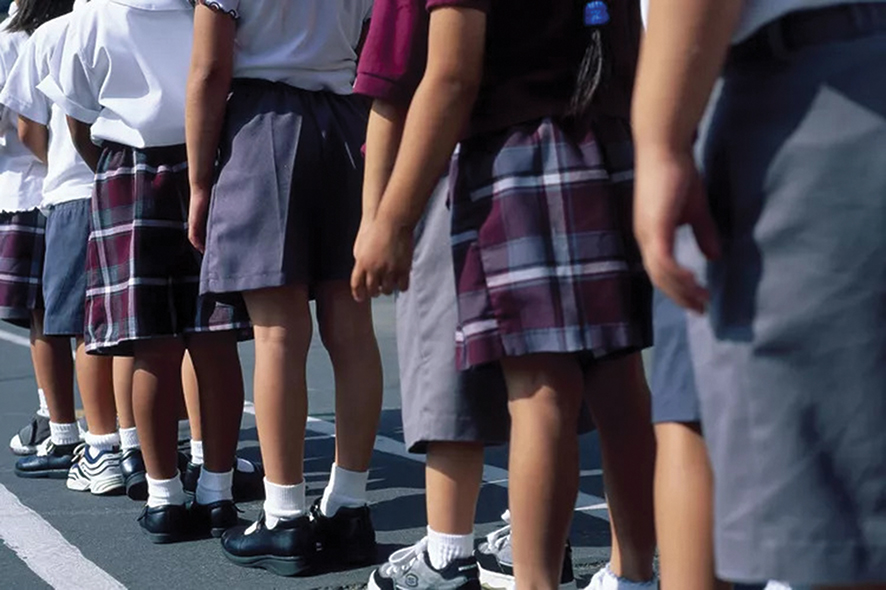
Uniformity will also return to public schools. Beginning next academic year, school uniforms will be reintroduced for pupils in grades 1 through 6 under a national pilot scheme. The initiative forms part of a larger reform package and is designed, according to Mikanadze, to promote discipline and a sense of community. To ensure equitable participation, the state will cover the cost of uniforms for socially vulnerable families assessed at 60,000 points or below by the Ministry of Health. The ministry is also considering additional support for large families. A notable component of the program involves engaging female convicts enrolled in vocational institutions to sew uniforms for children in need. For other students, uniform procurement will be arranged either through school tenders or by parents.
Schools will be invited to choose from several uniform designs that incorporate national or local symbols, following a public design-selection process to be completed by early spring. Although the pilot focuses on primary grades, authorities will rely on feedback before deciding whether to extend the policy to older students. The ministry has stated that the goal is to make uniforms mandatory nationwide starting with the 2026–2027 academic year.
Students’ daily experiences in school will also change under new discipline measures. The Ministry of Education plans to enforce a strict ban on mobile phone use during school hours. Mikanadze said the decision aims to reduce distractions, improve concentration, and boost participation in lessons. Implementation standards will be created for all schools, balancing the need for uninterrupted learning with provisions that allow students to contact parents or guardians in necessary situations.
Alongside structural and behavioral reforms, authorities have launched a new nationwide anti-drug initiative titled Me Momavlshi (“I Am the Future”). Beginning this fall, the program will reach 60 public schools, and will initially focus on pupils in the 6th and 9th grades. Law enforcement officers, psychologists, social workers, and trained school safety specialists will lead interactive sessions on the risks of psychoactive substances, strategies for resisting peer pressure, and the importance of healthy decision-making. The campaign also incorporates comic competitions, sports events, creative workshops, and practical modules designed to engage students in age-appropriate ways. Early phases will take place in Tbilisi, Adjara, and Kvemo Kartli, with nationwide expansion planned afterward.
Program coordinators have already held simulation meetings to prepare facilitators for school visits.
A more structural transformation concerns the overall duration and organization of schooling. The ministry has confirmed that Georgia will transition to an 11-year model of compulsory education, replacing the existing 12-year framework. However, a 12th grade will remain available as a voluntary option for students who wish to continue their studies. A dedicated online platform will open each March, and schools will establish 12th-grade classes only if enough students register. Mikanadze said the updated system aligns with modern standards, while giving families greater flexibility. The final, 11th, year is set to become more specialized, allowing students to focus on the subjects required for national exams—a change the government hopes will reduce the widespread reliance on private tutoring.
Textbook policy will also be overhauled. Within the next two to three years, all current schoolbooks will be replaced by new state-approved textbooks, with every school using the same set for each subject. The ministry has already selected expert groups to produce the new materials. Officials argue that a unified approach will raise quality, ensure consistency across regions, and support fair, measurable educational outcomes.
This wave of school-level reforms coincides with a far-reaching restructuring of higher education, introduced by Prime Minister Irakli Kobakhidze in October under the concept titled “One City – One Faculty.” The plan seeks to address chronic problems such as the duplication of faculties across universities in the same city, variable teaching quality, limited research integration, and inefficient resource allocation. Under the proposal, each faculty will be consolidated into a single university per city based on institutional strengths and historical identity. Students currently enrolled will be allowed to complete their degrees during a transition period.
Other measures include shifting higher education to a 3+1 model—three years for a bachelor’s degree and one for a master’s—reducing part-time academic positions in favor of full-time faculty, and reorganizing funding to align state support with labor market needs. The government also plans to build modern university campuses in Tbilisi and Kutaisi and modernize regional institutions, partly financed by the sale of non-historical university buildings in central Tbilisi.
Together, these reforms represent an ambitious attempt to standardize learning conditions, improve discipline and focus in classrooms, strengthen social support systems within schools, and modernize both general and higher education. While the government argues that the changes will create a more cohesive and equitable system, debates are expected to intensify as implementation proceeds and families, educators, and students adjust to a rapidly changing educational landscape.
By Team GT