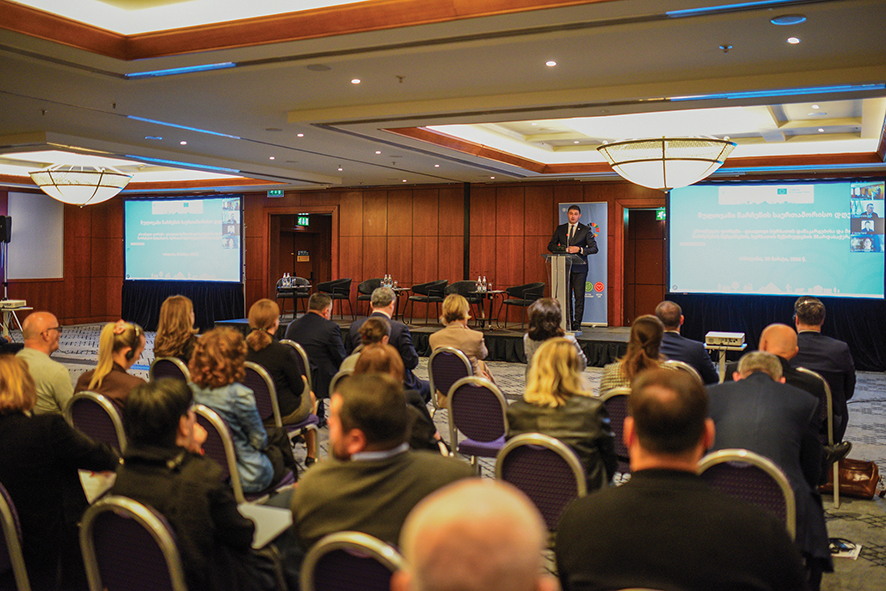
Tbilisi came together on March 30, 2026, to tackle a problem that affects both people and the planet: food loss and waste. Government officials, charity organizations, private sector representatives, and community leaders gathered for a national forum on food donation and waste reduction, marking the International Day of Zero Waste. The event, organized by the Food and Agriculture Organization of the United Nations (FAO) with support from the EU-funded European Neighborhood Program for Agriculture and Rural Development (ENPARD IV), spotlighted Georgia’s increased efforts to turn surplus food into a lifeline for those in need.
The International Day of Zero Waste is observed each year to raise awareness about reducing waste and promoting sustainable consumption and production. This year, the focus was on food, a resource that too often ends up in the trash while families go hungry. The forum encouraged action from governments, businesses, and households, highlighting how practical solutions and partnerships can make a real difference.
The forum brought together stakeholders from across Georgia’s food system to share experiences, strengthen partnerships, and explore practical solutions for minimizing food loss and waste. Through presentations, panel discussions, and networking sessions, participants looked at ways to make the food value chain more efficient, preserve surplus food, and ensure that edible food reaches people in need rather than being thrown away.
During the forum, participants signed a joint statement reaffirming their commitment to scaling up efforts to reduce food loss and waste and to promote food donation. This commitment aligns with Georgia’s national priorities and global targets, including the United Nations Sustainable Development Goal 12, which focuses on sustainable consumption and production and aims to halve per-capita global food waste by 2030.
“On the International Day of Zero Waste, we are celebrating Georgia’s substantive progress in transforming the challenge of food loss and waste into an opportunity for improved food security,” said Raimund Jehle, FAO Representative in Georgia. “With the legal framework in place and growing engagement from the private sector, food banks, and charity organizations, the foundations of an effective food donation system are already in place. Strengthening coordination and partnerships will be key to scaling these efforts.”
Ketevan Khutsishvili, Program Manager at the Delegation of the European Union to Georgia, highlighted the EU’s support. “The European Union has supported the introduction of the legal framework in Georgia to address reduction of food loss and food waste, as well as food donation,” she said. “To this end, the EU cooperated with the FAO, Georgian legislative and executive branches, leading to the adoption of the law in 2023. Following this, the European Union further provided assistance to advance the respective system formation. Apart from change of consumer behavior, it is important to address the supply chain issues and respective technology and infrastructure management. Ultimately, environmental and economic impact, reaching to the contribution to climate change and resource depletion mitigation, will also reduce the respective economic cost.”

Georgia took a major step in 2023 by adopting the Law on Food Loss and Waste Reduction and Food Donation. This law formalized procedures for food donation, removed tax barriers for surplus food contributions, and established national standards for food safety. It also provided a clear legal framework for accredited food banks to operate, which encouraged broader participation from businesses and public institutions.
Since the law was passed, food banks in Georgia have made significant operational progress. Enkenia, the country’s first accredited food bank, has formalized its operations, set up a warehouse with proper food safety and quality control measures, and expanded its distribution network. Following international food safety standards, Enkenia ensures that donated food is safe for recipients. The organization now provides thousands of meals and food parcels to families in Tbilisi and surrounding regions, and works with volunteers and partner groups to reach more communities.
Other initiatives, such as the Food Bank of Georgia, provide monthly food aid to low-income families and complement the work of redistribution enabled by the new law. Legal clarity has allowed these organizations to formalize agreements with supermarkets, producers, and distributors, creating a more reliable and scalable system for donating and distributing food.
Despite this progress, challenges remain. A significant volume of surplus food still goes unused, and expanding infrastructure and distribution beyond Tbilisi to rural areas remains a priority. Strengthening coordination among food banks, logistics providers, and local organizations is essential to ensure that food reaches those in need efficiently and safely.
By linking these national efforts with global initiatives like the UN’s Zero Waste program and Sustainable Development Goal 12.3, the forum highlighted Georgia’s growing commitment to transforming its food system. The country is working to reduce food loss and waste at every stage while ensuring that surplus food reaches people in need and contributes to environmental sustainability.
By Katie Ruth Davies