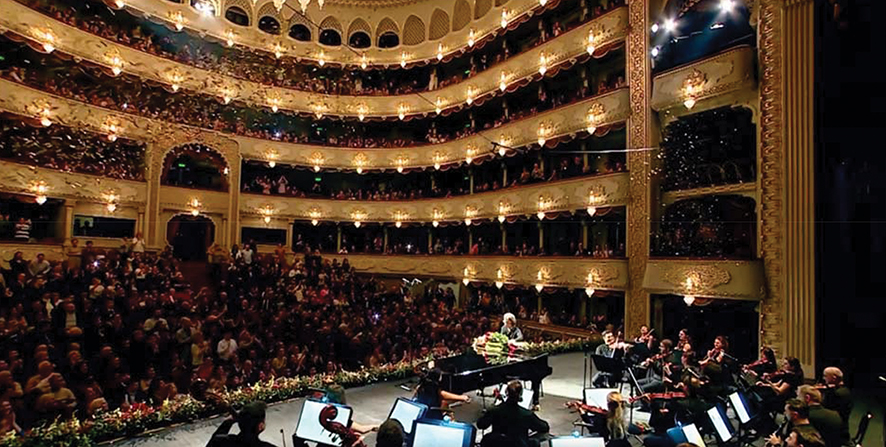
The Tbilisi Opera Theater looked like it had been waiting decades for this night. The city’s most ornate hall turned into a listening chamber for a single pianist who has quietly defined Georgia’s musical intelligence for half a century. Valerian Shiukashvili’s 50th-anniversary recital was not about nostalgia or celebration. It was about authority—earned through precision, time, and a kind of emotional engineering that belongs entirely to him.
Shiukashvili’s manner at the keys has the calm of an architect inspecting his own design. Every gesture seems measured in millimeters. He has built a career on structure and spectacle—an aesthetic that resonates deeply in Georgia’s cultural scene, where substance carries its own rebellion. His teaching, his piano competition, his long commitment to cultivating new performers: all these surround his playing with the quiet gravity of a figure who builds systems rather than moments.
At fifty, he performs with the detachment of someone who understands that music is a form of thought. His recital program felt almost schematic in its logic—Handel to Scarlatti to Mozart to Chopin to Mozart again. The outline could have come from a music history textbook. In his reading, it became a narrative of human concentration.
The evening began with Handel’s Minuett in G minor, delivered with surgical stillness. Each phrase opened like a line of architecture, symmetrical and deliberate. Shiukashvili’s sound stayed dry and taut, closer to Bach’s moral discipline than to the ornamental theater often associated with Handel. The tempo suggested internal balance rather than external motion.
Scarlatti’s Sonata in D minor, K.9 arrived with a metallic gleam. The articulation was percussive, the phrasing almost percussive in its self-awareness. Shiukashvili avoided Mediterranean heat; he offered clarity instead, as if testing how much tension a phrase could hold before it cracked. Scarlatti’s obsessive repetitions turned hypnotic under his hands, like minimalism long before minimalism existed.
The Sonata in C major, K.330 moved through its three movements with the fluency of a mathematician talking about pleasure. The first was a textbook in balance, the second a study in restraint, the third a controlled release of wit. Shiukashvili’s Mozart lives in a world where elegance has edge. The phrasing sliced rather than caressed; the rubato existed only where logic allowed it.
The five mazurkas that followed felt like a detour into the subconscious. Each one sounded like a confession filtered through rhythm. The A minor piece drifted like smoke, its harmony searching for ground. The C major swayed with a drunken dignity. The D-flat major revealed an aristocratic sadness. The F minor had a subterranean pulse that kept the piece alive long after the final note. The B minor ended the set with a sense of beautiful exhaustion. Shiukashvili’s Chopin does not melt. It thinks. He shapes every phrase as if examining an emotion under laboratory light, finding its geometry, then releasing it back into air.
The concert closed with Mozart’s Piano Concerto No. 23 in A major, K. 488. Shiukashvili’s collaboration with the Opera Theater Orchestra turned the score into a field experiment in transparency. The piano lines emerged like threads of glass woven into the orchestral fabric. The Adagio had a suspended, oxygen-thin quality, while the final Allegro assai carried an unforced brightness that felt earned rather than decorative.
In a culture that still treats classical performance as ritual, Shiukashvili brings the mind of a designer. His playing is stripped of sentimentality, his repertoire curated like a thought experiment about continuity and time. At fifty, he plays as if still editing his own legacy.
The audience that night didn’t witness a retrospective. It witnessed a recalibration—a pianist dissecting the European canon to see what still breathes inside it. Georgia’s musical scene rarely produces figures who combine precision, risk, and institutional influence with such coherence. Shiukashvili’s recital offered a blueprint for that synthesis.
Review by Ivan Nechaev