
In Georgia, spring arrives with a small logistical mystery that sees florists suddenly running out of tulips twice within the same week. The explanation sits in the calendar. On March 3, the country celebrates Mother’s Day, a national holiday when state offices close and children show up at family tables with flowers. Five days later, the ritual repeats itself for International Women’s Day, the Soviet-era celebration that survived the collapse of the Soviet Union with surprising ease.
This double holiday belongs to one of those subtle cultural compromises that Georgia performs particularly well: the art of replacing something without actually getting rid of it.
Mother’s Day appeared in 1991, the year Georgia declared independence. The idea came from Zviad Gamsakhurdia, the country’s first president and a man deeply invested in symbolic gestures of national renewal. The reasoning felt straightforward. March 8 carried the unmistakable smell of Soviet ceremonial life: official speeches, carnations distributed at workplaces, the ritualized praise of the “working woman of socialism.” The new Georgian state wanted a holiday that sounded less ideological and more domestic. Motherhood seemed like the obvious candidate.
Yet Georgian culture, as it turned out, had no particular interest in eliminating March 8. The holiday had already woven itself into everyday life. Flowers, polite congratulations, a day of mild festive warmth in the gray end of winter—these things rarely disappear because a government decides they should. And so Georgia quietly adopted a second celebration. Mother’s Day arrived on March 3. International Women’s Day remained exactly where it had always been. The result is a curious five-day corridor of flowers.
In practice, the difference between the two holidays is emotional rather than official. March 3 feels intimate: family, mothers, grandmothers, children arriving with awkward bouquets. March 8 belongs more to the social sphere: colleagues congratulating colleagues, a certain ritual politeness in offices and cafés. Together, they form a small seasonal choreography of appreciation. If one wanted to locate the symbolic heart of this arrangement, the search would probably end on a hill above the Old Town.
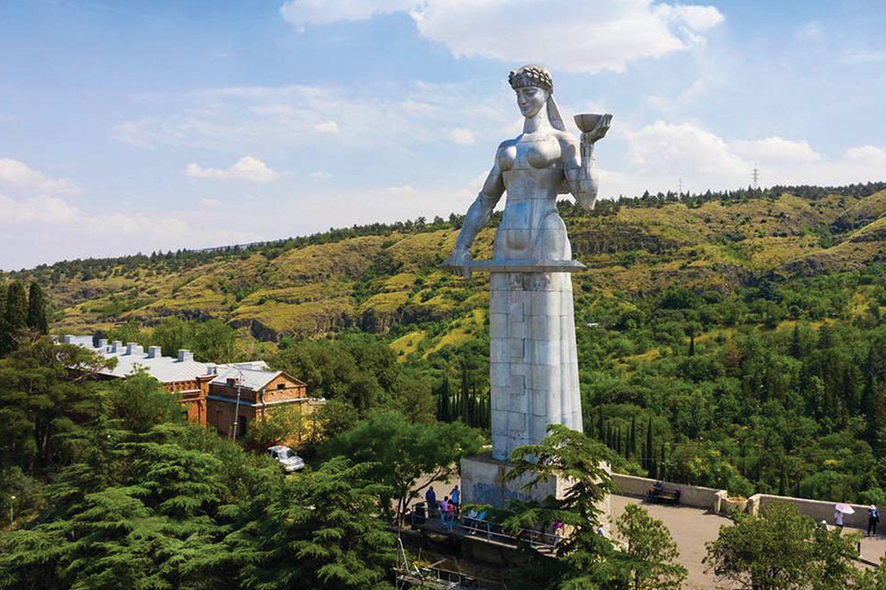
There stands Mother of Georgia, the monumental woman who has been watching over Tbilisi since 1958. Locals know her simply as Kartlis Deda. From the Sololaki ridge, she surveys the city with two objects in her hands: a cup of wine for friends and a sword for enemies: the most concise summary ever attempted of the Georgian national character.
The statue was created by the sculptor Elguja Amashukeli for the celebration of Tbilisi’s 1500th anniversary. Its language belonged unmistakably to the visual vocabulary of the late Soviet era: heroic scale, clear symbolism, a monumental female figure representing the nation itself.
When Georgia regained independence, the monument suddenly found itself in an awkward category. It was Soviet in origin and deeply Georgian in meaning. Some politicians in the early 1990s suggested replacing it with something more contemporary.
History intervened with a practical problem. The original statue, despite its imposing presence, had been constructed around a wooden internal frame. By the end of the century the structure had begun to deteriorate. The Mother of Georgia was, quite literally, starting to rot from the inside. The authorities turned again to Amashukeli.
The sculptor did something quietly brilliant: he created a new version of the same monument. The updated figure received a metal internal structure. Her clothing shifted slightly; the long medieval sleeves of the earlier design gave way to something a bit more modern. The head covering changed too—less traditional scarf, more stylized form, touched with laurel leaves.
For a short period in the 1990s, Tbilisi briefly had two Mothers of Georgia standing at once: the aging Soviet monument and the newly redesigned one that would replace it. The episode says a great deal about the way the country deals with its past. Georgia rarely erases history outright. It edits it. Adjusts the costume. Reinforces the structure.
The statue still performs its quiet theatrical role above the city. On clear evenings it glows with the golden light that settles over Tbilisi just before sunset, the aluminum surfaces catching the last warmth of the day. From below, the figure appears less ideological than mythological: a guardian watching over the slow swirl of city life.
On March 3, the symbolism becomes unusually literal. Government offices close, including the sleek glass halls of the Public Service Hall, Georgia’s famously efficient bureaucratic machine. Administrative life pauses for a day dedicated to something the state cannot easily regulate: maternal affection.
Children deliver flowers. Families gather around tables. Social media fills with photographs of mothers who look slightly embarrassed by the attention. And above the city, the monumental mother keeps holding her two objects—the wine and the sword, hospitality and defense, tenderness and resolve.
In a way, the entire Georgian calendar seems to follow the same logic. One holiday replaces another and somehow both remain. A Soviet monument becomes a national symbol after a change of clothes. Spring arrives twice in a single week. And the florists, every year, prepare for both days.
By Ivan Nechaev