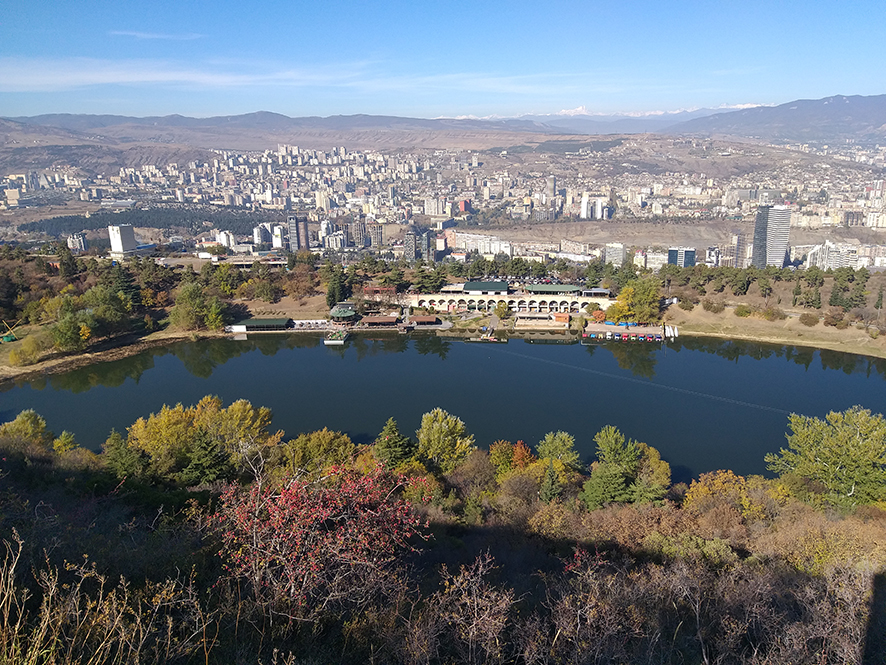
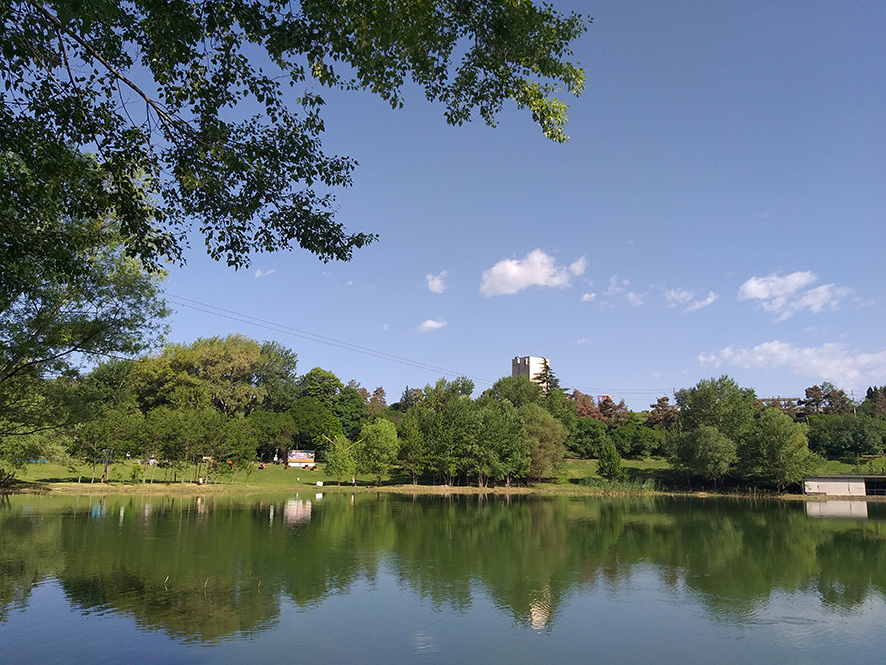
During the 15 years I’ve lived in Georgia, my feelings for Turtle Lake (in Georgian: Kus Tba) and its morning inhabitants have undergone a complete evolution. The path from enthusiastic gasps to quiet contemplation was a long one, but it eventually led me to a conscious and profound love.
My first notes on the “Turtle Lake phenomenon” were written in a high tone of admiration: I was charmed by literally everything and everyone I met! Gradually, the daily ascent to those cherished heights became a ritual even more mandatory for me than a morning cup of coffee. And that, you must admit, says a great deal.
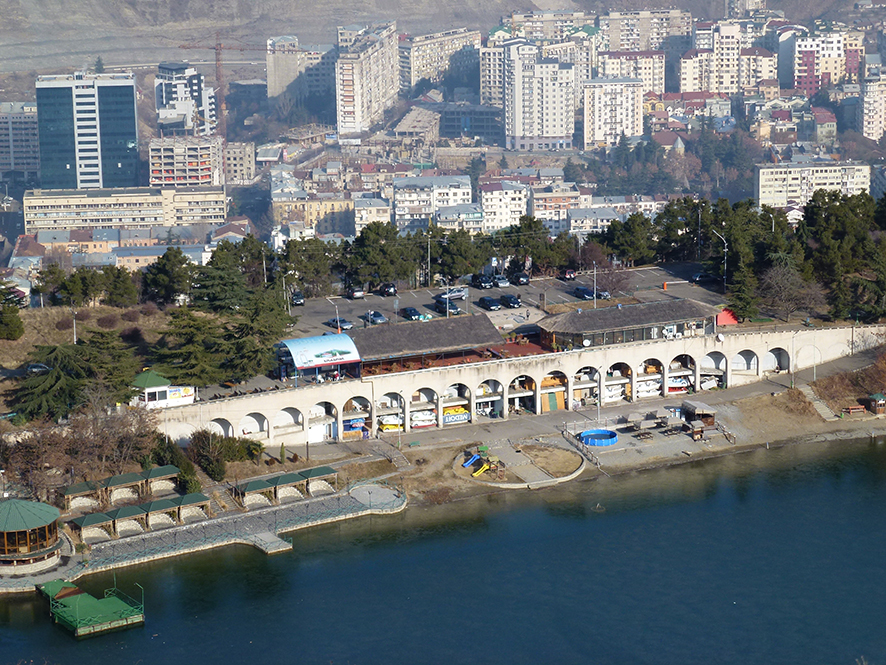
The hours immediately following dawn at the height of the swimming season are particularly healing. Every morning on the beach, you encounter the same familiar faces. Mostly, these are people of a venerable age for whom caring for body and soul became a habit half a century ago. Some perform methodical terrenkurs (health walks) along the trails around the lake; others complement them with a mandatory swim. It is striking to see elderly men plowing through the water using various strokes, even the technically demanding butterfly. They don’t do it for show, but simply because it is part of their morning ritual. In such moments, you feel sincere admiration as you watch these examples of genuine vigor, strength of spirit, and loyalty to oneself.
And not just the men. Some of the women at the lake are striking in their incredible fitness and endurance. Seeing their persistent training in the water, even when the weather turns unkind, is a distinct pleasure. There is such tempering and stature in their movements that it’s impossible not to admire them.
Inspired by the example of these dignified people, I decided to make a change myself. After years of what could be called “lazy resort swimming,” I finally bought a pair of fins. From that moment on, my swims took on a completely different character: they transformed from relaxed splashing near the shore into full-fledged, solid workouts.
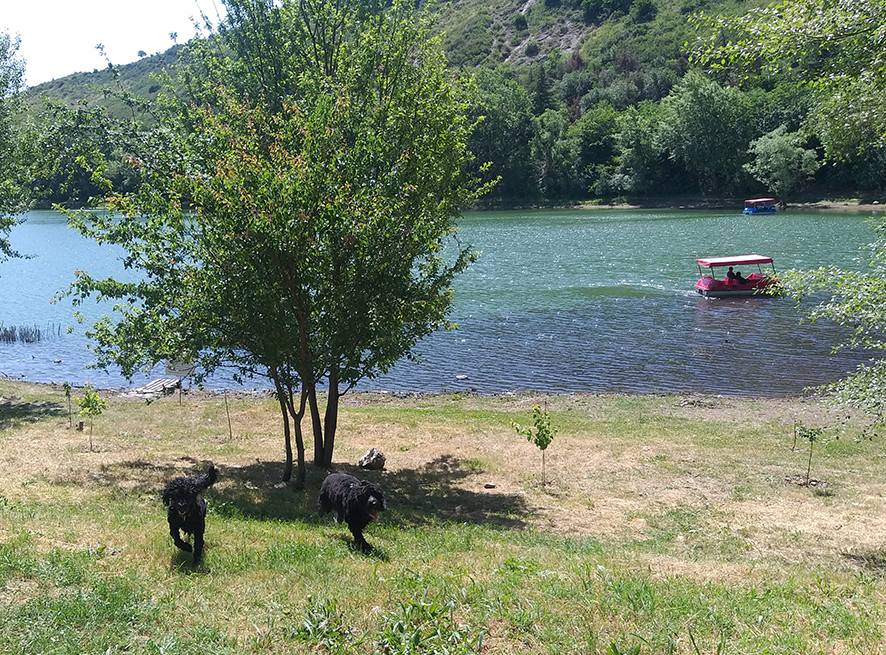
Many regulars can also be found beyond the beach, walking along the ridge or in the shady woods between the mountains. You can see and hear “our people” from afar. We greet each other with genuine joy, exchanging a few phrases whose meaning always boils down to one thing: how beautiful life is when it can be spent amidst such nature! Having shared and thus multiplied this quiet delight, we each go our separate ways.
If a random passerby happens to cross your path with a sullen look, failing to smile or say hello, it always creates an internal dissonance. It seems almost impossible to walk in such a paradise and not show engagement or, at the very least, basic politeness to a fellow wanderer. After all, up here at this altitude, we are all connected by this silence and this unique morning!
An incredibly tender relationship has formed between us: knowing almost no details about one another, we all share a deep sense of belonging to one large “family.” And it couldn’t be any other way; after all, we are all serving in the ranks of the Turtle Guard!
In our honest company, there is no division into men’s or women’s circles. At Kus Tba, absolute equality reigns, seasoned with light, non-binding flirting. Here, everyone shares the delights of morning Zen as equals: kindly, affably, and almost always with a pinch of subtle humor. My verdict: if you want to meet true gentlemen of the old school, look for them first and foremost at Kus Tba!
There is another unwritten rule: conversation topics must never be burdensome. At the start of the day, when everything exists in its pristine purity, worries and anxieties remain behind the invisible line of this sacred lakeside territory.
We come here for something else: it is customary to fill oneself with light, to reset, and to live exclusively in the current, blissful moment. Even if politics comes up, it’s mentioned in passing, with light irony and without diving into details. At Kus Tba, hustle and bustle give way to contemplation.
In recent years, as Tbilisi has seen many newcomers, some of whom have also taken a liking to the lake, the “Old Guard” treats them with obvious skepticism and keeps its distance. In this circle, trust must be earned over years.
The most blissful time comes after the swim. You can sit on the shore, squint your eyes, and stretch out under the sun, feeling your body go sweetly numb after a good workout. And suddenly, the silence is broken by a voice: one of the fellow swimmers begins to recite Galaktion Tabidze or Vazha-Pshavela with inspiration, passing the “alaverdi” (the turn to speak/toast) to his comrades. In such minutes, to the sound of great poetry, you clearly realize: happiness exists! And we never tire of sharing this happiness with each other every God-given—or rather, every “turtle”—morning.
Over the years of socializing, I’ve learned that the core of our Guard consists of the old Soviet intelligentsia: doctors, scientists, writers, engineers, teachers, translators… People whose names once shaped the intellectual face of the city.
One of the old-timers once revealed the historical underside of this place to me. It turns out that in Soviet times, Turtle Lake was not just a recreation area, but a kind of informal political club. In the morning hours, you could find party officials of all ranks here. It was here, away from the offices, that the “right people” were “fished out” for important conversations: whether it was a hiring issue, securing a job, or an offering that opened the necessary doors.
I readily believe this story. But does it scare me? Does it change my attitude toward the current inhabitants of the shore? To be honest: no.
The thing is, all my companions of these blessed morning hours possess traits that, in my system of values, stand above all else: impeccable dignity, an innate sense of tact, and that deep inner culture that can’t be bought or faked. I would issue such a “diploma” to each of them without hesitation. And now it’s not so important who they were in that distant Soviet past: in the end, time has put everything in its place, leaving behind only the human essence.
Recently, on a forest path above the lake, I met my acquaintance Eteri. She is a small, lean, and incredibly energetic woman who seems to radiate light. Eteri is already over seventy, but every single morning she is at her post walking up the hills. She admits she simply cannot imagine her life without these multi-kilometer walks.
Sometimes, warming herself on a bench at the very edge of the mountain, Eteri freezes in a sweet slumber. Other days, overflowing with delight, she shouts at the top of her lungs into the abyss—and then, from the depths of the gorge, an echo answers her solemnly and joyfully. In those moments, it seems the mountains themselves reciprocate her feelings.
“Listen, dear,” Eteri said to me. “A couple of days ago I saw you with a woman. She’s been coming here quite often lately. I’ll be honest with you—she’s very much not a good person. You shouldn’t associate with her!”
We started trying to figure out who Eteri meant, and at last I realized.
“Eteri, she’s a perfectly normal, reasonable woman!” I replied. “What makes you think she’s bad?”
“How can a person be good,” Eteri exclaimed sincerely, “if she meets you here on the mountain again and again and hasn’t said hello even once?”
I hurried to apologize on behalf of my acquaintance. I explained that she wasn’t local and didn’t know our customs, and that you can’t label someone “bad” simply for being quiet. Jokingly, I promised to do some “educational work” with her so she would improve.
“That’s right—that’s how it should be, well done!” Eteri encouraged me. “Why do we need ‘bad’ strangers at Kus Tba? We already have enough bad ones of our own!”
Blog by Tatjana Montik
Tatjana Montik – journalist, author, and passionate admirer of Georgia – has spent the past 15 years living in and reporting on this captivating South Caucasus country. See more of her experiences in her new travel diary and cultural guide, Georgia: A Tapestry of Time and Space.