In early February, Tbilisi tends to move at a different tempo. The city’s hills grow quieter, its cafés slightly more introspective, its cultural institutions more alert to gestures that require attention rather than noise. It is into this season of softened perception that CinExpress in Cinema House introduces a compact yet resonant retrospective of Iranian cinema, curated by Lika Glurjidze, Nini Shvelidze, Alexandre Gabelia, and Giorgi Javakhishvili. All screenings are presented in the original languages with English subtitles, reinforcing the retrospective’s openness to an international, non-Georgian-speaking audience.
Iranian cinema has always travelled well. Its grammar—minimalist, morally alert, resistant to spectacle—has crossed borders with unusual ease, perhaps because it never confuses intimacy with insignificance. What this Tbilisi retrospective proposes is not a survey of masterpieces for their own sake, but a study in attention: to childhood, to ethical hesitation, to social pressure rendered visible through the smallest gestures.
The opening night belongs to Abbas Kiarostami’s Where Is the Friend’s House? (1987), a film whose apparent simplicity remains one of the most radical acts in modern cinema. An eight-year-old boy, a misplaced notebook, a village mapped by obligation rather than geography. In Georgia—where cinema audiences have long been trained to read moral weight in everyday movement—Kiarostami’s film lands with particular clarity. This is cinema that insists responsibility begins before ideology, before adulthood, before explanation. It is an ethics learned by walking.
The following evening shifts the terrain from rural pathways to industrial ruins with Amir Naderi’s The Runner (1984). Set in Abadan, amid the detritus of war and oil economy, the film introduces Amir, an orphan surviving in the shell of a tanker. Movement here is no longer moral wandering but physical necessity. Running becomes both survival tactic and metaphysical act. The film’s raw kinetic energy stands in productive tension with Kiarostami’s contemplative pacing, outlining two poles of Iranian cinema: stillness as inquiry, motion as resistance.
Saturday’s dense sequence unfolds like a compressed history of Iranian cinema’s global ascent. Majid Majidi’s Children of Heaven (1997) returns to childhood, but now framed through deprivation managed with grace. Shoes become currency, secrecy becomes love, and poverty is neither romanticized nor instrumentalized. The film’s emotional precision explains its enduring international appeal; it trusts sentiment without surrendering dignity.
From there, Mohsen Makhmalbaf’s A Moment of Innocence (1996) turns cinema back onto itself. Half autobiographical, half reenactment, the film stages memory as negotiation. Violence is neither denied nor simplified; instead, it is examined through the ethics of representation. In a Georgian context—where the question of how to narrate political pasts remains sharply contested—Makhmalbaf’s reflexive approach feels especially current.
The afternoon continues with Jafar Panahi’s Crimson Gold (2003), a film whose quiet rage accumulates with devastating effect. Through the daily routes of a pizza deliveryman, Tehran reveals itself as a geography of humiliation structured by class. Luxury here is not aspiration but provocation. The final act’s tragic inevitability feels less like plot than consequence—social inequality translated into narrative pressure.
Sunday opens with animation, though nothing about Marjane Satrapi and Vincent Paronnaud’s Persepolis (2007) is escapist. The black-and-white aesthetic strips ideology down to its emotional residue. Revolution appears not as abstraction but as interruption: of childhood, of music, of private space. For a Georgian audience with lived memories of ideological reformatting, Persepolis reads as both memoir and warning.
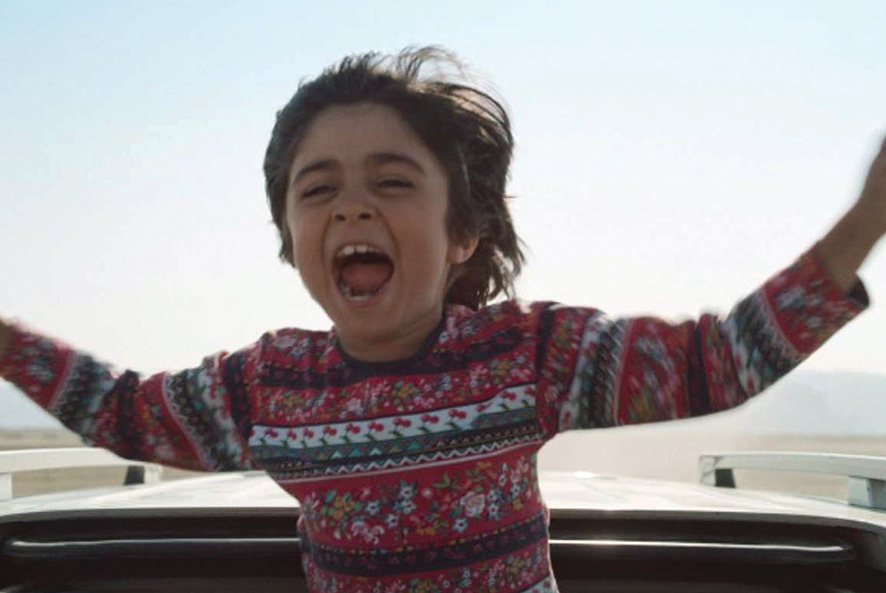
Recent Iranian cinema enters the program with Panah Panahi’s Hit the Road (2021), a road movie that understands displacement as emotional condition rather than logistical event. The family at its center performs normalcy with increasing strain, humor masking dread. Silence becomes the film’s most articulate language. It is a work acutely aware of inheritance—stylistic, political, familial—without being trapped by it.
The retrospective concludes with Asghar Farhadi’s A Separation (2011), arguably the most internationally recognized Iranian film of the last two decades. Yet its power remains undiminished. The film’s domestic dispute expands into a moral labyrinth where truth fractures under pressure. No character is innocent, none entirely culpable. Farhadi’s genius lies in constructing drama as ethical density. In Tbilisi, where legal, familial, and moral responsibilities frequently collide, A Separation feels less like foreign cinema and more like a mirror angled slightly differently.
What unites this program is not nationality but a shared refusal of spectacle. Iranian cinema here is presented as a cinema of consequence—where every decision carries weight, where silence is meaningful, where the political emerges through the personal without announcement. Cinema House, by offering the films in their original languages with English subtitles and free admission, frames the retrospective as a public act rather than a curated luxury.
In the current Georgian cultural landscape—marked by urgency, protest, and a search for ethical vocabulary—this retrospective performs a quiet but insistent function. It reminds us that cinema can be both modest and radical, that looking carefully remains a political act, and that sometimes the most subversive gesture is simply to follow a child down a dusty road until responsibility comes into focus.
By Ivan Nechaev