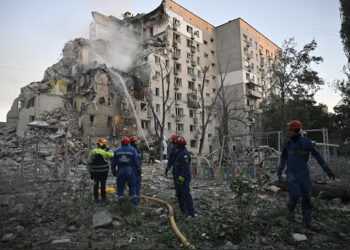
Russia’s war against Ukraine entered another winter week marked by heavy bombardment, fierce urban combat in Donetsk Oblast, and only minor territorial shifts, even as diplomacy and military-aid debates gathered pace in Washington, Brussels, and across Europe.
The fiercest fighting continued around Pokrovsk, the key logistics hub that has become the center of Russia’s slow-moving push in eastern Ukraine. Kyiv reported one of the largest mechanized assaults inside the city to date, with Russian forces deploying around 30 armored vehicles, cars, and even motorcycles in an attempt to penetrate deeper from the south. Ukraine says it retains control of the northern part of the city, where urban combat remains intense. Western analysts believe Russia may eventually take both Pokrovsk and nearby Myrnohrad, but only at significant cost and over a longer timeframe than Moscow anticipated.
Elsewhere along the Donetsk front, Russian forces continued pressing towards Slovyansk, Lyman, Chasiv Yar, and Toretsk. These axes have seen months of grinding Russian efforts aimed at widening gains following the earlier captures of Avdiivka and Chasiv Yar. Independent military assessments, however, noted no major territorial breakthroughs this week, reinforcing the picture of an offensive that trades personnel and machinery for only incremental ground.
While the frontline remained largely static, the air war escalated dramatically. Overnight on 5–6 December, Russia launched one of its largest combined drone-and-missile attacks in months, firing more than 650 drones and 51 missiles in a single wave. Although most were intercepted, strikes still hit critical infrastructure in at least eight regions, forcing nuclear plants to reduce output, knocking out power and heating for hundreds of thousands, and damaging a major railway hub in Fastiv outside Kyiv.
Energy infrastructure in Kyiv, Chernihiv, Lviv, Odesa, Zaporizhzhia, Dnipropetrovsk, Mykolaiv, and Kharkiv oblasts suffered “severe” damage. In Chernihiv, drones also struck a residential area. Ukrainian authorities reported at least eight people injured in the first wave alone, while subsequent strikes killed at least one civilian and wounded more than 15 across several cities. On 8 December, Russian shelling killed at least four civilians in Donetsk and Kherson regions and injured nearly 50 people. A UN briefing to the Security Council noted that dozens were injured and hundreds of thousands left without basic utilities following the massive 5–6 December barrage, warning that the intensifying strikes were undermining ongoing diplomatic contacts.
Russia continued this pressure throughout the week. Kremenchuk, a major industrial and energy node in Poltava Oblast, was targeted repeatedly. A large attack earlier in the week damaged several energy facilities, and another strike on 11 December again hit local power infrastructure, sparking fires despite significant interception by Ukrainian air defenses. Kyiv warns that Moscow is once again attempting to systematically degrade the grid as winter deepens, a strategy reminiscent of the 2022–23 campaign.
Ukraine, meanwhile, continued striking deep into Russian territory and waters. On 5 December, a Ukrainian drone attack forced the Syzran oil refinery on the Volga River to halt crude processing, adding to the growing list of disrupted Russian energy assets. Satellite imagery also confirmed major damage at the Livny oil depot in Oryol Oblast earlier in the month, where at least two fuel tanks were destroyed.
These attacks form part of Kyiv’s long-running effort to disrupt Russia’s fuel supply and export routes. By early October, nearly 40 percent of Russia’s refining capacity had been temporarily taken offline at some point in 2025 due to Ukrainian strikes.
At sea, Ukraine escalated the campaign further. Naval drones struck the Dashan tanker—part of Russia’s so-called “shadow fleet” used for sanctioned oil shipments—as it sailed through Ukraine’s exclusive economic zone in the Black Sea. The drones caused critical damage to the vessel’s stern, marking the third Ukrainian strike on a shadow-fleet tanker within two weeks. Insurance premiums for ships in the region have already begun rising as a result.
Russia also faced intensified drone activity over its own territory. The defense ministry reported intercepting at least 287 Ukrainian drones this week, including around 40 near Moscow, causing major flight diversions. Russian officials claimed at least seven civilians were killed and dozens injured by Ukrainian strikes on border regions, though these figures have not been independently verified.
A particularly sensitive incident for Moscow occurred in Chechnya, where Ramzan Kadyrov confirmed that a Ukrainian drone hit a high-rise building in the Grozny-City complex near his residence. While reporting no casualties, Kadyrov vowed “a stern response” and linked subsequent Russian strikes to the incident. Independent reports suggest this was at least the third Ukrainian attack inside Chechnya recently, reflecting Kyiv’s expanding ability to reach deep into Russian territory.
Beyond the battlefield, the war’s spillover effects triggered a rare security emergency within NATO territory. Lithuania declared a national state of emergency after waves of meteorological-type balloons—some carrying contraband cigarettes—were launched from Belarus, repeatedly disrupting civil aviation and forcing the temporary closure of Vilnius airport. Lithuanian officials described the balloons, alongside a steep rise in drone incursions, as part of a hybrid campaign by Belarus, with over 600 balloons and around 200 drones detected this year. The emergency measure allows military involvement in border enforcement and movement restrictions in affected areas.
Diplomatically, progress remained uneven. In Washington, the US House of Representatives passed the 2026 National Defense Authorization Act, which allocates $400 million annually for Ukraine’s Security Assistance Initiative in 2026 and 2027, and limits any presidential attempt to reduce the US military footprint in Europe. Although the legislation still requires Senate approval, its passage signaled continued bipartisan willingness to support Kyiv.
In Brussels, NATO foreign ministers reaffirmed their long-term commitment to Ukraine’s security, highlighting ongoing work on multi-year assistance plans. The European Commission, meanwhile, outlined several options to cover Ukraine’s financing needs in 2026–27, including a “reparations loan” backed by frozen Russian central-bank assets and new EU-level borrowing mechanisms. European Council President António Costa urged leaders to reach decisions this month to prevent a funding gap, especially with growing uncertainty around US politics.
Yet analysts warn that overall military-aid commitments have fallen significantly from earlier phases of the war. Many European officials fear that Russia’s incremental advances in Donbas are being enabled not only by Moscow’s intensified efforts, but also by Western hesitation.
Peace diplomacy remains fragile. A leaked US–Russia draft peace proposal, criticized for appearing to lock in Russian territorial gains, has been reworked following consultations with Kyiv, with US envoy Steve Witkoff expected to present the updated version to Vladimir Putin. President Volodymyr Zelensky and European leaders say they are preparing their own “refined” peace plan, insisting that any settlement must provide a “dignified peace” and avoid legitimizing aggression. UN and EU officials caution, however, that Russia’s escalating strikes against civilian and energy infrastructure directly contradict claims of readiness for meaningful negotiations.
Alongside the missiles, drones, and shifting frontlines, the human toll continues to rise. A recent UN report noted a sharp increase in civilian casualties between June and November 2025, with last month’s strike in Ternopil becoming the deadliest in western Ukraine since the full-scale invasion began. This week alone, dozens of civilians were killed and well over a hundred injured across Ukraine and Russia amid blackouts, infrastructure failures, and relentless bombardment.
Taken together, the week’s developments reveal a conflict increasingly defined by long-range strikes and attritional pressure rather than dramatic territorial shifts. Russia continues battering Ukraine’s energy grid and pushing along the Donbas front, while Ukraine hits deeper into Russia’s oil infrastructure and shadow fleet. Diplomacy is active, funding debates are intensifying, yet with winter closing in, artillery, drones, and missiles still drown out any emerging peace proposals.
Compiled by Ana Dumbadze