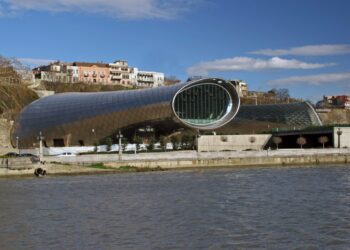
The 26th Tbilisi International Film Festival unveiled a work that drifts through the screen with the weightless focus of a dream. Alexander Koberidze’s Dry Leaf arrives as a cinematic gesture shaped by tenderness toward the fragile structures of daily life. His new film expands the poetic grammar that has followed him since What Do We See When We Look at the Sky?, yet it forms an independent constellation with its own rhythm, its own musical pulse, and its own philosophy of looking.
Alexander Koberidze’s Dry Leaf enters contemporary cinema with the poised assurance of a film that trusts its viewers. Its three hours unfold with a calm, steady pulse, as if the world were revealing its details only to those willing to move at its tempo. A father travels across Georgia in search of his daughter, a photographer devoted to recording the country’s unassuming football pitches. The premise resembles a straightforward journey. The film grows into something far more intricate: a diary of gestures, a field atlas of memory, a meditation on landscapes where small movements illuminate entire emotional climates.
Koberidze shapes this world through observation. Each scene rests within a vibration of attention. A roadside café dissolves into an open field. A field becomes a village that feels stitched from light and dust. A corridor of faces appears like a soft pageant of everyday Georgian life. Narrative events drift through this geography with quiet authority. The film gathers people, places, and weather into a single slow-moving organism.
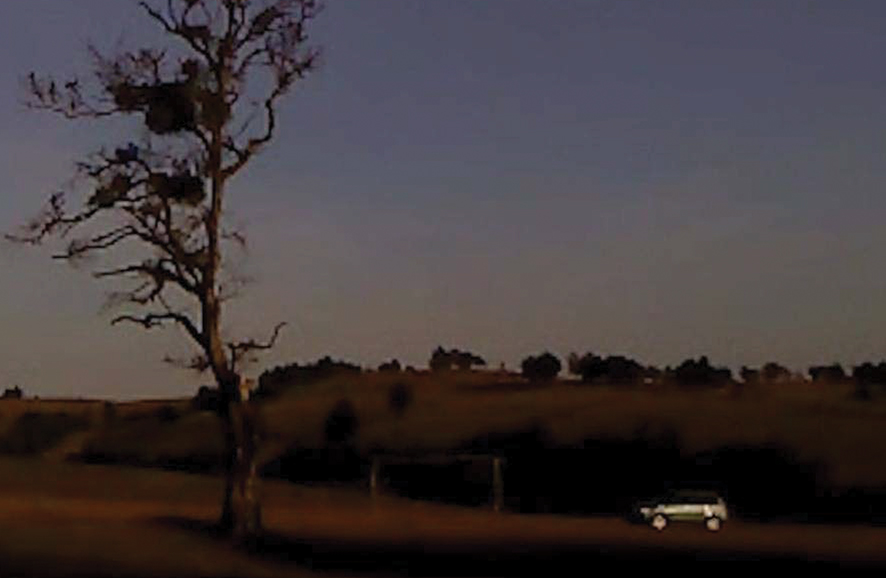
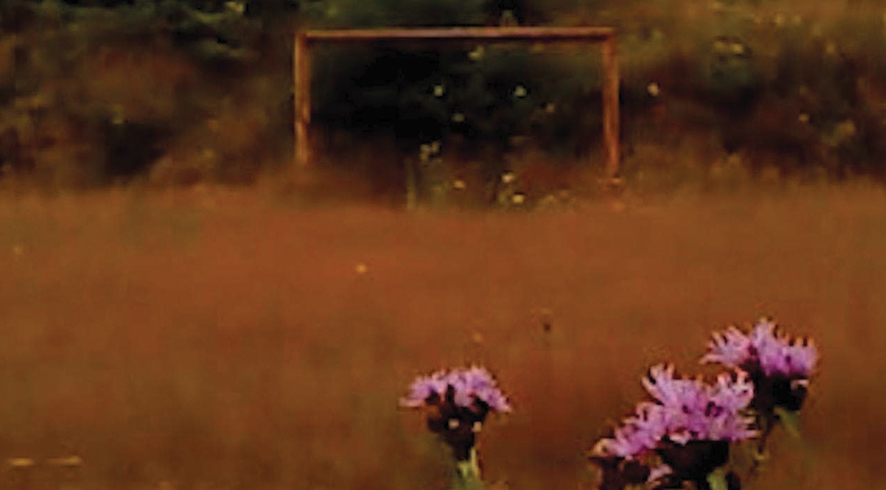
The director’s devotion to low-resolution imagery once again forms the heart of his method. Grain thickens the air. Edges blur until they become emotional zones rather than visual boundaries. A match in progress gains the aura of a half-remembered dream. A landscape seen from the window acquires the tenderness of an old photograph. This aesthetic brings the viewer into a state of heightened receptivity. Texture becomes meaning; the uncertainty of outlines turns into a form of intimacy.
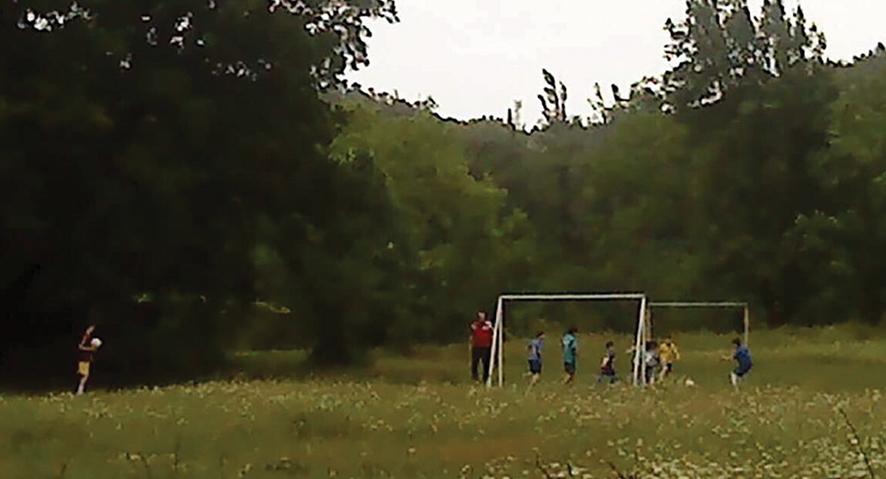
The father’s path feels like a pilgrimage through a country mapped through community memory rather than geography. Football fields emerge as civic organs that store collective histories. Weather-beaten goalposts, worn lines traced by countless hands, and patches of grass that have endured many seasons speak with the sincerity of testimonies. The faces encountered along the way—players, teenagers, elderly goalkeepers, singers, wanderers—form a polyphonic portrait of Georgia’s emotional terrain. Their stories appear without ceremony. Each anecdote enters the film like a small relic offered with open palms.
Koberidze’s sense of duration deepens this portrait. Time shifts into long, supple arcs. A ball rolling across uneven ground becomes a study in rhythm. A woman describing a match from years earlier becomes a vessel for memory. The father’s pauses at village entrances and dusty pitches carry a devotional quality. Viewers begin to sense the tonal shifts of afternoon light with unusual clarity. Every gesture expands into a small revelation.
Giorgi Koberidze’s score forms the emotional skeleton of Dry Leaf. Its presence glows through the film with remarkable restraint. The music arrives in long intervals, sometimes after stretches of ambient quiet, sometimes as a soft echo of what has just passed across the frame. The score moves like a parallel journey — a sonic itinerary woven beneath the father’s search.
Several musical elements anchor this world: sparse piano figures that resemble uncertain footsteps; long, elastic electronic pulses that follow the film’s slow temporal drag; strings that hover at the threshold of silence, creating a sensation of suspended breath, a faint folk aftertaste, present like a memory rather than a motif.
These materials form a shimmering acoustic environment. The music listens to the world. Its phrasing respects the rhythm of a drifting leaf, a child pausing before speaking, a goalkeeper adjusting his stance on an empty field. The score creates a sense of continuity that binds the father’s encounters into a single emotional arc.
The sound design extends the composer’s work into a continuous auditory cartography. Outdoor scenes hum with distant machinery. The bounce of a ball creates a gentle percussive mantra. Winds carry murmurs from the edges of the frame. The acoustic world behaves like a woven fabric rather than a set of isolated environments.
Through this weaving, Georgia appears as a unified sensory field. Each location vibrates with the memory of another. A roadside pitch carries the trace of a distant village. A closed stadium gate echoes with the faint hum of a previous conversation. The sound team creates a world where place becomes a living instrument.
Performance in Dry Leaf arises from presence rather than dramatic shaping. Many of the film’s participants inhabit the frame with a natural grace that emerges from their biographies. The father’s quiet endurance forms a steady emotional anchor. The people he encounters speak with unguarded sincerity, offering fragments from their own lives with openness that feels earned rather than staged.
These encounters accumulate into a social portrait. A teenager recounts a local match with the clarity of a storyteller. An elderly goalkeeper stands by an empty net as if guarding a memory. A passerby recognizes the father and shares a detail that may or may not aid his search. The film’s drama grows from these exchanges, each carrying the density of lived experience.
The kinship between Dry Leaf and the video works of Bill Viola becomes increasingly vivid as the film unfolds. Viola cultivates a visual grammar shaped by expanded time, hypnotic luminosity, and ritualized gesture. Water rises. Faces emerge from deep blue. Fire circulates with suppressed intensity. Each movement resembles a liturgical act.
Koberidze’s film constructs a similar perceptual environment. A gust of wind that lifts the leaf carries the same ceremonial resonance as Viola’s slow ascents. Human figures share a sculptural calm. The city’s ambient soundscape forms a halo around each scene.
Viola stretches time until emotion becomes a physical entity. Koberidze’s scenes lengthen until the viewer perceives the texture of everyday life with almost clairvoyant clarity. Duration becomes a spiritual material. Viola’s elements—water, fire, air—anchor his vision. Koberidze builds his entire cosmology on air currents and seasonal light. The leaf functions as an elemental protagonist, a small weather system with its own consciousness. Viola achieves transcendence through pure presence. Koberidze achieves a similar resonance through attention alone. The camera reveals an invisible architecture of feeling inside each gesture.
With Dry Leaf, Koberidze refines a cinematic language built from slowness and finely tuned perception. Duration becomes a vessel for revelation. Grain becomes a method for revealing the interior life of landscapes. Music becomes a gentle current that amplifies the film’s tenderness.
The film illuminates Georgia as a constellation of fields and faces, linked by stories that move across regions with the steady pace of weather. The composer’s album extends this constellation into the auditory realm. The score forms a map of almost tactile emotions, shaping the viewer’s memory of the film long after the screening ends.
The festival presentation introduced a work of unusual clarity and devotion. Dry Leaf expands the possibilities of contemporary Georgian cinema by offering a ritual of attention — a way of looking that allows the world to reveal its quiet radiance. Through this radiance, the film builds a space where landscapes speak, time breathes, and human presence becomes the primary material of meaning.
By Ivan Nechaev