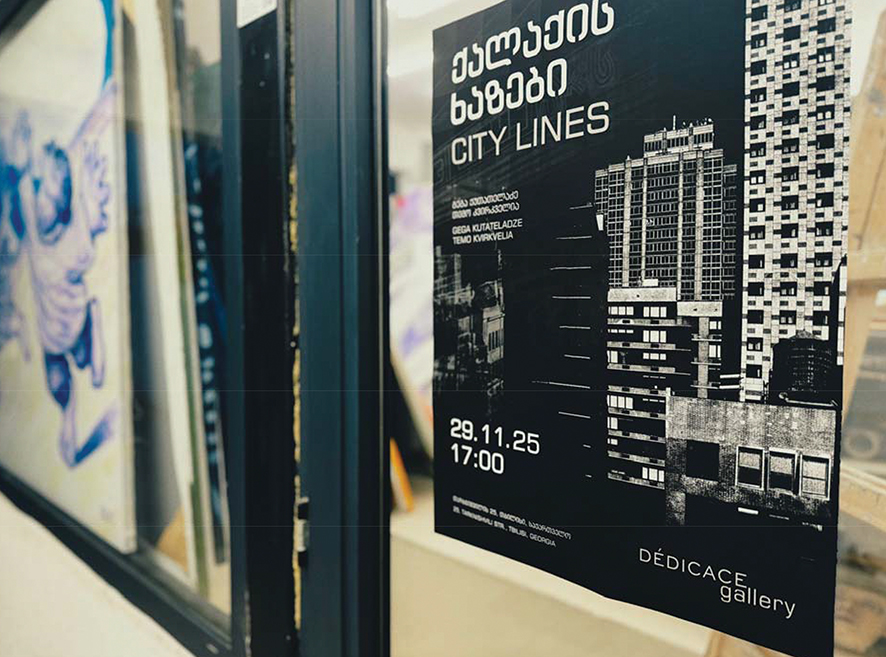
The new joint exhibition at Dédicace Gallery unfolds like a quiet intervention into the sensory habits of urban life. It offers a way of seeing that treats the city as a receptive surface, a field where memory, intuition, and stray atmospheres accumulate. The project gathers two artists who approach the metropolis as a mutable interior landscape—one through the ascetic discipline of graphite, the other through the uncanny textures of analog photography. Their works create a shared territory where the city behaves like a dream that remembers you back.
The Cartographer of Micro-Sensations
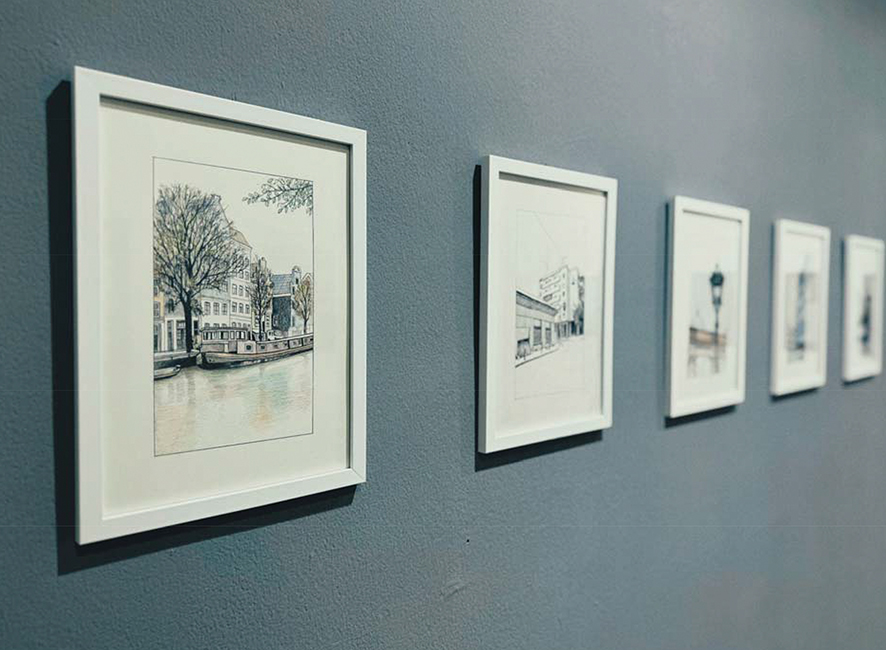
Gega Kutateladze brings pages that resemble distilled recollections. His drawings emerge from journeys, yet they resist all narrative claims. They trace the moment when a place softens into memory, when its architecture dissolves into a mood. The pencil becomes a device for registering the faintest tremors of experience. Each line feels like a breath that landed on paper and decided to stay.
Kutateladze’s economy of gesture shapes a compositional ethic. Shadows hover at the edge of recognition, and contours appear only as long as they remain necessary to sustain the image’s pulse. The viewer enters a field charged with possibility; a surface that asks for participation rather than offering closure. His minimalism behaves like a porous threshold, absorbing the viewer’s interior states and letting them circulate freely.
The effect recalls early modernist diaristic drawing—Anne Ryan’s paper fragments, Paul Klee’s wandering lines—yet Kutateladze’s mode is grounded in a specifically Georgian sensitivity toward landscape. The city is not documented; it is inhaled.
The Engineer of the Uncanny Frame
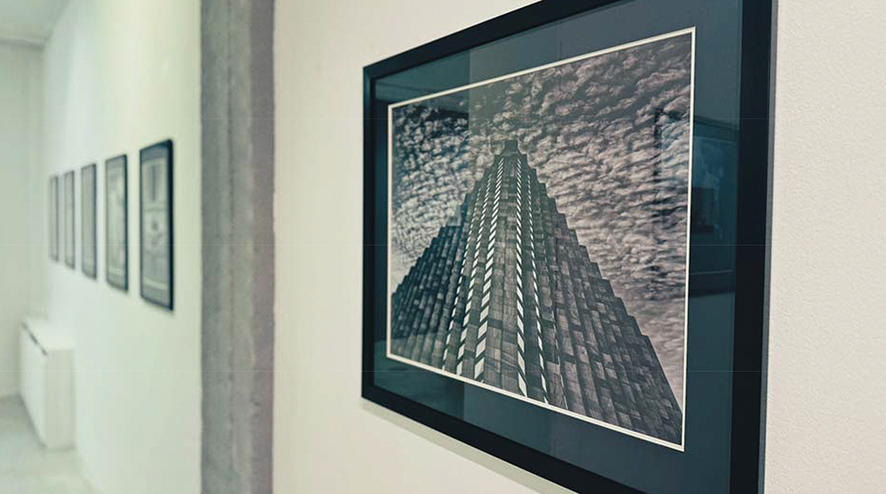
Temo Kvirkvelia works within that fragile zone where photography abandons its documentary habits and slips into reverie. His analog process generates images that seem to have drifted out of sleep before the mind could anchor them. Buildings lean with the logic of a private hallucination. Streets shimmer with an atmosphere that suggests a theatrical cue rather than a public space.
These photographs carry the spectral confidence of Magritte’s suspended reality or Delvaux’s nocturnal compositions. Every surface appears slightly displaced, as though the city were rehearsing another version of itself. Kvirkvelia uses film to establish a tenderness toward strangeness. The surreal effect arises not from digital manipulation but from the inherent unpredictability of the medium—light leaking through a mechanical aperture, emulsions leaving traces like half-forgotten thoughts.
The city becomes a site of latent narratives, still waiting for their protagonists.
Two Methods, One Atmosphere
The dialogue between Kutateladze and Kvirkvelia thrives through resonance: two distinct techniques generating a shared sensory temperature. The graphite drawings invite a contemplative slowness; the analog prints open a corridor toward dream logic. Together they shape a vision of urban space as an emotional ecosystem.
Dédicace Gallery frames this union with remarkable clarity. Since its founding in 2009, the institution has cultivated contemporary Georgian art through exhibitions that foreground artistic autonomy and material experimentation. City Lines extends that mission by forming a compact study in urban psychology—an atlas of personal geographies born from attentive looking.
The City as a Mutable Organism
What emerges is a portrait of the city understood as an active participant in perception. Its façades operate like membranes; its corners retain the residue of previous wanderers. Both artists sense this dynamism and translate it into works that hold the city in suspension.
Walking through the exhibition feels like moving through a parallel Tbilisi—one that exists beneath the visible one, one composed of impressions that never reached language. The artworks sharpen that threshold between familiarity and estrangement. They ask the viewer to inhabit the city with renewed interiority, as though architecture were capable of recording our unspoken currents.
City Lines becomes a meditation on how the urban world shapes inner weather. It foregrounds the subtle negotiations between sensation and structure, between our wandering attention and the city’s patient surfaces. The works suggest that every street contains a latent dream, waiting only for someone to slow their gaze enough to encounter it.
By Ivan Nechaev