On October 28, CENN together with GIZ hosted the closing event of the Tbilisi Circular Laboratory, bringing together entrepreneurs, innovators, and local and international organizations to reflect on the initiative’s achievements and explore the future of the circular economy in Georgia.
Launched in June 2024, Tbilisi Circular Labs (TCL) is part of the global Circular City Labs initiative, which tests reusable packaging systems in cities worldwide. Implemented in Georgia by GIZ on behalf of the German Government, in partnership with CENN, the project has quickly become a leading platform for promoting sustainable business models, responsible consumption, and waste reduction, while also supporting women and female entrepreneurs in the local circular economy.
After a business acceleration program from July to September, two pilot projects were selected: Fabrika, a multifunctional urban space, and CAMPA, a popular beverage company. Both worked closely with experts to design reusable packaging systems, focusing on cups and bottles, tailored to their operations. Since their launch, the pilots have provided practical insights into how circular practices can be implemented in urban settings, paving the way for wider adoption across Georgia.
The Vision behind the Project
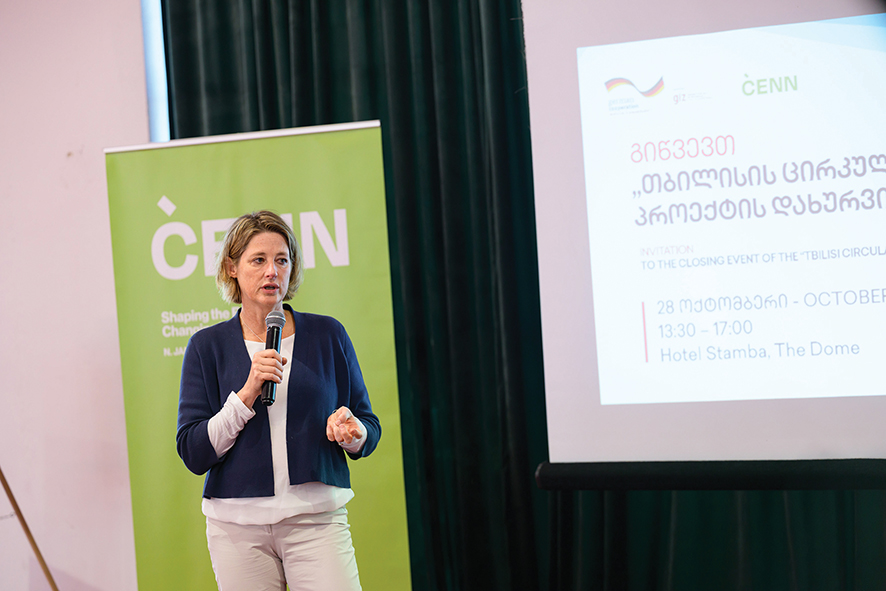
“The Circular City Labs project was conceptualized three years ago to find countries and partners interested in testing reuse systems as part of the circular economy, focusing on preventing waste rather than just managing it,” said Katja Suhr, Program Head at GIZ headquarters in Germany. The initiative now runs in four countries: Georgia, South Africa, Colombia, and Albania. Each country serves as a living laboratory for exploring practical, economic, and cultural ways to implement reuse systems. “We didn’t want another recycling campaign,” Suhr explained. “We wanted systems that allow materials to circulate again and again. For that, we needed active industries, engaged municipalities, and curious consumers. Georgia offered all three.”
On Georgia’s progress, Suhr observed: “I can see many secondhand clothing stores. These may seem like small trends, but they’re actually ways to prevent waste and reflect growing awareness.”
She noted that reuse systems face challenges on both the consumer and business sides. “Some people worry about hygiene, though that’s usually a perception issue. The real challenge is logistics and standards. If there are too many individual solutions, it becomes complicated for people to return items. That’s why businesses and municipalities need to work together on shared standards and infrastructure.”
Economic incentives are also crucial. “Only when reuse is economically viable will it endure. If virgin plastic is cheaper than reusing a bottle, no one will invest. Over time, if people see the financial benefits, behavior shifts, and the circular economy grows, not by guilt, but by smart economics.”
The project concludes at the end of 2025, but Suhr emphasized its long-term impact. “Projects may end, but ideas don’t. Once people see the benefits, they carry them forward. That’s how change takes root.”
“We Are Just Beginning” — CENN’s Perspective on Georgia’s Waste Reality
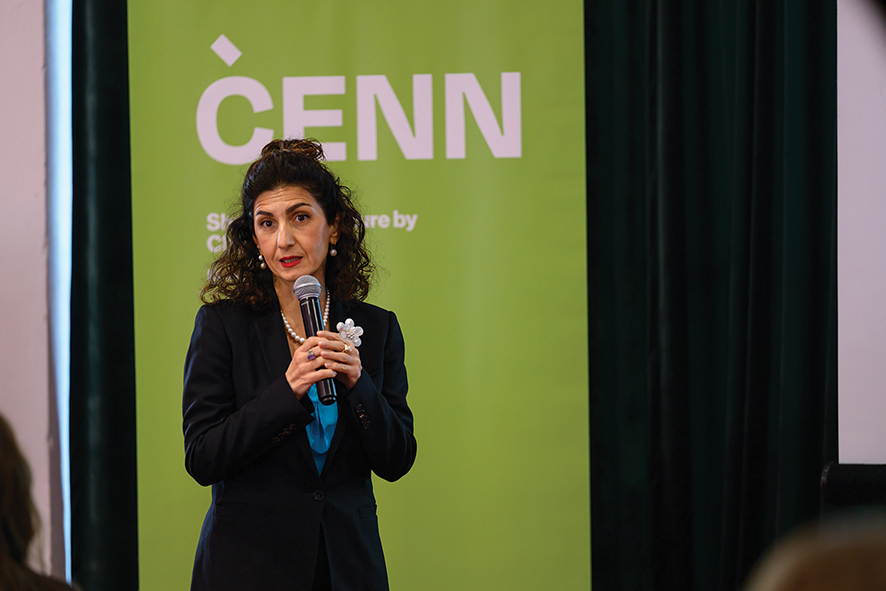
Nino Shavgulidze, Deputy Director of CENN, opened the event, grounding the conversation in Georgia’s circularity context.
“We are just beginning,” she said firmly. “Reuse approaches are practically new here. Over the last decade, the import and production of disposable tableware increased by 135 percent. Most of it ends up in landfills, if not worse.” This, she noted, has far-reaching consequences. “Waste brings not only environmental risks, but also economic losses, especially for agriculture and aquaculture. Entire ecosystems are suffering.”
The core of CENN’s project was packaging, the most visible and persistent source of single-use waste. “Packaging materials are the number one issue,” she explained. “Most are disposable, produced in massive quantities, and then thrown away. This includes not just plastic, but also glass, metal, and paper. We wanted to change that,” Shavgulidze said.
The Tbilisi Circular Laboratory was designed to do exactly that: identify local businesses willing to pilot reuse models, and provide them with tools and mentorship to make it happen. “The goal was to help introduce reusable packaging systems — not just as ideas, but as functioning models,” explained Nana Takvarelia, CENN’s Project Manager. “And we succeeded; We tested two reuse systems with companies, and ran public campaigns, set up the necessary infrastructure, and took part in festivals.”
For Takvarelia, the significance of the project lies in its practical outcome and the opportunity to test and closely monitor the results. “This was not only about knowledge,” she said. “It was implemented in real businesses, in real conditions. We can now proudly say that Georgia has functioning reuse systems.”
She extended gratitude to the pilot companies, CAMPA and Fabrika, calling them pioneers. “Without these businesses, the system wouldn’t have worked,” she said. “They have set the precedent. They showed that reuse is possible in Georgia. They gave us the experience we can now build upon.”
Fabrika: Reuse as Culture and Identity
When Salome Kuprashvili, Head of Marketing and Community Strategy of Fabrika, took the microphone, she began not with technical details, but with a story.
“Fabrika itself is a symbol of reuse,” she said. “It was a Soviet sewing factory for forty years. When the Soviet Union collapsed, it stood abandoned. We brought it back to life.”
Today, Fabrika is a creative district, home to artists, designers, start-ups, and the region’s largest youth hostel. It attracts 700,000 visitors a year, making it one of the most visited places in Tbilisi. Yet even here, unsustainable habits persisted. “At one of our meetings, we realized just how many disposable plastic cups were being used daily,” Kuprashvili recalled. “When we counted, it was around 400,000 single-use cups per year. That was just us.”
That moment sparked change. Fabrika decided to act. “We joined the Circular Lab to test a reuse system,” she said. “We wanted to replace disposable cups with reusable ones and see how it would work in a place like ours, a community space with constant movement.”
The process wasn’t simple. Logistics, timing, and supplier coordination all posed challenges. Yet the biggest task, she said, was changing people’s behavior. “The hardest part is awareness,” she said. “The user is the main link in the chain. If the customer doesn’t understand or doesn’t care, the system collapses. So, communication was crucial.”
Initially, Fabrika wanted to implement a deposit system: visitors would pay a deposit when receiving a drink and get it back upon returning the cup. However, due to some gaps in regulations in Georgia, Fabrika opted not to proceed with such system. Instead, they decided to rely entirely on the trust of their visitors. Surprisingly, the system still proved highly effective. Over the five months the reusable cups system was in place, and only about 30% of cup stock was lost. Salome Kuprashvili explained that most missing cups were taken as souvenirs, while instances of improper disposal on Fabrika’s premises were promptly corrected by staff and fellow visitors, reinforcing a culture of responsible use.
Her takeaway was philosophical: “You don’t change habits overnight. You plant the idea, you test it, and you let people experience it. That’s how a cultural shift begins.”
Thanks to the reusable system, Fabrika was also able to save 42,000 GEL by avoiding the costs associated with buying single-use plastic cups, demonstrating both the environmental and economic benefits of circular practices.
CAMPA: Reusable Packaging Solutions
CAMPA, one of Georgia’s leading beverage producers, took on the challenge of testing bottle-return systems. Sandro Buadze, General Manager of CAMPA, spoke about the company’s motivation. “In our production, we generate a certain amount of waste that, unfortunately, ends up in landfills,” Buadze said. “That was one of the reasons we joined this project, to change how we handle materials.”
But the pilot quickly revealed structural challenges. “In Georgia, we face issues with infrastructure, legislation, and awareness,” he noted. “Neither consumers nor businesses are used to returning or refilling. But that’s exactly why we wanted to test it.”
Public reaction to the idea of reusable packaging was more positive than expected. “Many people actually reached out to us, asking if they could return bottles,” he said. “That showed that the desire exists, people just need the system.”
Buadze reflected on existing modern conditions, which he admitted, are a bit complex. “It’s not easy convincing cafes and distributors when there’s no central system,” he said. “But we are seeing small, positive steps, businesses willing to participate, customers showing interest.”
CAMPA is now exploring how to scale up, supported by awareness campaigns.
“We’ve launched communication efforts to explain how and why the reuse system works,” Buadze said. “Change starts small, but it grows.”
Panel Spotlight: The Body Shop’s Refill Initiative
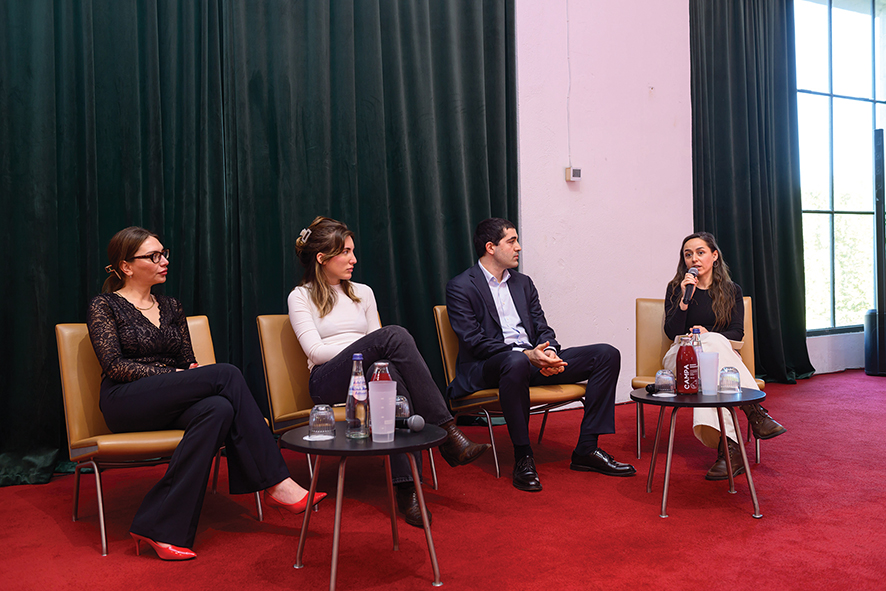
“After the presentations by Fabrika and CAMPA, Nana Takvarelia led a panel discussion on how circular solutions work in practice. One of the speakers was a representative from The Body Shop Georgia, a company actively promoting reusable packaging”
The Body Shop representative highlighted the company’s refill initiative, which allows customers to refill aluminum bottles for products like shampoos and shower gels, a key part of their circular design strategy.
“We also lead awareness campaigns to explain the concept, and we offer almost 50% off on products when customers bring their bottles back for a refill,” they explained.
While customers who tried the refill stations were enthusiastic, initial adoption proved challenging.
“At the beginning, only about 15 to 20 percent of customers understood the concept,”
The company’s communication efforts were crucial in overcoming these hurdles.
“People need clear guidance and motivation. Otherwise, habits take over, it’s easier to just buy a new bottle,” they said.
Despite these challenges, The Body Shop sees Georgia as a promising market for circular practices, noting growing interest among younger consumers and a gradual shift toward circular thinking as a lifestyle choice.
Showcasing digital solutions
Joining online, Ana Maria Villegas, CEO of Xiclo from Colombia, one of the pilot projects of GIZ’s global initiative, presented the company’s software for managing reuse systems. The software tracks every container individually and shows in a simple dashboard which containers have been returned and which are still out. It also offers ways to encourage people to return containers, such as deposits, guarantees, or rewards. The containers themselves are strong, food-safe, BPA-free, and can be used up to 500 times.
Xiclo can be used by companies that already have their own washing and delivery system, or as a complete package with reusable containers for quick pilot programs. One example is the “Tap and Reuse” system, where a container is linked to a purchase so that returning it is easy and organized.
“We Have a Precedent Now” – Looking Ahead
In her closing remarks, Nino Shavgulidze reflected on what had been achieved and what lies ahead.
“We can proudly say that these companies, CAMPA and Fabrika, have paved the way for the circular economy in Georgia,” she said. “They gave us precedents, working examples of reuse systems functioning in practice.” And these we will take forward through our new EU-funded initiative, ‘Circular Cities and Regions of Georgia’ where we are mobilizing businesses, CSOs, and universities to pioneer advanced circular practices in two specific regions, Kakheti and Adjara AR, turning Georgia into a regional sustainability leader.
“We will continue to support pilot projects and new initiatives,” she said. “We’ve proven that collaboration works. Now it’s time to expand.”
By Kesaria Katcharava