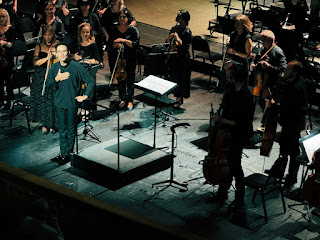
When the Tbilisi Opera and Ballet State Theater devoted an evening to a purely symphonic program on September 19, it staged another example of an unusual encounter: an opera orchestra stepping into the self-contained world of symphonic argument. For a Georgian audience accustomed to hearing this ensemble mostly buried in the pit, its emergence on the stage was an experience in artistic redefinition. Giacomo Sagripanti, an Italian conductor with roots in the operatic repertoire, led the orchestra through two works bound by tonal gravity and historical weight: Mozart’s Symphony No. 40 in G minor and Dvořák’s Symphony No. 7 in D minor.
Both symphonies inhabit minor tonalities whose rhetoric bends toward struggle, foreboding, and inner urgency. Both resist the superficial brightness that audiences often associate with Classical or Romantic orchestral writing. The program proposed an evening of shadowed architectures, testing whether an orchestra trained in the dramaturgical reflexes of opera could sustain large-scale symphonic dialectics.
Mozart: The Restless Grammar of G Minor
The G minor symphony is one of Mozart’s most enigmatic creations, a work that resists interpretation precisely because of its balance between order and agitation. The first movement’s sighing figure—an anacrusis that collapses into falling seconds—becomes a structural germ, driving the entire Allegro molto with breathless inevitability. Sagripanti’s reading emphasized propulsion: the articulation in the strings was clipped, almost brittle, underscoring the instability of the tonic space. The orchestra, more used to accompanying vocal lines, here had to negotiate a texture where every voice mattered. Particularly in the development section, where harmonic excursions dismantle the home key, the violins and violas maintained a tense dialogue rather than simply layering sound.
The Andante, often taken as a pastoral reprieve, was shaded instead with unease. Sagripanti’s phrasing allowed rests and suspensions to breathe like unanswered questions; the second violins carried their lines with an introspection rare in a theatre orchestra. The Menuetto, far from courtly, became a demonstration of Mozart’s ability to weaponize dance form—accented, rough-hewn, even aggressive. The finale pressed forward with a manic energy that left little space for consolation: sequences of rising scales, tightening harmonic traps, and the constant reassertion of G minor created an atmosphere of tragic inevitability. The orchestra’s discipline paid off here: balance between winds and strings was unusually clear, with clarinets and flutes cutting into the texture with sharp relief.

Dvořák: The Symphonic Will to Form
If Mozart’s G minor is all tension within Classical syntax, Dvořák’s Seventh is a Romantic essay in expansive symphonic narrative. It is a work haunted by Brahms yet defiantly personal, transforming folk rhythm and Slavic coloration into a monumental architecture.
The first movement unfolds as a struggle with thematic destiny: the opening figure in the violas, a murmuring D minor pulse, gradually erupts into a storm. Sagripanti resisted excess sentimentality, instead pressing the structure forward with clear attention to motivic development. One sensed an operatic conductor’s instinct for drama: climaxes were staged like revelations, arrivals timed with theatrical precision. The slow movement offered contrast—a broad cantilena in the clarinets, set against a restless undercurrent in the strings. Here the orchestra’s operatic training emerged fruitfully: wind solos were shaped with vocal inflection, the phrasing of a singer transposed into instrumental tone.
The Scherzo, one of Dvořák’s most rhythmically charged, bore a folk imprint—triple-time dance figures disrupted by syncopations. The Tbilisi players leaned into the rhythmic bite, with a rustic, almost rough intensity. In the finale, Dvořák pits optimism against menace, constantly threatening to dissolve triumph into turbulence. Sagripanti highlighted this ambiguity, the brass section projecting heroic declarations only to be undercut by brooding strings. The final D major affirmation rang out with conviction, but the memory of struggle was never erased—a victory earned, not given.
Toward a Broader Horizon
Opera orchestras often remain hidden, their virtuosity subsumed to singers, their interpretive agency suppressed. In stepping onto the stage, the Tbilisi Opera orchestra claimed an independent voice. The discipline required by Mozart’s contrapuntal textures and the vast architecture of Dvořák’s Seventh tested their capacity for dialogue without external protagonists.
Culturally, the gesture matters. Tbilisi’s musical landscape has long revolved around opera, ballet, and occasional large-scale choral events. The sustained cultivation of symphonic programming within the opera theatre could enrich the city’s repertoire, bringing not only canonical works but potentially rarer and contemporary music. Such evenings keep orchestral musicians in shape, demanding a level of technical and interpretive rigor distinct from operatic accompaniment.
By Ivan Nechaev
Header image: Giacomo Sagripanti, Tbilisi Opera and Ballet Theatre Orchestra // Photo by the author