The de facto authorities in Russian-occupied Abkhazia have described former Georgian President Mikheil Saakashvili’s recent remarks about restoring Tbilisi’s control over the region as an “alarming signal” and called on the Georgian authorities to formally assess his statements.
Oleg Bartsits, the de facto foreign minister of Abkhazia, told Russia’s TASS news agency that Saakashvili’s comments had caused no surprise in Sokhumi.
“Such a statement from Saakashvili, of course, surprises no one. It fits entirely within the paradigm of his politics, worldview and attitude toward people,” Bartsits said.
He claimed that what matters is not only the substance of Saakashvili’s remarks, but also how they are assessed in Georgia and how the Georgian government responds.
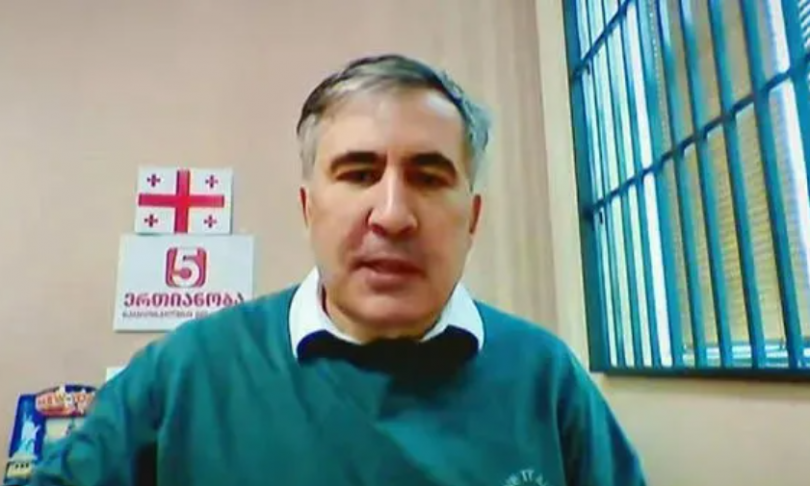
Saakashvili recently wrote on Facebook that Georgia’s control over Abkhazia had, in his view, been lost only temporarily and that he planned to restore it “together with other patriots” after his release from prison. He said “all necessary means” would be used to restore control and argued that the Abkhazia issue could not be resolved until the region was brought back under Tbilisi’s control.
Bartsits said Saakashvili’s remarks should not simply be dismissed as the “ravings of a madman.” Instead, he characterized them as a political statement representing part of the Georgian establishment that, he claimed, continues to support the former president.
“These are, essentially, their plans for resolving the Abkhazia issue as they see it. I think they have exactly the same plans regarding the people of South Ossetia. Statements like Saakashvili’s completely negate the peaceful rhetoric we hear from Georgia’s current leadership,” Bartsits said.
The de facto foreign minister said the remarks should receive close attention from representatives of international organizations, experts and Western political circles.
“This is a very alarming signal which, unfortunately, is still coming from a fairly significant part of the Georgian political spectrum toward the people of Abkhazia,” he said.
Bartsits added that the de facto authorities were prepared for any possible scenario.
“It is precisely such bloodthirsty plans, among other things, that drive our efforts to strengthen military security and actively cooperate in the military sphere with our strategic ally and partner, the Russian Federation. This work will continue. We cannot rely on chance or the goodwill of Georgian politicians,” he said.
Bartsits claimed that if statements such as Saakashvili’s do not receive a strict legal assessment, this would indicate that Georgia’s current authorities either share such views or consider them among possible courses of action.
Bartsits also referred to previous remarks by former Georgian Vice Prime Minister, State Minister and Interior Minister Giorgi Baramidze concerning Abkhaz prisoners during the 1992–1993 war.
Bartsits stated that Baramidze had said that the Georgian side eventually had no Abkhaz prisoners available to exchange for Georgian captives because they had been killed on the spot.
Bartsits claimed that although Georgian prosecutors opened a criminal case against Baramidze, he was ultimately charged with treason rather than war crimes or complicity in such crimes.
“This is an obvious attempt to conceal crimes against humanity, which are well known in Abkhazia and South Ossetia,” Bartsits said.