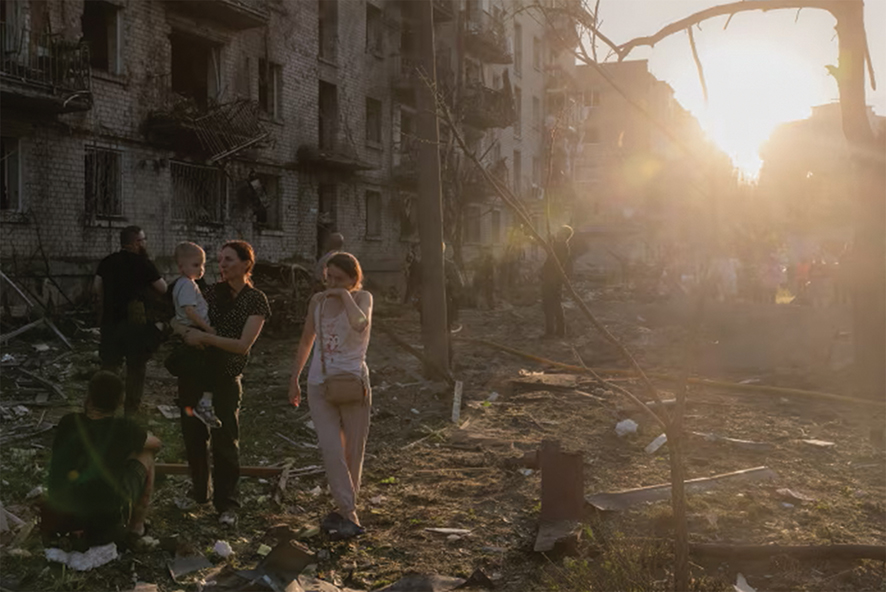
Russia and Ukraine spent another week locked in a costly war of attrition, with fierce fighting continuing across the eastern and southern front lines while both sides intensified long-range strikes far from the battlefield. As Russian forces pressed for incremental territorial gains in Donetsk and Zaporizhzhia regions, Ukraine expanded its campaign against Russian energy facilities, military industries, logistics hubs, and air-defense systems deep inside Russia and occupied Crimea. Meanwhile, Russian missile and drone attacks on Ukrainian cities continued to inflict heavy civilian casualties and renewed calls from Kyiv for additional Western air-defense support. Although neither side achieved a decisive operational breakthrough, the week’s developments underscored the increasingly long-range nature of the conflict, with both armies seeking to weaken the other’s ability to sustain the war as much as to seize territory.
The fiercest fighting of the week remained in eastern Ukraine, where Russian forces kept up relentless pressure across several key sectors. According to the Ukrainian military, Pokrovsk, Sloviansk, Kostiantynivka, Lyman, and Huliaipole saw the most intense combat, with more than 250 clashes recorded during a single 24-hour period at the beginning of July.
Pokrovsk remained at the center of Russia’s offensive. Russian troops launched repeated assaults near Hryshyne, Novooleksandrivka, Shevchenko, Udachne, and Kotlyne, while also pushing toward Serhiivka and Bilytske. Beyond its symbolic importance after months of fighting, Pokrovsk is strategically significant because further Russian advances to its west and northwest could put Ukraine’s broader defensive network in Donetsk region under greater strain.
Farther north, Russian forces continued probing attacks around Lyman and Sloviansk, repeatedly attempting to push toward Lyman, Borova, Yampil, Ozerne, and nearby settlements. Fighting also persisted near Kryva Luka, Rai-Oleksandrivka, and Kalenyky. Military analysts believe these assaults are intended to stretch Ukrainian defenses by forcing Kyiv to commit reserves across multiple threatened sectors at once.
The situation around Kostiantynivka also remained difficult. Russian units continued attacking positions near Kostiantynivka, Ivanopillia, Illinivka, Stepanivka, and Sofiivka. Reuters reported that Moscow has intensified pressure on the city, part of Ukraine’s so-called “fortress belt,” with small Russian assault groups trying to infiltrate its outskirts and surrounding approaches.
Activity also increased on the southern front. Ukrainian forces reported more than 20 Russian attacks in a single day in the Huliaipole sector, with fighting near Kosivtseve, Dobropillia, Hirke, Vozdvyzhivka, Staroukrainka, Tsvitkove, and Charivne. The area has grown in strategic importance in recent months, as Russian advances toward Huliaipole could threaten Ukrainian defensive positions in Zaporizhzhia region and complicate efforts to hold territory farther south. By contrast, the Orikhiv and Dnipro sectors remained relatively quiet during the reporting period, with Ukrainian officials saying Russia launched no major offensive operations there on July 1.
Despite the intensity of the fighting, the front line continued to move only slowly. The week’s battlefield developments reinforced a familiar pattern: fierce combat producing modest territorial gains rather than major breakthroughs. According to Russia Matters, citing DeepState and the Institute for the Study of War (ISW), Russian forces gained a net eight square miles of Ukrainian territory between June 23 and June 30, according to DeepState’s assessment, while ISW estimated gains of about 17 square miles. Looking at the entire month, DeepState calculated Russian advances at 31 square miles between June 2 and June 30, while ISW estimated 11 square miles. Although Russia continues to make gradual progress in some sectors, the pace remains slow and costly, with no sign of a rapid collapse in Ukraine’s defenses.
Away from the front line, Ukraine continued to expand its campaign of long-range strikes against Russian military and energy infrastructure. President Volodymyr Zelensky said Ukrainian forces struck the Ufa oil refinery for the second time in a week, targeting a facility more than 1,000 kilometers from Ukraine that plays an important role in Russia’s fuel and lubricant production. Ukraine also reported striking a missile component factory in Penza. “Every such strike reduces Russia’s ability to wage war,” Zelensky said, describing the campaign as an effort to undermine the infrastructure supporting Moscow’s invasion.
Occupied Crimea also came under sustained pressure. Russian-installed authorities declared a state of emergency amid fuel shortages and power disruptions following repeated Ukrainian attacks on logistics and energy facilities. Crimea remains one of Russia’s key military hubs for operations in southern Ukraine, making its supply network a critical target.
The disruption reflects a broader fuel crisis now affecting parts of Russia. Ukrainian drone strikes on oil refineries and fuel depots have disrupted refining capacity, leading to fuel rationing, long queues at filling stations, and sharp price increases in several regions. In Sevastopol alone, official Russian statistics showed gasoline prices rising by around 30 percent in a single week, prompting authorities to limit fuel sales and shorten public transport operating hours.
President Vladimir Putin acknowledged that Ukrainian strikes had created fuel shortages, although he insisted the situation was “not critical.” He said Russia needed to “rapidly and significantly increase production of air defense systems” while speeding up repairs at damaged refineries. To ease shortages, Moscow has begun importing gasoline from India, is negotiating additional supplies from neighboring countries, and is considering a temporary ban on diesel exports to keep more fuel on the domestic market.
Russia responded by stepping up its own aerial campaign against Ukrainian cities. Kyiv endured one of the deadliest attacks of the week as Russian missiles and drones struck residential neighborhoods and civilian infrastructure. Ukrainian authorities said at least 18 people were killed and more than 90 injured after an 11-hour bombardment involving hundreds of drones and dozens of missiles.
Fires broke out across several districts of the capital, damaging apartment buildings and other civilian sites. Following the attack, Zelensky renewed his appeal for additional Western air defenses, warning that “every delay in decisions, every delay in support means lost lives.”
Elsewhere, Russian attacks continued to hit civilian areas across southeastern and northeastern Ukraine. Strikes in Dnipropetrovsk, Sumy, and Kharkiv regions killed civilians, while guided bombs, drones, and artillery repeatedly targeted frontline communities. Kharkiv remained under constant pressure from drones, glide bombs, and cross-border attacks, while shelling and evacuation concerns persisted in the border areas of Sumy region.
The human cost of the war continued to mount. In addition to the week’s civilian casualties, a new assessment by the Center for Strategic and International Studies estimated that Russia’s full-scale invasion has resulted in more than two million military casualties on both sides since February 2022. The report estimated Russian military casualties at roughly 1.4 million, including between 400,000 and 450,000 killed. Ukrainian military casualties were estimated at between 525,000 and 625,000, including 125,000 to 150,000 killed. While the figures cannot be independently verified, they underscore the staggering cost of a conflict increasingly defined by attrition, drones, artillery, and enormous losses for relatively limited territorial gains.
On the diplomatic front, attention turned to preparations for the NATO summit in Ankara on July 7-8, where Ukraine is expected to remain high on the agenda. NATO says allies will continue providing military assistance while working to make long-term support more sustainable. As of June 2026, member states had committed more than $6 billion for U.S.-supplied military equipment through the Prioritized Ukraine Requirements List (PURL), with additional announcements on Ukraine’s urgent defense needs expected during the summit.
Meanwhile, Kyiv continued pressing its Western partners for more air-defense systems, long-range weapons, and a reliable supply of ammunition. Ukrainian leaders argue that defending the country’s cities and holding the front increasingly depends on a combination of Western air defenses, expanding domestic drone production, and sustained international financial support. Moscow, meanwhile, continued to reject Ukrainian and Western conditions for a negotiated peace while pursuing gradual battlefield advances and retaliatory strikes.
Compiled by Ana Dumbadze