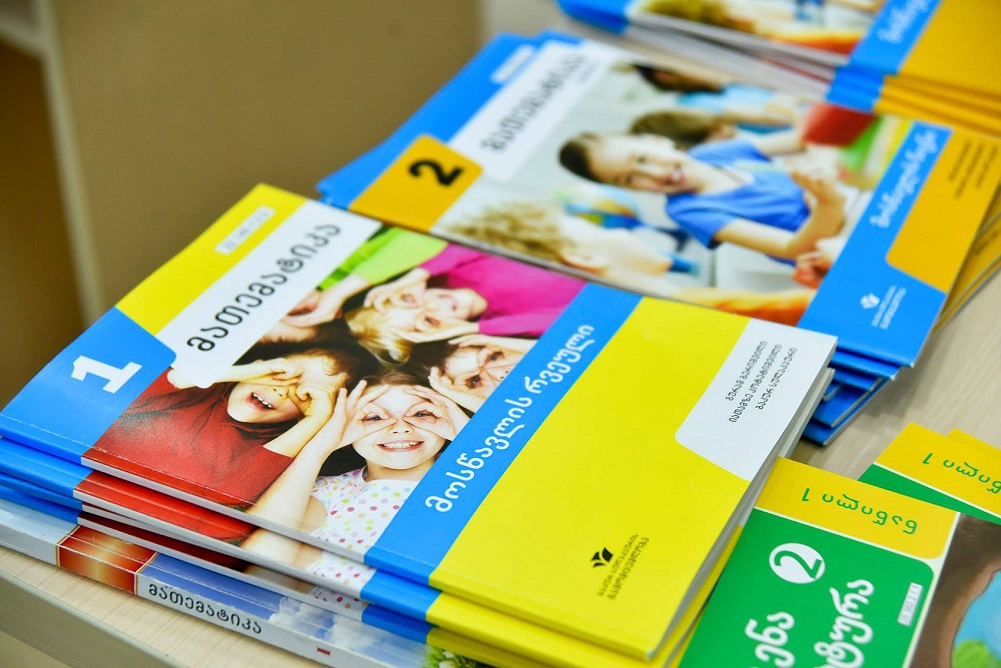
The Minister of Education of Georgia, Givi Mikanadze, says new school textbooks will place greater emphasis on national values, with covers featuring Georgian cultural and scientific achievements and the same textbooks being used in both public and private schools.
Speaking to the Georgian Public Broadcaster on June 30, Mikanadze said the redesigned textbooks will include examples of Georgia’s cultural heritage across different subjects.
“The chemistry textbook will feature Georgian winemaking, which is linked to a chemical process. The back cover explains how this 8,000-year-old tradition is recognized by UNESCO,” he said.
The physics textbook will highlight Georgian engineer Elguja Medzmariashvili’s satellite-related achievement, while the biology textbook will feature Georgian grain varieties. The Georgian language and literature textbook will include references to medieval writer Ioane Zosime and The Knight in the Panther’s Skin.
Mikanadze also announced that Grade 10 students will study the history of Georgia as a separate subject, with a dedicated textbook, while world history will be taught independently.
The minister said the new textbooks will contain more than 500 illustrations of Georgian architectural monuments, museum exhibits, and other cultural treasures.
He added that the books will also include quotations from the late Catholicos-Patriarch of All Georgia, Ilia II, alongside references to writer Ilia Chavchavadze. Mikanadze described the inclusion of these materials as part of the government’s goal of integrating national values into the education system.
“The main starting point in the updated national goals of general education is the maximum integration of national values into the educational process,” he said.
Mikanadze stated that all humanities and STEM textbooks will be replaced with new editions by September 15, 2028.
He also announced that students at the same grade level will use identical textbooks in both public and private schools.
“Private schools will have to purchase these textbooks, while public schools will continue to receive them free of charge,” the minister said.
The first new textbooks will be introduced on September 15, 2026, for first, seventh, and tenth grade students.
Mikanadze said parents had expressed dissatisfaction with the current system, arguing that students who transfer between schools often face different textbooks and teaching methods for the same subject.
“This causes confusion for children and significantly reduces the effectiveness of learning. That is why we have made specific decisions regarding textbooks, and I believe we will see the results very soon,” Mikanadze added.