From May 21-24, Tbilisi will once again become a regional focal point for contemporary art as the latest edition of Tbilisi Art Fair (TAF) opens at ExpoGeorgia. The Georgian capital continues to strengthen its position as an emerging cultural hub in the South Caucasus, drawing growing international attention to the region’s artistic landscape.
Held biennially, TAF has developed into a key meeting point for regional and international artists, galleries, curators, and collectors. The 2026 edition further expands this role by connecting artistic communities across the South Caucasus and Eastern and Central Europe within a broader transregional framework. The fair positions itself not only as an exhibition platform but also as a space for dialogue and exchange across borders and disciplines.
Throughout the fair, Georgia Today will present a series of features on participating galleries and curated projects. The first in the series is Reach Art Visual (RAV), whose presentation reflects several of the broader curatorial directions shaping this year’s edition of TAF.
RAV at TAF 2026: Archives, Amalgams, and the Framing of Georgian Art
Recent developments in Georgia’s art market were marked by Hessink’s auction in Tbilisi, which achieved a white glove result and netted €1.3 million across 93 lots while setting several benchmark sales for Georgian artists. The auction’s selection was curated by Thea Goguadze-Apfel, founder and CEO of Reach Art Visual. She also played an important role in launching Bonhams’ 2025 London auction dedicated exclusively to Georgian art.
Together, these developments point to growing international interest in Georgian modern and contemporary art, as well as a broader shift in how the field is positioned within the global art market. Increasingly, Georgian art is being framed through its own distinct cultural and historical context rather than through inherited post-Soviet classifications.
It is for this reason that Georgia Today begins its coverage of TAF 2026 with Reach Art Visual. Their presentation highlights ongoing efforts to position Georgian and regional art within a clearer and more defined international framework.
Curating Against Chronology
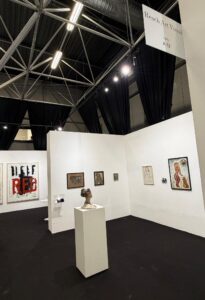
The curatorial approach adopted by Reach Art Visual for TAF 2026, as art historian Konstantine Bolkvadze notes, explicitly resists linear historiography. Instead, it constructs a “layered curatorial field” in which works from different generations, geographies, and artistic lineages are placed into deliberate dialogue – less as a method of comparison than as a way of unsettling fixed historical sequence. This strategy of fragmentation and juxtaposition moves beyond the limits of national and chronological narratives. In the Georgian context, it responds to a historiographic condition marked by discontinuity: Soviet institutional legacies, post-independence fragmentation, and the uneven incorporation of local practices into global discourse.
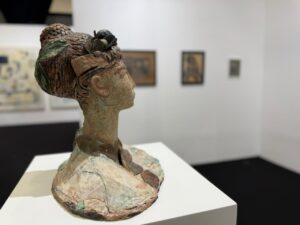
Thus, RAV’s first booth operates as a kind of counter-archive. Rather than reaffirming established trajectories, it repositions well-known artists through lesser-seen or early works, unsettling the idea of artistic maturity as the final horizon of interpretation.
Prominent ceramic artist Lia Bagrationi’s early drawings, for instance, are presented not as precursors to a defined practice, but as evidence of a visual language still in formation – where gesture, bodily movement, and fragility operate less as stylistic choices than as conditions of perception and knowledge.
The inclusion of Gregor Danelian further complicates any national framing. His presence points to the multicultural codes embedded within Tbilisi’s artistic history, shaped by Armenian and Georgian entanglements that resist neat cultural partitioning and reveal the layered nature of Georgian modernity.
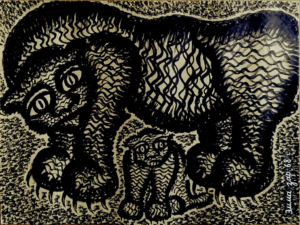
More provocatively, the inclusion of Emma Zar-Khutsi (Emma Zarafishvili-Khutsishvili, born Murzina) exposes the geopolitical instability of classification itself. Born in Uzbekistan and later active in Soviet-era Tbilisi, her trajectory unsettles any attempt to read “Georgian art” as geographically contained. Her work has often been associated with naïve, primitivist, and outsider traditions, further complicating conventional art historical categorization.
Taken together, the booth examines how artistic legacies are stabilized through selective visibility.
Fragmentation as Contemporary Condition
If the first booth interrogates archival logic, the second turns toward the unstable grammar of contemporary artistic production. Curated by Marian Shergelashvili, it brings together emerging practices that foreground fragmentation, abstraction, and semiotic disruption as structuring principles rather than stylistic effects.
The booth centers a younger generation of artists. Across the works of Mari Babaevi, NOBU, Giorgi Shengelia, and Kristine Tusiashvili, form is treated less as composition than as residue, something constructed through interruption, erasure, and coded repetition.
Young Georgian artist of Azerbaijani descent Mari Babaevi’s Zanāneh (“created by women”) series centers the braid as both a material form and social metaphor. Read through this lens, the braid is not merely symbolic of identity or memory, but of labor systems that remain largely invisible: repetitive, embodied, and historically assigned to women. The braid becomes not only a marker of endurance but also a structure through which inherited systems of labor and identity are carried forward.
Young Georgian artist NOBU’s fragmented visual field operates as a semiotic system in breakdown. The work of the Georgian-born artist, now living abroad, evokes architectural remnants, typographic ruptures, and unstable markings that suggest not communication but its suspension. Meaning appears only in partial transmission, signals that fail to fully resolve into language. In this sense, the work reflects not only memory or displacement, but also the conditions under which legibility itself becomes unstable.
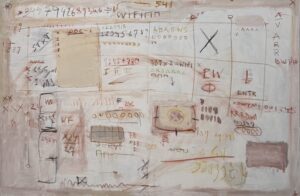
Giorgi Shengelia’s erased and layered surfaces similarly refuse visual resolution. What emerges is not image but process: the continuous undoing of coherence as a formal strategy. The works suggest that abstraction here is not a withdrawal from reality but a confrontation with instability itself.
Kristine Tusiashvili’s The Tip of the Needle introduces a more overtly sociocritical register, reworking collage traditions to expose contemporary regimes of aspiration and symbolic value. Power, money, and visibility appear not as themes to be represented, but as forces embedded within the very structure of looking.
Reframing the Regional
Read together, Reach Art Visual’s presentation at TAF 2026 makes a quiet but precise intervention in how “Georgian art” is defined. Rather than reinforcing a single national narrative, it turns to overlap, proximity, and historical entanglement as its operative conditions.
The question is no longer whether Georgian art is being newly discovered, but how it becomes legible at all – and who has the authority to decide.
In this sense, the presentation reads less as an exhibition than as a proposition: “Georgian art” is not a fixed category, but a shifting field of relations in which classification itself functions as cultural power.