Russia’s war against Ukraine entered another week of heavy attrition, with the most intense fighting again concentrated in eastern Ukraine, while both sides expanded long-range strikes against infrastructure far from the front. The battlefield picture remained defined less by major territorial breakthroughs than by constant assaults, drone saturation, guided bomb attacks and efforts to exhaust the opponent’s air defense, logistics and manpower.
Ukraine’s General Staff reported that 137 combat engagements were recorded on April 29 alone, with the Pokrovsk sector remaining the hottest part of the front. Russian forces launched 31 attacks there, attempting to advance near Pokrovsk, Rodynske, Udachne, Kotlyne and surrounding settlements. Ukrainian forces also reported heavy fighting in the Kostiantynivka, Huliaipole, Lyman and Sloviansk directions, while no major changes were reported in other sectors. Russia used missiles, guided aerial bombs, thousands of kamikaze drones and artillery strikes throughout the day, underlining the continued intensity of its spring-summer offensive effort.
Independent battlefield assessments suggested that Russian forces have not achieved a decisive breakthrough, despite continued pressure. The Institute for the Study of War assessed that Ukraine has largely blunted Russia’s current offensive so far, although Russian troops continue probing across several axes. ISW also reported Ukrainian advances in the Kostyantynivka-Druzhkivka tactical area, western Zaporizhzhia, Pokrovsk, Oleksandrivka and Huliaipole directions, while noting that Russia continues to rely on mass assaults and drone-heavy attacks.
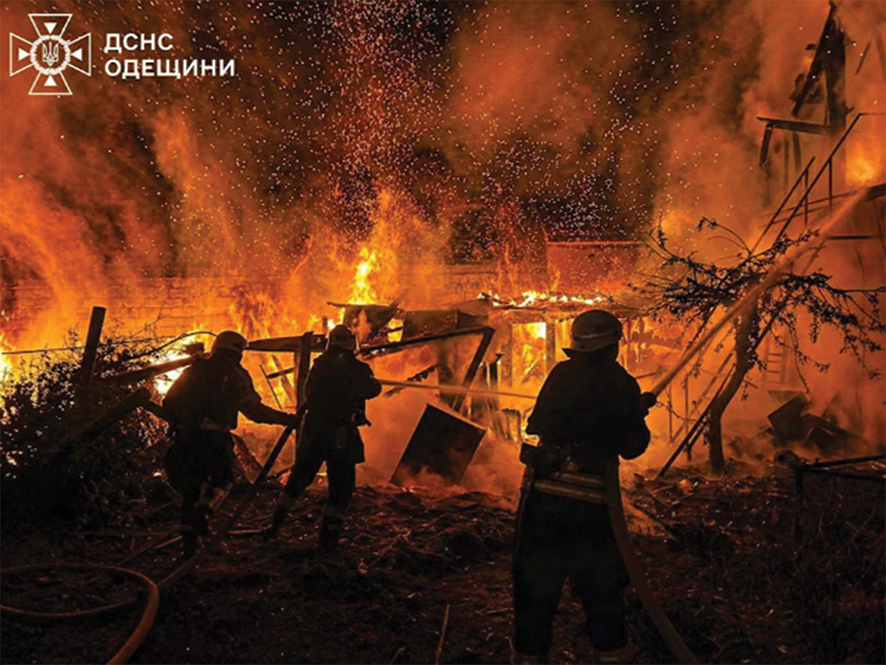
The air war remained especially intense. Russia launched a large drone attack against Ukraine overnight, with Ukrainian air defenses reporting that 154 of 171 drones were intercepted. Odesa was among the main targets. Strikes damaged residential buildings, port and infrastructure facilities, a kindergarten, commercial sites and vehicles, while 16 people were injured, including a 17-year-old. Earlier attacks in southern Odesa also damaged a hospital and port infrastructure, while in Sumy region, Russian drone and missile strikes killed one person and injured two others.
Energy and transport infrastructure were again targeted. In Mykolaiv region, Russian Shahed-type drone attacks damaged energy and transport facilities, causing power outages in several settlements. Five people were injured, regional authorities announced. The attack continued a pattern seen throughout the war: Russia striking civilian and dual-use infrastructure to disrupt electricity, transport and regional resilience far behind the front line.
Ukraine, meanwhile, continued to expand its campaign against Russian oil and military infrastructure. Kyiv said it struck a Transneft oil pumping station near Perm, around 1,500 kilometers from Ukrainian territory. President Volodymyr Zelensky said Ukraine would keep extending the range of such strikes in order to weaken Russia’s war infrastructure. The strike formed part of a broader campaign against Russian refineries, depots, oil terminals and logistics nodes, although trade data cited by Reuters suggested Russia’s April crude loadings from Baltic and Black Sea ports remained broadly stable.
The impact of Ukraine’s deep-strike campaign was also visible politically. Russia announced that its May 9 Victory Day parade would be held without military hardware for the first time in nearly two decades, with officials citing the “current operational situation.” Analysts linked the move to fears of Ukrainian drone attacks and the need to protect military assets. The decision was symbolically important: the parade has long been used by the Kremlin to project military power, but this year’s scaled-down format reflected the pressure Russia faces both on the battlefield and at home.
Diplomatically, the week was dominated by a phone call between US President Donald Trump and Russian President Vladimir Putin, during which a possible temporary ceasefire around Victory Day was discussed. The Kremlin presented the idea as a holiday truce, while Trump described the call positively. Kyiv, however, remained cautious, as Russia has previously announced limited ceasefires that Ukraine says were violated or used for tactical advantage. The main political gap remains unchanged: Moscow continues to demand Ukrainian territorial concessions, while Ukraine rejects surrendering occupied territory as the price of talks.
International support for Ukraine also advanced. On April 23, the Council of the European Union finalized a €90 billion loan to Ukraine, intended to support urgent budgetary and defense needs in 2026 and 2027. Council says the loan is expected to allow disbursements from the second quarter of 2026, with an indicative €60 billion directed toward strengthening Ukraine’s defense industry and procurement capacity.
NATO and the EU also held a joint meeting in Brussels, calling for predictable, coordinated and sustained support to Ukraine. NATO noted that allies and EU member states account for most military, financial and humanitarian assistance to Kyiv, while the EU Military Assistance Mission has trained 90,000 Ukrainian soldiers. The message from Brussels was that Ukraine’s immediate defense and long-term deterrence remain central to European security.
A separate and important development came from Norway. Ukraine and Norway signed an agreement to jointly produce Ukrainian-designed mid-strike drones on Norwegian territory, with several thousand systems planned for Ukraine’s Defense Forces. The project will be financed by Norway from funds in addition to its already allocated $7 billion in defense support for Ukraine in 2026, and the first deliveries are expected as early as this summer.
The week showed a war still moving through exhaustion rather than resolution. Russia continued to press hardest around Pokrovsk and other eastern sectors, paying a high price for limited gains, while Ukraine increasingly relied on drones, mobile defense, long-range strikes and international industrial partnerships to offset Russia’s numerical advantages. The front line remained unstable but not broken; the diplomatic track remained active but far from agreement; and the infrastructure war continued to reach deeper into both countries.
Compiled by Ana Dumbadze