The fire that caught on the nation 37 years ago is still burning, and the fuel feeding that passion is an undying source, keeping the free and independent Sakartvelo up and going. At least this is the feeling that most people around me are nursing in their hearts and minds.
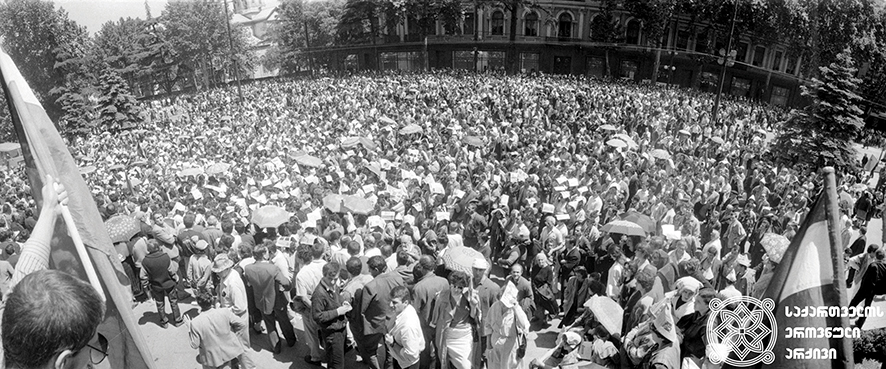
The 9th of April memorial is bringing back the huge national pain suffered in 1989, when the ‘Ancien Régime’ murdered peaceful demonstrators holding a nonviolent sit-in and striving for national independence from the Soviets. The protest took place in front of the Parliament House on Rustaveli Avenue. On that bloody, tragic day, 21 people, mostly young females, died, and hundreds were injured and poisoned due to brutal force and an unknown chemical gas.
The day is one of the most significant dates, rendered as a turning point in modern Georgian history, marked with an absolutely unbridled, all-national readiness to fight for freedom. Naturally, a memorial was installed in front of the parliament building, which the citizens of Georgia visit and adorn with flowers to pay homage to the innocent victims of Soviet troops. So, it would be not an iota of exaggeration to call the 9th of April the Day of National Unity, but notwithstanding this glorious designation, this year the supposedly peaceable and reverential commemoration turned into unpredictably explosive political tension between modern-day protesters and government officials at the well-known and heartily frequented memorial on Rustaveli Avenue.
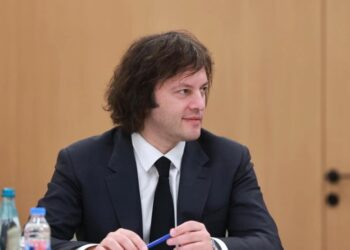
This year, the day started with a noiseless vigil while it drizzled and the sky was somber. Thoughtful Georgians kept a nocturnal vigil at the memorial, small groups substituting each other, spending the whole night at the site. But trouble was in the air, and the situation became unpleasantly strained when the ruling party frontrunners arrived, among them the current head of the government.
All of a sudden, protesters grew around like mushrooms, shouting as the officials laid flowers. The accusations were trivially old: “Russia lovers.” A confrontation was imminent, and quickly turned into abusive, even physical altercations; no longer a peaceful service. Some of the protesters who knocked down the wreaths placed by the administration representatives were arrested on the spot. Vituperative and scurrilous language was exchanged between the crowd and the officialdom. The strong police presence became indispensable, and all this was witnessed by members of the diplomatic corps accredited in Georgia.
Meanwhile, the 9th of April Big Day is asking for deep and meaningful analysis for the generations to come. It certainly was tragic, but at the same time a pivotal point in the history of modern Sakartvelo. That day, almost two scores of years ago, the Georgian people were out in the streets with the intention of ridding the country of the Soviet regime and with a demand for Georgia’s independence, the inner sense of national freedom having been the prerequisite for those two politically overcharged claims.
Carnage, gas poisoning, and repression followed; the dead, injured, shocked, and traumatized individuals filled the place. If interpreted purely politically, the Soviet Union was becoming weaker on a daily basis, and national movements all around the big Soviet country spread ubiquitously. The downfall of the nuclear power covering one-sixth of the globe was clearly looming.
In Georgia, the national forces clashed with the imperial authority, which made catastrophic mistakes, used excessive force, and made false analyses of the overall situation in the country: the sturdier the governmental repressions, the stronger the popular protest, and, as a result, Soviet legitimacy lost meaning and supremacy in the eyes of the Georgian people.
The public reaction to this was unification, consolidation, unanimity, a sharpened sense of independence, and finally, a declaration of independence after two years of earnest fight. All this was followed by international reaction to the metamorphosis ‘A la Géorgienne’. The world saw Soviet-type cruelty with its own eyes. The victory worked as a political catalyst for further events in the country and as a historical test of the endurance and viability of the Georgian people.
Now, it is time for relevant conclusions: force cannot always defeat the truth; a united nation is a decisive power, a split society is a loser; emotion is not decisive but helps; freedom asks for sacrifice; history has to be evaluated thoroughly; not interminable mourning but rational reasoning over the future is necessary; and finally, ask not what happened but what was learned from the lesson. Time to know well what we want to make of ourselves!
Op-Ed by Nugzar B. Ruhadze