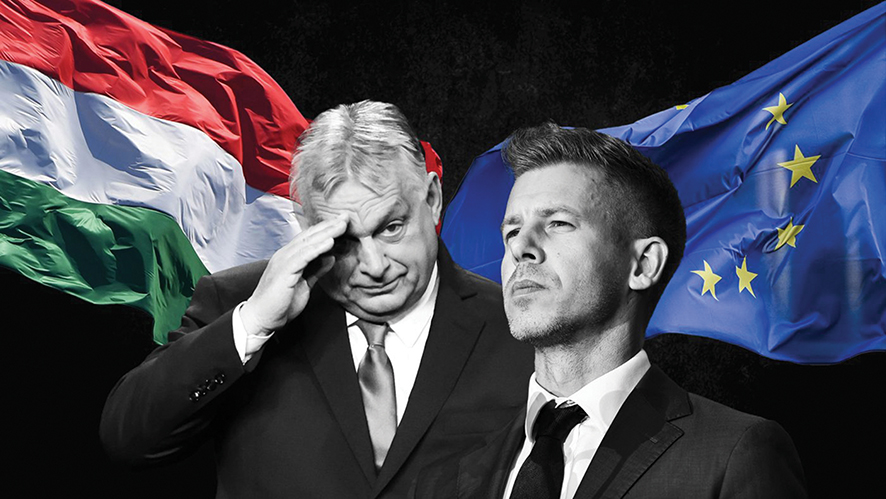
The political earthquake that rattled the Hungarian steppe on April 12 did more than just end Viktor Orbán’s sixteen-year tenure; it shattered the glass of the world’s premier laboratory for “soft autocracy.” For over a decade, Budapest served as a global beacon for the illiberal right, a place where state institutions were methodically captured while maintaining the polished veneer of democratic legitimacy.
But as Péter Magyar and his Tisza party swept into power with a crushing constitutional supermajority, the message to the world’s populist movements was clear: ideological crusades eventually wither when they fail to insulate the citizenry from the rot of economic stagnation and systemic corruption.
In Washington, the shockwaves are being felt acutely within the far right of the MAGA movement, which had long anointed Orbán as the “spiritual father” of modern conservatism in Europe.
The fall of his model in its own birthplace suggests that nationalist rhetoric is no longer a sufficient shield against domestic dissatisfaction. For the Kremlin, the implications are nothing short of catastrophic. For years, Orbán acted as Vladimir Putin’s primary spoiler within the European Union, a reliable wrench in the gears of Western unity, who used his veto to paralyze aid to Kyiv and dilute sanctions. With his departure, the “Russian backdoor” into European intelligence and diplomatic circles is being slammed shut, isolating Putin from his most effective lever of obstructionism in the West.
Yet, Magyar’s victory is not a simple “clean break.” The new Prime Minister inherits a nation physically and financially tethered to Moscow through a labyrinth of energy dependencies. Hungary remains lashed to the Soviet-era-built Druzhba oil pipeline, and bound by a fifteen-year Gazprom contract that defies easy exit. Most daunting is the Paks II nuclear project; with the first concrete already poured for the Rosatom-built reactors, Magyar faces the ultimate paradox of modern sovereignty: trying to pivot toward Brussels while the nation’s power grid remains an anchor of Russian technology and debt.
Domestically, the task is equally Herculean. Despite his two-thirds majority, Magyar must “de-capture” a state where the chief prosecutor and the heads of the media and constitutional authorities sit on long-term mandates specifically designed to survive a change in regime. His strategy, a rapid pivot toward the European Public Prosecutor’s Office and the creation of a National Asset Recovery office, is a desperate bid for the transparency required to unlock billions in frozen EU funds. These funds are the only lifeline for a budget currently bleeding from high deficits and the inflationary hangover of the Orbán era.
Beyond the Danube, the “Magyar Method” has already become a tactical manual for the “frontline” democracies, where political opponents are studying Magyar’s rise, paying attention not for his technology, but for his narrative, echoing realities on the ground, dismantling systems in power with insider’s knowledge. Although, most importantly, this was a good lesson to those that attribute themselves to a political know-it-all, the Hungarian experience is clearly proving an example that even the most entrenched systems can be overturned through sheer voter mobilization.
As the frost between Budapest and Kyiv begins to thaw, the new administration is signaling a pragmatic reset. The era of state-sponsored vilification of Volodymyr Zelensky has ended, replaced by a commitment to humanitarian support and financial stability. While Magyar remains wary of direct military aid, balancing a public sensitive to the proximity of war, his realignment solidifies a unified European front.
Hungary is finally returning to the Western fold, but it is doing so by walking a razor-thin tightrope: satisfying the democratic demands of Brussels while managing a Kremlin that still holds the keys to its energy future.
Op-Ed by George Katcharava
Author’s bio: George Katcharava is the founder of eurasiaanalyst.com, a geopolitical risk and advisory firm.