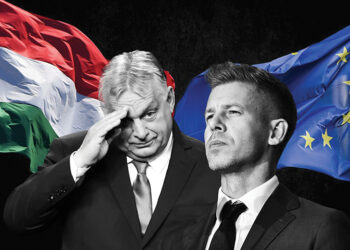
After 16 years in power, Viktor Orbán is out, and Hungary is stepping into unfamiliar territory. His defeat is more than just a change in leadership; it reflects a deeper sense of frustration among voters who no longer saw progress in a system that had come to feel stagnant, insular, and increasingly out of sync with the rest of Europe. As political economist Dalibor Rohac puts it, this was “mostly a vote against the status quo in Hungary,” driven by years of economic disappointment, corruption concerns, and a growing sense that the country was falling behind its neighbors.
In his conversation with Radio Free Europe/Radio Liberty’s Georgian Service, Rohac explains that the breakthrough came when that frustration finally found a political outlet in Péter Magyar, giving Hungarians a credible alternative for the first time in years. Still, the path ahead is anything but simple.
Hungary now faces the difficult task of untangling deeply embedded political and economic networks, while trying to reset its place in Europe. The question now is not just what comes after Orbán, but whether Hungary can truly move beyond the system he built.
Let’s look at Viktor Orbán – 16 years at the helm. What are the main factors that contributed to his downfall?
Viktor Orbán lost this election for essentially two reasons. One is his track record in office; the fact that 16 years of Orbán’s rule did not bring about prosperity for Hungary, nor did it strengthen the country.
Hungary, in fact, started lagging behind its neighbors, became one of the least well-governed countries in Europe, the most corrupt country according to Transparency International, and one of the poorest places in the European Union. So, this was mostly a vote against the status quo in Hungary.
And the second reason was that, for the first time in those 16 years, that anger and disappointment had a real outlet in the form of the Tisza party. Previously, the opposition was divided, fragmented; found it difficult to cooperate, and didn’t have an obvious leader. That had helped Viktor Orbán get through some of the recent elections. Not anymore. It was the emergence of Tisza, and Magyar in particular, as a political force that helped to coalesce the opposition.
What should we expect from Magyar? Just how different will his policies be compared to his predecessor?
Péter Magyar started out in the environment of the Fidesz party. He was the husband of the now disgraced former justice minister, and he broke with Fidesz over some of these scandals, specifically an incident involving a presidential pardon for people who were covering up sex abuse scandals in a children’s orphanages in Hungary. He’s coming from that center-right environment. His messaging has actually been very distinctly center-right and focused on traditional Hungarian values, patriotism, etc.
Georgian Dream has already crossed lines that Orbán never did
So, in some ways, he doesn’t represent a radical, revolutionary shift from the status quo. But for those who care about the rule of law, corruption, and Hungary’s place in the EU, it is a cause for celebration.
Viktor Orbán was somebody who very consciously and deliberately pursued an ideological project that sought to peel Hungary away from the EU, bring it closer to Russia and China, and pursue a different model of political economy and development. And I think that’s the end of that story: it ends with this defeat. We will now be seeing Hungary’s return to far more conventional, far more normal politics.
How large will Orbán’s shadow be – or rather that of the system he built – looming over Magyar?
I would venture to suggest that most of Magyar’s time will be spent firefighting. Hungary is not in great economic shape. It’s facing an energy crisis, like other parts of Europe. Obviously, there will also be the tail end of this Iran war influencing the energy situation.
There are structural dependencies on Russia and China that not only went unaddressed by the previous government, but, if anything, were deepened. So, I think there will be a lot of firefighting and cleaning up to do.
Orbán spent 16 years building this system. Just how pervasive is it, and how difficult will it be to undo the damage?
It’s going to be complicated. The fact that he has a constitutional majority helps in that endeavor. But just to offer one concrete example, Péter Magyar already, on the night of the election, called for the resignation of the sitting president of Hungary. The president is elected by parliament. There is a complicated procedure that allows for his impeachment, which requires a two-thirds majority in parliament, and it also requires the assent of the constitutional court.
I’m pretty sure Mr Magyar would prefer the president to step aside quietly, but if he does not, he will have to go through the formal impeachment procedure, with an uncertain outcome. That is just one constitutional office among many. There are judges appointed by Fidesz, people in the public administration, central bankers, and the whole nexus of economic and media power controlled by individuals close to Fidesz. I think it’s going to be an uphill battle.
Perhaps one of the reasons for the peaceful handover of power by Viktor Orbán is the expectation that Magyar will eventually fail in this task, and that Orbán could return to office in the future.
How likely is it that criminal proceedings will be started against Orbán and his people? One of the more colorful figures in his entourage, Foreign Minister Szijjártó, given the recent leaks about Russian ties, might be feeling the heat.
I’m agnostic about that, and also about their future career prospects. But one thing that I think is reasonably clear is that Hungary ran this experiment for 16 years, trying to build an alternative to liberal democracy in the heart of Europe, and that experiment has proven to be a failure, both politically and substantively.
Therefore, I suspect that the demand for Viktor Orbán’s ideas and political thought will decline, and that the current infatuation, especially in Republican circles in the United States, will weaken and fade in the months to come.
What does this change for the European Union?
I think Magyar will try to repair Hungary’s relationship with the EU and restore its standing. He will need to unlock close to 20 billion euros in EU structural funds that have been frozen. Because he harbors no anti-European or anti-Ukrainian animosity, he will no longer be an obstacle to European-level consensus.
And I think for some of Orbán’s former allies, such as Robert Fico, this will mean increased pressure to fall in line as well. So, I think EU politics will become less contentious and less fractious, and perhaps the EU will be able to arrive at common decisions more quickly and effectively.
Since you already mentioned Ukraine – what does it change for Kyiv?
I think this will be a qualitative change for the better from the Ukrainian perspective. You don’t need the Hungarian prime minister to be an explicit cheerleader for Ukraine: you need the Hungarian prime minister not to stand in the way of common European solutions, whether it comes to EU membership for Ukraine, helping Ukraine defend itself, or providing financial support.
I do think we will see changes in that direction, and they will be quite noticeable.
Another change that will inevitably occur, but for the worse, will be for Russia. What does the loss of Orbán mean for Russia?
The Orbán government has acted as a sort of handmaiden to Russian interests in Europe. It has provided intelligence to the Russians about what was happening at EU summits. It was providing all kinds of support. There are reports of FSB operatives in Hungary, even during the election campaign, but more significantly, Hungary served as a conduit for various Russian individuals who were able to enter the Schengen area through it.
I think all of that will go away. Again, this is part of the task that stands before Mr Magyar: to try to clean Hungary up. And going after Russian intelligence agencies and other forms of Russian influence will be part of that task.
How likely is it that Hungary will be more robust on Russian sanctions? And what kind of game do you expect Magyar to play with Vladimir Putin?
One of the slogans that gained traction in the final days of the election campaign was “Russians go home.”
I don’t think there are any friendly or fuzzy sentiments towards Russia in Hungary. In fact, far less so than in some neighboring countries, such as Bulgaria or Slovakia. The only importance of Hungary in this process has been as a weak link within the EU.
We don’t need Hungary to be the leader of sanctions efforts against Russia. We just need Hungary to play its part: not to be an obstacle and not to provide avenues for circumventing sanctions. And I do expect that Hungary will be able to play that role.
How much will Magyar have to play along, given Russia’s energy leverage? It’s probably a question of when, not if, Moscow uses it.
Yes, you could easily imagine Russia trying to use that leverage against Hungary. And if you are in the midst of an energy crisis in Europe, if you are in the midst of an economic downturn, then I think the room for maneuver will be somewhat limited.
But I also think the momentum against Russia after these 16 years is too strong. This train has left the station, amid chants of “Ruszkik haza!” (Russians go home), and there won’t be much for Putin to do. This is a challenge for Magyar, but it is something that can be addressed over time. Just look at how the EU has made significant strides in moving away from Russian energy in the short term.
Let’s look at the more distant horizon: the United States. President Trump was very vocal in his support for Orbán, and the vice president personally traveled to Budapest to back him.
I think the vice president’s visit demonstrated that US soft power, so to speak, does not quite work the way people might have expected. I don’t think it did much to change the outcome of the election: if anything, it may even have worked to Fidesz’s detriment.
For Donald Trump, I think this is going to be a setback, and an important one, because until now Hungary has played an outsized role in the imagination of some MAGA intellectuals and Trump-aligned conservatives, as a living example of a country governed under an illiberal democracy, offering an alternative model on key policy questions.
Hungarian voters have said a very resounding “no” to this form of governance, and so you look at Donald Trump and he looks increasingly isolated, increasingly aligned with people who, I think it’s fair to qualify as losers, right? I don’t think anybody is trying to emulate Mr Fico in Slovakia, for example, or Mr Vucic in Serbia. So, if that’s the company Donald Trump keeps, it becomes far less impressive and perhaps even far less potent as a political force.
Another ally of Orbán is the Georgian Dream government in Georgia. What does this change for them?
For Georgia’s current government, this is another setback. It is already fairly isolated in the West.
Orbán’s Hungary was one of its few cheerleaders and advocates within the European Union, perhaps alongside Slovakia. I don’t think it was a particularly effective advocate for Georgia, but it was still an entry point into the EU, and now Georgian Dream has lost that.
So, hopefully, that will put some additional pressure on the government and perhaps might lead to democratic change in Georgia itself in due course.
But I would also argue that Georgian Dream has already crossed lines that Orbán never did, in terms of the use of political violence, the suppression of dissent, and a willingness to override traditional checks and balances.
I do think that Georgian Dream and Georgia are in a different place, partly because Georgia is not part of the EU, but also because the system has become more autocratic, more willing to jail opponents, and more willing to just use brute force. And so it will be harder, I think, for Georgia to get to a healthier place.
Are there lessons from Péter Magyar that the Georgian opposition and the broader protest movement could learn?
I think the main lesson is that leadership matters, and that an opposition getting its act together matters. We have seen an incredible mobilization of civil society and of the Georgian public, but that mobilization has not translated into effective opposition politics.
And I understand that the situation is different, because Georgian Dream does not operate under the constraints imposed by the EU. It is more violent, more ruthless, and more autocratic than Orbán was, and has demonstrated that it does not believe in peaceful transfers of power or in the procedural norms of democracy.
Ultimately, Orbán still proved to be a kind of normal democratic political actor. So I think the main lesson is the need for the opposition to get its act together.
Interview by Vazha Tavberidze