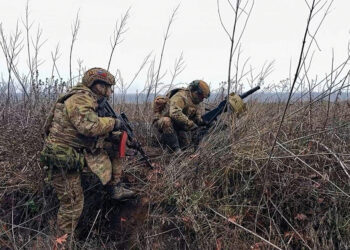
While global attention spans flicker between the war in Iran and the enduring struggle in Ukraine, the latter continues to shape itself as a war of attrition. Over the past week, the battlefield in eastern and southern Ukraine remained active, with slow-moving frontlines paired with an intensified campaign of long-range strikes targeting infrastructure and logistics. No major breakthrough occurred, yet missile and drone attacks continued to damage energy networks, transportation hubs, and civilian areas, reinforcing that the war is far from reaching any resolution.
Frontline Movements and Territorial Shifts
Recent battlefield assessments indicate that Russian forces made only limited territorial gains, capturing roughly 25 square miles over the reporting period, reversing a minor loss recorded the previous week. Ukrainian troops maintained a small foothold inside Russian territory near the Kursk and Belgorod border, estimated at about four square miles, with no significant change elsewhere. These figures illustrate a persistent pattern: the war’s fifth year is being defined by continuous offensives and counterattacks, with frontlines moving only incrementally despite heavy fighting.
Ukrainian officials reported localized successes in the southeast. Commander-in-Chief Oleksandr Syrskyi said Ukrainian forces retook several settlements in the Zaporizhzhia region since late January, advancing near Oleksandrivka and Huliaipole. Defensive lines were maintained in contested areas like Kupiansk in the northeast and the strategic Pokrovsk direction in Donetsk. February also saw a slowdown in Russian territorial gains compared with previous months. Independent military analyses suggest that Ukrainian forces liberated slightly more territory than they lost during the latter half of February, the first net gain since the major 2023 counteroffensive, highlighting Russia’s difficulties in turning sustained attacks into significant breakthroughs.
Despite Ukraine’s localized successes, Russia continued offensive operations across multiple sectors, particularly in Donetsk. Fighting remained heavy around key logistical hubs and defensive positions, including renewed assaults in the Pokrovsk direction and other parts of eastern Donetsk. Analysts note that Russia’s strategy relies on sustaining pressure along a broad front, forcing Ukraine to distribute defensive forces across multiple sectors rather than massing them for a decisive counteroffensive.
Long-Range Strikes and Infrastructure Damage
Alongside ground combat, Russia intensified its long-range missile and drone campaign. Ukrainian authorities reported attacks on energy and transportation infrastructure: gas facilities in Poltava and electricity substations in Kyiv and Dnipro were hit, injuring at least 20 people. Railways were repeatedly targeted; a drone strike hit an empty passenger train in Mykolaiv, injuring a worker, and a missile damaged a railway station administrative building in Odesa, wounding two children and another railway employee. Multiple rail facilities have been damaged over recent weeks, highlighting Russia’s ongoing aim to disrupt military logistics and civilian transport.
Maritime infrastructure was also affected. A drone strike damaged a foreign cargo vessel near the Black Sea port of Chornomorsk while it carried corn, underscoring the persistent risks to Ukrainian grain exports.
The repeated attacks on energy infrastructure are causing broader economic disruptions. ArcelorMittal announced suspension of operations at a Kryvyi Rih steel plant, citing instability in electricity supply.
Ukrainian officials warn that repeated strikes on power systems are raising electricity costs and complicating industrial production. Concerns about nuclear safety also emerged: Russian-installed authorities reported a temporary ceasefire near the Zaporizhzhia nuclear plant to repair a damaged external power line, emphasizing the importance of stable electricity for cooling systems.
Ukraine’s Counterstrikes
Ukraine continued to target Russian military and energy infrastructure. The most notable strike hit Novorossiysk, a Black Sea port city, where drones disrupted oil terminal operations and caused fires in fuel storage facilities. Russian officials reported five injuries and damage to residential buildings. Earlier in the week, a Ukrainian drone strike on a chemical plant in western Russia reportedly caused seven deaths and injured at least ten people. While the plant’s exact role in military supply chains is unclear, the strike reflects Ukraine’s focus on industrial and logistical facilities far from the frontlines.
Diplomatic Efforts
Efforts to advance peace and secure a ceasefire have continued, though progress remains stalled. Ukrainian President Volodymyr Zelenskyy said that trilateral peace negotiations involving Ukraine, the United States, and Russia, previously expected to resume in early March, are currently on hold because of the ongoing conflict involving Iran, which has shifted the priorities of external mediators and disrupted planning for a new round of talks. Kyiv officials said that although dialogue with the US continues almost daily, “the necessary signals for a trilateral meeting haven’t come yet,” and no firm date or venue has been confirmed for the next session. Ukrainian leaders also highlighted ongoing work aimed at securing the release of prisoners of war, signaling that while a comprehensive ceasefire deal remains distant, incremental humanitarian cooperation continues.
Military assistance remains critical. Ukrainian officials highlighted concerns over air defense interceptors, including Patriot missiles used against ballistic threats. Shortages of air-to-air missiles for newly deployed F-16 fighter jets also emerged, reflecting broader strains on global air defense resources due to simultaneous regional conflicts.
Compiled by Ana Dumbadze