Russia’s campaign this week combined steady, persistent pressure along key ground axes with a renewed focus on long-range strikes against Ukraine’s power and heating systems, a pattern that has become sharper as temperatures remain low and diplomacy stalls. Ukraine has maintained a two-track approach: holding the line where Russian assaults are most intense, while widening its own strike capabilities against Russian military logistics and infrastructure deeper inside Russia and in occupied territory. The result over the past seven days has been limited territorial change, but ongoing tactical churn, with small advances and reversals around villages and treelines, alongside a notable rise in attacks on energy facilities and the human cost that follows.
Fighting in the East
On the battlefield, Russia’s most consequential ground activity remained in the east, with multiple “micro-advances” reported by open-source geolocation and Ukrainian and Russian statements. In the broader Donetsk theater, geolocated footage analyzed by independent experts showed Russian forces advancing toward Slovyansk, including movement in southern Nykyforivka, southeast of the city. The same reporting pointed to Russian advances in the Kostyantynivka–Druzhkivka area, with units pushing within and around settlements southeast of Kostyantynivka, such as Pleshchiivka and areas near Ivanopillya. These movements reflect ongoing efforts to compress Ukrainian defenses around the “fortress cities” belt. While incremental, these advances are operationally significant, enabling heavier artillery and drone pressure on Ukrainian supply routes and raising the cost of holding fixed positions.
Probing in the North and Northeast
In the northeast and along the northern border, the week also saw active Russian probing. Geolocated footage indicated advances in northern Sumy Oblast, north of Nova Sich, consistent with Russia’s goal of creating a buffer zone along the border. Elsewhere in the wider Kharkiv–Luhansk interface, Russian forces were reported advancing in central Bohuslavka, northeast of Borova, highlighting that the Oskil River line remains a live pressure point even when major headlines focus elsewhere. These moves did not produce a breakthrough, but they reinforce an emerging winter pattern, with Russia attempting to stretch Ukrainian reserves by forcing Kyiv to respond simultaneously in Donetsk, along the Oskil axis, and on northern approaches.
Ukrainian Counteractions
Ukraine recorded some limited but notable tactical responses during the same period. Analysts reported that Ukrainian forces cleared Chuhunivka in the Velykyi Burluk direction, after earlier Russian claims suggested temporary Russian entry into the settlement. In the south, Ukrainian activity around Hulyaipole appeared more dynamic than in recent weeks. Ukrainian forces reportedly cleared several villages northwest of Hulyaipole, in Ternuvate, Tsvitkove, and Staroukrainka, and also cleared Zaliznychne west of Hulyaipole. Geolocated footage also suggested Ukrainian movement in Kosivtseve. These actions were primarily clearing operations and the removal of infiltrating groups rather than a major offensive, but they demonstrate that Ukraine can still generate local counter-pressure, especially where Russian forces rely on small-unit infiltration and drone-enabled harassment.
The Civilian Toll
The human cost of the week’s ground and air campaigns remained heavy, with several strikes standing out for both lethality and symbolism. In the Ukrainian-controlled part of Donetsk region, a Russian airstrike killed an 11-year-old girl and her mother in Sloviansk and wounded 14 others, including a 7-year-old girl. In Dnipropetrovsk region, Russian strikes killed four civilians in localities near Synelnykove, with additional injuries reported in separate incidents. Across southern and northern arcs, Russia’s expanding drone campaign again hit homes as well as infrastructure. A Reuters account of overnight attacks reported at least four deaths across Ukraine, including a mother and child in Kharkiv region. The same wave included a fatal strike in Odesa and a separate death in Chernihiv region, along with multiple injuries in Dnipropetrovsk region. These incidents, clustered across multiple oblasts, illustrate how Russia’s air campaign aims to create nationwide strain rather than only frontline attrition.
Energy Infrastructure Under Fire
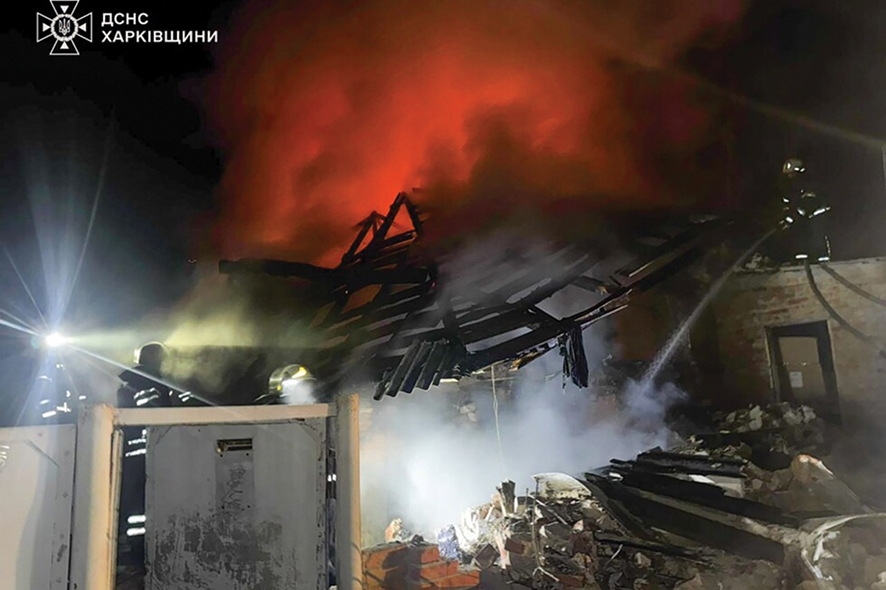
Energy infrastructure was a central target, and this week’s strikes repeatedly caused widespread outages. On February 7, Russia launched a large missile-and-drone attack that Ukrainian officials said hit two thermal power stations in western Ukraine and key electricity distribution elements, including substations and major distribution lines. This prompted emergency power cuts and requests for cross-border support, including imports from Poland. Odesa region was hit again on February 10, when Russian forces struck energy facilities, leaving over 95,000 people without power, with local officials warning that thousands depended on electricity for heat and repairs could take a long time. The week culminated overnight on February 12 with another large-scale strike described by Ukrainian officials as involving “hundreds” of drones and ballistic missiles targeting energy systems. Injuries were reported in Kyiv, Dnipro, and Odesa, and officials said the attacks disrupted power, heating, and water supplies. The operational logic is clear: repeated hits on energy nodes turn restoration into a race against continuing strikes, making even successful air defense a partial shield rather than a full solution.
Ukrainian Retaliation and Deep Strikes
Ukraine’s response combined air defense and long-range retaliation. Kyiv frames its deep strikes as a mirror response to Russia’s energy attacks, aiming to raise the cost for Moscow by targeting refinery output, fuel storage, and logistics supporting Russian forces. This week, Ukrainian drones reportedly struck the Volgograd oil refinery, linked to Lukoil, sparking a fire and forcing local authorities and Russian channels to acknowledge disruption. Ukrainian officials also reported longer-range strikes on Russian military infrastructure, including missile facilities, as part of an effort to complicate Russia’s ability to sustain high-tempo missile salvos. In occupied and near-front areas, Ukraine struck fuel and lubricants depots and other military facilities, highlighting a sustained focus on Russian rear support rather than purely symbolic targets.
Diplomacy Continues
Diplomatic activity continued in parallel with the fighting, but it did not slow attacks. US-brokered talks in Abu Dhabi produced a prisoner exchange of 314 individuals, 157 from each side, and an agreement to continue discussions. Key issues, including Donetsk and other core territorial demands, remained unresolved. Ukrainian officials argued that ongoing strikes, particularly those targeting energy and civilian areas, undermine the credibility of Russia’s negotiating position. The timing of the heaviest attacks this week reinforced that message. On the ground, the battlefield still appears to shape the negotiating table rather than the other way around, with Russia pressing for leverage through incremental advances and infrastructure pressure, while Ukraine emphasizes that any pause without enforceable guarantees risks locking in Russian gains and enabling future coercion.
International Support
International support for Ukraine also advanced this week, especially for sustaining air defense and munitions amid uncertainty over new US appropriations. The United Kingdom pledged £150 million (about $205 million) to the NATO-backed “Prioritized Ukraine Requirements List” (PURL), financing purchases of US-made weapons for Ukraine, a step designed to keep air-defense and other critical systems flowing. Separately, EU institutions advanced a large 2026–2027 support framework tied to financing Ukraine’s budget and strengthening defense industrial capacity. On Wednesday, the European Parliament announced it had approved a €90 billion loan for Ukraine, providing a financial lifeline to the country four years into Russia’s invasion. MEPs voted by 458 to 140 in favor of the loan, intended to cover two-thirds of Ukraine’s financial needs for 2026 and 2027 and backed by the EU’s common budget – after plans to tap frozen Russian central bank assets fell by the wayside. “Support for Ukraine rests on a small number of countries and most if it comes from Europe,” centrist MEP Nathalie Loiseau said ahead of the vote. While not immediate battlefield game-changers, these measures are crucial in the cumulative math of air defense interceptors, spare parts, and ammunition, precisely the categories strained by Russia’s intensified winter strike campaign.
Compiled by Ana Dumbadze