What happens when artificial intelligence can create almost everything that was once the exclusive domain of humans? In this new reality, technology is no longer the defining competitive advantage for businesses. Trust is.
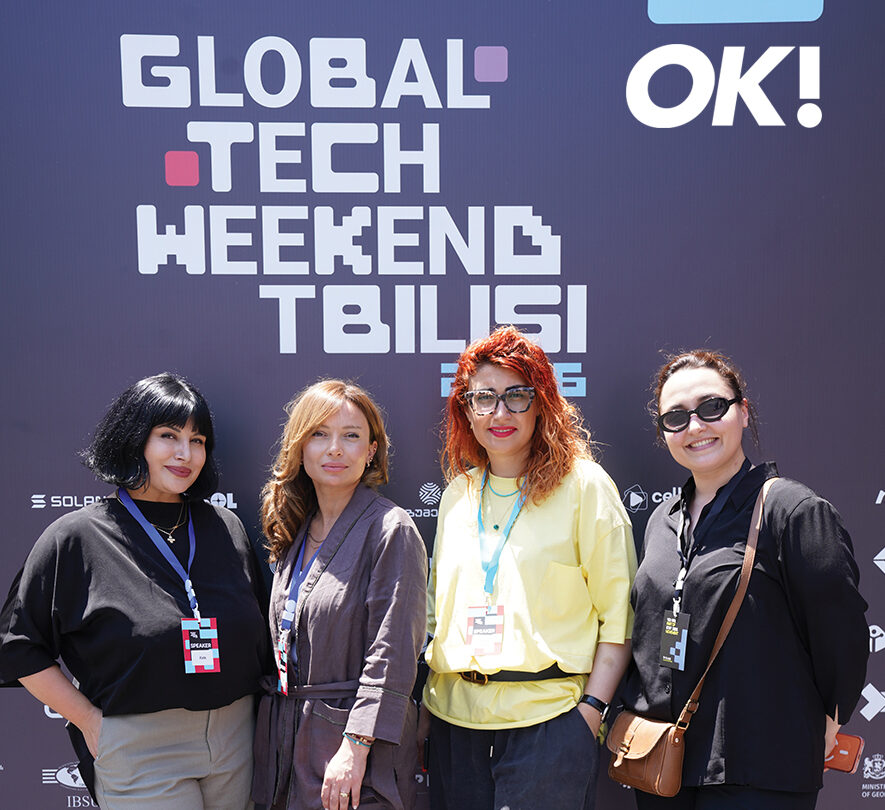
This was the central theme of one of the panel discussions at Global Tech Weekend, where Ketevan Daushvili, Head of Marketing at OK! Magazine Georgia, Natia Jibladze, Co-Founder of CX Hub, and Nino Kurasbediani, Strategic Advisor on Personal Data Protection, explored some of the most pressing challenges facing modern businesses.
The panel delivered a clear message: in the age of AI, technology is simply a tool. Trust is the strategic asset that drives customer loyalty, shapes brand reputation, and determines long term business success.

Ketevan Daushvili Head of Marketing, OK! Magazine Georgia
Global Tech Weekend once again proved to be a platform where conversations about technology extended well beyond innovation itself. The defining strength of this year’s discussions was that, amid the rapid rise of artificial intelligence, digital transformation, and an increasingly dynamic business landscape, the focus shifted to what matters most: people and trust.
During the panel discussion with Natia Jibladze and Nino Kurasbediani, we explored why trust has become the most valuable asset in modern business.
For many years, a company’s competitive advantage was defined by its product. Later, service became the key differentiator, followed by customer experience. Today, however, we live in a world where artificial intelligence, advanced technologies, and digital platforms are accessible to almost everyone. Creating and distributing products, services, and ideas has become easier than ever before.
As a result, the most important question businesses face is no longer simply, What are we selling? It is, Why should customers trust us?
From the perspective of the media industry, this transformation is particularly significant. Today, virtually every brand has its own platform, its own social media presence, and the ability to tell its own story. Yet in an age of information overload, visibility is no longer the greatest challenge. Trust is.
Trust is built when a brand’s promise, the customer’s actual experience, and public perception all align. It is this consistency that creates a strong reputation. No advertising campaign and no technological solution can build lasting credibility if the real customer experience tells a different story.
Another important part of our discussion focused on personal data and the responsible use of technology. Businesses increasingly rely on data to better understand their customers. However, people only entrust organizations with their personal information when they are confident it will be handled responsibly and used to create genuine value. That is why data protection is no longer simply a matter of regulatory compliance. It is an essential part of building trust.
Artificial intelligence offers businesses extraordinary opportunities. It enables faster decision making, deeper analytics, more personalized experiences, and more effective communication. Ultimately, however, AI cannot replace trust. Technology can improve processes, but lasting relationships can only be built through responsibility, transparency, and a genuine commitment to customers.
That is why I believe the future belongs to companies that successfully balance technological progress with human values. The winners will be the brands that are not only innovative, but also trustworthy.
Global Tech Weekend once again demonstrated that when we talk about the future of business, technology is only a tool. Trust remains the true competitive advantage, the value that is the most difficult to replicate and is rapidly becoming the most important currency of the new economy.

Natia Jibladze Co-Founder, CX Hub • Customer Experience Management Agency
CX Tech & AI Systems Lead | TBC
AI does not transform customer experience. It amplifies the experience that already exists, whether it is shaped by well designed processes or by processes that still need improvement.
Today, it is difficult to find a company that is not talking about artificial intelligence. AI is no longer a concept for the future. It is today’s business reality. Yet the faster organizations adopt new technologies, the more important one question becomes: Is the business truly ready for AI transformation?
The answer cannot be found in technology alone.
During the OK! Magazine panel at Global Tech Weekend, we discussed artificial intelligence, customer experience (CX), employee experience (EX), trust, and the responsible use of personal data. My central message was straightforward: AI transformation cannot succeed unless it is preceded by a thorough understanding, evaluation, and redesign of both the customer and employee experience.
We often assume that technology automatically solves problems. In reality, it simply accelerates what already exists. If an organization’s processes are inefficient, employees are confused, or customers are frustrated, AI will not resolve those issues. On the contrary, it will make them more visible and spread them more quickly.
That is why, when planning transformation initiatives, I often say:
“If we digitize a broken experience, we are simply scaling disappointment.”
Today, businesses no longer compete solely on price, products, or services. We already live in the Experience Economy, where customers choose the brands that make them feel understood, valued, and supported. In this environment, trust has become both a company’s most valuable asset and one of its most important forms of economic capital.
According to Bain & Company research, 80 percent of companies believe they deliver an outstanding customer experience, while only 8 percent of customers agree. This gap demonstrates why customer experience must be managed strategically and systematically. Before investing in AI, organizations need to understand their customers’ real expectations, identify the obstacles preventing employees from delivering exceptional experiences, and determine exactly where trust is being lost throughout the customer journey.
Today, at CX Hub, our CX Tech & AI Solutions enable us to analyze thousands of customer calls, chats, and other interactions within minutes. We identify emotional signals, recurring issues, and the underlying causes of customer dissatisfaction. This is no longer simply automation. It is the ability to make informed decisions based on data and CX emotional drivers.
The most successful companies of the future will not define themselves as AI first organizations. They will define themselves as customer first organizations. They will use technology not to replace people, but to understand them better. That is precisely why collaborative CX diagnostics and AI transformation projects have become the most in demand services within our portfolio.
In this context, it is particularly encouraging to see Georgia gaining increasing recognition on the international customer experience map. Today, CX Hub represents the International Customer Experience Awards (ICXA™) across the Caucasus and Central Asia, and we are already preparing to bring the regional CX Awards to Georgia in 2027.
This represents a genuine opportunity for our country to become a place where discussions about creating outstanding customer experiences move beyond theory and become an established business standard.
Before then, this November, we will welcome Georgian and international brands at Wembley Stadium in London, where we will participate as members of the International Customer Experience Awards jury and as partners of the event.
Ultimately, technology can be copied. The experience a brand creates cannot.
Only when we understand exactly where trust is lost, where processes become unnecessarily difficult, and where emotional barriers emerge can we truly improve customer experience and design successful technology and AI transformation initiatives.
That is the competitive advantage that is the most difficult to replicate.

Nino Kurasbediani Strategic Advisor on Personal Data Protection
Every morning, almost without thinking, we make dozens of digital decisions. We unlock our phones, interact with artificial intelligence, share information, make payments, work, learn, and create. In the process, we often forget that every action leaves behind a digital footprint. Today, that footprint is as valuable as any financial asset.
As a business leader, I can confidently say that technological advancement is one of the greatest opportunities of our time. Artificial intelligence has transformed the way businesses operate, increasing efficiency, accelerating decision making, and creating entirely new opportunities for organizations and individuals alike. At the same time, the faster technology evolves, the greater our responsibility becomes.
Today, personal data is no longer just technical information. It reflects our lives, our choices, our values, and our everyday habits. Behind every data point is a real person with a unique story, a family, emotions, and trust. That is why protecting personal data is about far more than complying with regulations. It is about safeguarding the trust that people place in us every day.
In recent years, we have repeatedly seen that customers no longer evaluate companies solely on the quality of their products or services. They also pay close attention to how transparent an organization is, how ethically it uses technology, and how responsibly it handles personal information. In today’s world, trust has become an asset that takes years to build but can be lost because of a single mistake.
Artificial intelligence raises that responsibility even further. Modern AI systems can analyze data, identify patterns, predict trends, and anticipate customer needs. These capabilities create extraordinary opportunities for innovation. They also require us to continually ask ourselves one essential question: Are we using technology in a way that always places human freedom, dignity, and the right to choose first?
I believe the strongest companies of the future will not be distinguished by innovation alone. They will stand out because they have built cultures rooted in trust. When data protection becomes an integral part of an organization’s daily operations, rather than simply a legal obligation, it creates an environment where people feel secure. That is the foundation on which long term partnerships, customer loyalty, and sustainable growth are built.
As leaders, we must remember that technology is only a tool. Its true value lies in how we use it to improve people’s lives. Ultimately, business success is measured not only by financial performance but also by the trust that people place in us.
I believe that, in the age of artificial intelligence, the most successful organizations will be those that never lose sight of one simple truth: behind every piece of data is a human being.
When we protect personal data, we are, in fact, protecting people, their dignity, and their future.
That is the kind of leadership the modern world expects from us.