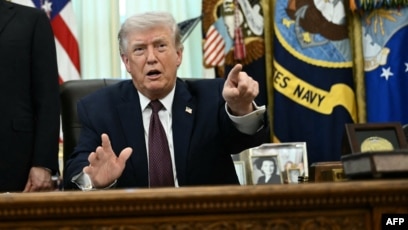
US President Donald Trump has said that the ongoing military operation against Iran could conclude within the next two to three weeks, expressing confidence that the campaign is nearing its objectives.
The remarks come amid continued escalation between the United States, Israel, and Iran, marked by a series of airstrikes on Iranian territory — including targets in Tehran and Isfahan — and retaliatory missile attacks by Iran on central Israel. Both sides have reported casualties and damage to military and civilian infrastructure.
US media reports suggest recent strikes have included the use of bunker-busting munitions against suspected weapons storage facilities, while Israeli forces have also confirmed targeting military sites in and around Tehran. Iranian authorities, in turn, say several people, including civilians, have been killed in the attack.
Despite the intensifying exchanges, Washington has not disclosed detailed timelines or operational goals, and it remains unclear under what conditions the operation would be considered complete. Analysts note that while Trump’s statement signals confidence, the situation on the ground remains volatile, with the risk of broader regional escalation still high.
In recent days, US President Donald Trump has repeatedly stated that negotiations with Iran are progressing well and that Tehran has agreed to most of Washington’s conditions. Iranian authorities have denied these claims. The United States and Iran are reportedly maintaining contact through mediation by Pakistan.
Last week, media outlets, citing informed sources, reported that the United States had conveyed a list of 15 conditions to Iran via Pakistan. These reportedly included abandoning nuclear weapons, limiting its missile program, and reopening the Strait of Hormuz, in exchange for halting military operations. Iran rejected these terms and presented its own conditions, including a complete cessation of aggression, guarantees against the resumption of war, and compensation for damages.
Iran’s Foreign Minister Abbas Araghchi said in an interview with Al Jazeera on March 31 that he has received messages from US presidential envoy Steve Witkoff, but stressed that this does not constitute negotiations.
Araghchi claimed that Iran is prepared to defend itself for as long as necessary. He added that Tehran’s condition for ending the war is the establishment of peace across the entire region.
“Those who supported Donald Trump yesterday are now being forced to pay the price,” he said.
Meanwhile, Iran’s President Masoud Pezeshkian stated that Tehran has the will to end the conflict, provided specific conditions are met, particularly guarantees preventing renewed aggression. Presidential office says Pezeshkian conveyed this position during a phone call with António Costa on March 31.
The White House press secretary Karoline Leavitt announced that President Trump will address the American public at 9:00 p.m. Washington time on April 1, with what was described as a “major update” on Iran.