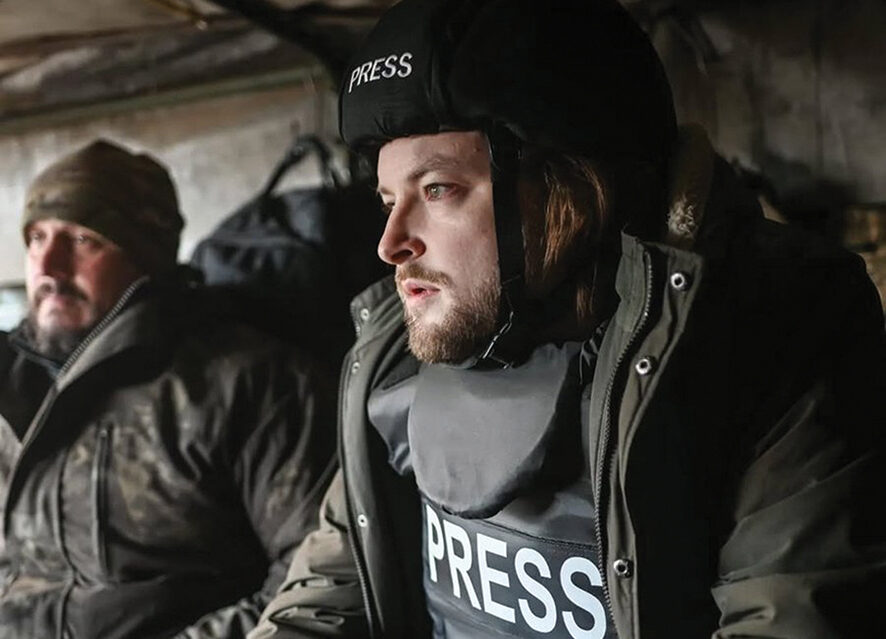
This might be Ukraine’s worst winter yet, – warns Neil Hauer, a field correspondent recently returned from Ukraine’s front lines. In this interview with RFE/RL’s Georgian Service, Hauer describes how the war has transformed into small-unit, drone-dominated combat — and how the “front line” itself has dissolved into a deep, chaotic combat zone. He discusses morale and manpower strains, the battle for Pokrovsk, and why Russia’s updated strike tactics could make this winter the hardest since 2014.
You’ve recently returned from Ukraine. What’s the situation on the front lines?
The situation on the front line is shockingly different from how it was two years ago. In terms of combat, it’s almost unrecognizable. Whereas before, in the first two years or so of the war, it resembled a conventional conflict, with tanks, artillery, aircraft, armored vehicles, and the like, now it has shifted to a war fought by very small unit formations.
Soldiers are literally operating in pairs or groups of three at most, using motorbikes for mobility more than anything else. In most cases, they can’t bring armored vehicles within 10 or 15 kilometers of the front lines without being absolutely pummeled by FPV (first-person-view) drones. Drones are everywhere, dominating the battlefield.
So the war has gone from one defined by heavy armor and Russian artillery superiority to one dominated by small arms and drones — men and machines as the two major components.
One Ukrainian officer you spoke to said, “There is nothing resembling a front line anymore.” What does that mean in practice?
Yes, absolutely. Since you can’t have more than three or four guys in one position without it becoming an immediate target for drones and being destroyed, the battlefield is now composed of very small, isolated outposts spread along the front.
The other key factor is Russia’s evolving strategy. In many cases, Russian forces don’t try to engage and destroy every Ukrainian position. Instead, they simply bypass them — often literally charging past on motorbikes. During these assaults, they take enormous casualties, sometimes 90 to 95 percent losses. But even if just a few soldiers make it through, they’ll reach a position behind the Ukrainian lines, dig in, get resupplied by drones, and wait for reinforcements to arrive. From there, they push further.
As a result, the front line now looks like a series of dots — scattered Russian and Ukrainian positions spread over several kilometers. The “front line” has effectively become a front zone, five kilometers deep. In some areas, the Russians are ahead; in others, the Ukrainians are past them. It’s messy, overlapping, and constantly shifting.
So as a Ukrainian soldier, you might be defending the front line — and still have the enemy behind your back?
Yes, absolutely. That happens very, very often.
What’s the mood among Ukrainian troops? We hear so often about their unshakable morale. Has it held up after three and a half years of war? Is that a finite resource?
That’s a good question — and one you have to approach indirectly. When you talk to soldiers, they don’t often speak about being exhausted or having morale problems. But you have to remember that those who do have morale problems aren’t there to give you quotes: they desert.
Desertion is a huge problem for Ukraine, and it’s getting worse. There was a figure published just yesterday showing that last month had the highest desertion rate of the war so far. Some troops leave and come back; it’s become a de facto way for people to blow off steam or take time away from continuous frontline service. Others leave to join different units, often because they think their officers are incompetent and going to get them killed.
The desertion rates are now bad enough that there are actually fewer infantry in the Ukrainian Armed Forces than there were two years ago, even though the total size of the military is larger. So on the surface, morale may look fine, but if you look at the numbers, it clearly isn’t.
What’s the critical threshold here? How close is Ukraine to reaching it?
That’s a great question, and one no one really has an answer to. But the effect is already visible: there simply aren’t enough men to cover every area of the front.
That’s why Russia has been able to break through more easily in some urban areas. The battle for Bakhmut, for instance, took almost a year — from late 2022 into the summer of 2023. But in Pokrovsk, Russian troops entered the city and were active in about 75 percent of it within two or three weeks. A huge factor in that is Ukraine’s shortage of manpower.
Of course, Russia has its own limits. They’re having to pay ever higher sums to get men to sign up. So manpower isn’t an infinite resource for them either. The big question is which side will crack first. This war increasingly feels like an unstoppable force meeting an immovable object.
Does Ukraine have a plan for solving the manpower problem?
Several Ukrainian officers I spoke to believe the issue can be solved without dropping the draft age to 18–25. They argue the real solution lies in reforming the armed forces — specifically by holding incompetent officers accountable.
Many soldiers desert because of poor leadership. There’s a large number of officers in the Ukrainian army who are simply unqualified or reckless, yet face no consequences for disastrous decisions that cost lives again and again. This discontent has been building for two years and is now being voiced more openly.
Soldiers are speaking publicly because private complaints haven’t worked. Many hope the top levels of the army command — and the president’s office — will finally impose real accountability.
Let’s talk about Pokrovsk. The Kremlin reportedly pushed its deadline to capture the city from November 15 to December 15. Does it look imminent that Pokrovsk will fall?
It does seem like a foregone conclusion at this point. Russian troops are active in three-quarters of the city — consolidated in some areas, still infiltrating in others. The pocket around Pokrovsk and Myrnohrad is nearly cut off.
One hopes that the Ukrainians have already withdrawn most of their troops, because otherwise they risk operational encirclement. If the pullout isn’t complete by the end of the year — if Ukrainian units are still in that area by December 31 — it’s likely not a good sign. They’re probably taking very heavy casualties and struggling to withdraw altogether.
What would the fall of Pokrovsk mean strategically and tactically?
It would leave very little of Donbas under Ukrainian control. After Pokrovsk, only a handful of major urban centers remain. Konstantynivka, for example, is already three-quarters encircled, with Russians gaining a foothold inside. It’s not a good scenario.
Lyman is in an equally bad position — almost cut off from resupply, accessible only across the river, and being relentlessly shelled. Then there are Slovyansk and Kramatorsk, which used to be the two untouched bastions in Donbas. But now, in the past month or two, Russian FPV drones have started operating inside those cities too, targeting both civilians and military personnel.
That’s essentially what’s left — four major cities, two of them already in serious trouble.
Could the fall of Pokrovsk affect peace talks? Some argue that such losses might force Ukraine into negotiations or even accepting Russian terms.
Yes, but people who argue that have been saying the same thing for three and a half years — after every setback. It doesn’t change much. The Russians still demand what they did on day one: complete capitulation. That’s not remotely acceptable to Ukrainians.
Even if Europe and the US cut off all support tomorrow, Ukraine would keep fighting under those conditions. It would be much harder, but they’d still fight. So we’re not any closer to a negotiated settlement than before.
Fighting is also intensifying in Zaporizhzhia and Kharkiv. Are those the next targets after Pokrovsk, or will Russia focus on taking all of Donbas first?
Donbas definitely remains the main focus. In the Kharkiv region, the situation isn’t great — the city is contested — but it’s not yet critical for Ukraine. The Russian push toward Zaporizhzhia, however, does seem to have some momentum. We’ll have to see how far they can take it.
Finally — what is Ukraine facing as winter approaches? How bad could it be?
All indications are that this might be the worst winter yet. The winter of 2022–2023 was the hardest to date, but Ukraine learned lessons and improved its resilience afterward. Now, though, Russia has changed its tactics — targeting the transmission points of the electrical grid instead of just the generation sites.
That’s already caused blackouts even in central Kyiv. Most people expect this winter to be Ukraine’s hardest since 2014. It’s going to be a very tough one.
Interview by Vazha Tavberidze