

As the United States and Israel entered the second week of their military campaign against Iran, questions began mounting about the war’s possible endgame, the limits of air power, and whether Washington ultimately seeks regime change, or simply compliance. In an interview with RFE/RL’s Georgian Service, retired US Army colonel and former Pentagon spokesperson Myles B. Caggins III says air supremacy gives Washington a decisive operational advantage, but does not guarantee a quick resolution. He argues that a ground invasion would be extraordinarily difficult, while predicting that the United States will ultimately push Iran toward negotiations and the emergence of a leadership willing to align with American security and economic priorities. The US, he says, will ultimately settle for “an Iran that is in America’s orbit.”
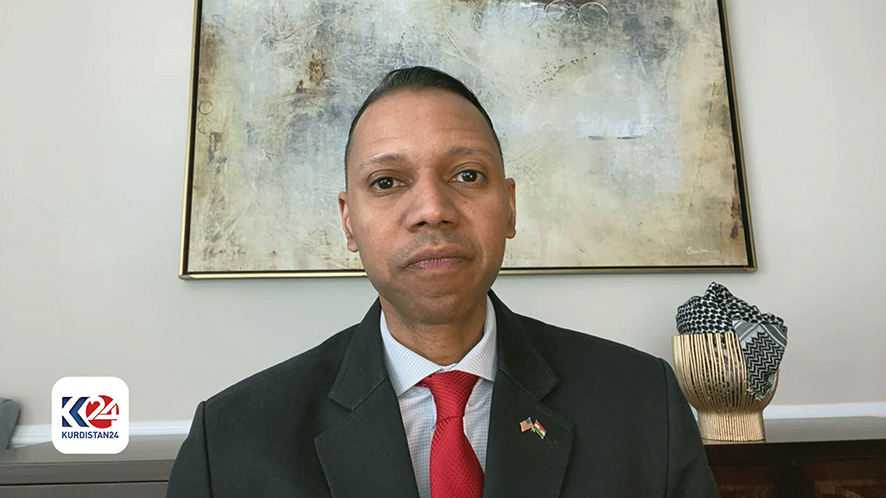
We are entering the second week of this joint military operation. The US and Israel have air supremacy over Iran. How decisive is that advantage, and how much will it shape the final outcome?
The air supremacy is evident by the ability of the two nations to suppress the Iranians’ air defenses, as well as bombing Iranian fighter aircraft on the ground before those planes could ever take off. This has been essential for the air campaign against Iran, which has been waged by multi-rolled fighters, including F-15 Eagles, F-35s, F-22s, F-16s, as well as long range bombers, B-2s, B-52s, B-1s. The entire US Air Force and US Navy have been involved in the air campaign against Iran.
The air supremacy is essential to the final outcome for the US, which is the defeat of the Iranian military, as well as the prevention of Iran’s ability to enrich uranium and create a nuclear weapon.
Iran’s strategy seems to be to widen conflict and basically wait it out. How effective has that been, do you think?
Iran has shown more of a will to fight and more of a capability to fight than many experts anticipated.
They have also shown a willingness to engage neighboring nations, not only on military targets, but also diplomatic targets and commercial assets, including oil production facilities and hotels, and they do not seem to discriminate against who they will potentially hit. The only nation that has not been directly targeted by Iran seems to be Turkey.
But this strategy will likely draw in more state action against them. The Gulf nations have highly capable military forces equipped and trained by the United States. And at some point, it is likely that they will be added to the air sorties.
Looking at this war, how impressed is the rest of the world with US military prowess? How much is this building up US military deterrence?
President Trump’s philosophy is peace through strength. And this war is another example of the strength of the US military. And when I mentioned all services being involved, there are operations happening from the Space Force and operations happening on the ground with Special Operations Forces, so it is the full range of US military muscle involved in this, as well as the significant ability of America to project power.
The world is understanding this, though the world has always been aware of American military power.
President Trump poured water on the idea of Kurds opening a second front. He does not want to see Iran devolve into a civil war
One thing that we’re not talking about as much is the impact of America’s war on Iran over its economic competitors. China is the biggest purchaser of Iran’s oil. Russia and India are also involved in getting oil and other resources from Iran. And now that has all been cut off. So there will be rebalances of power and permissions that have to be granted. And the US will be the primary party that is unleashing or reconnecting Iran’s resources with the world.
So now with the closure of the straits of Hormuz and the likely takeover of Iran’s oil industry by the United States, China will have to make purchases through some US entity that gives the US an advantage over them for this area.
How long can the Hormuz remain closed without the world economy actually starting to recoil?
The Strait of Hormuz can remain closed or mostly closed as long as the ship owners and operators do not think they’ve safe passage. Iran has capability to have attack ships inside of the Arabian Gulf, but it has not waged a lot of direct war on the oil tankers, LNG tankers, and other commercial ships that go through the Strait of Hormuz.
What we will have to see in the next few days, as the war progresses, is some sort of safety guarantee, and perhaps as this war winds down, the Iranian regime will say that they will stop attacking commercial targets, just as the President has said he does not intend to attack regional nations.
If the opposite happens and they continue to attack commercial targets, will that force the US to give out more concessions?
I don’t anticipate the US making any concessions. I think President Trump has primed Americans by explaining that there will be some short-term pain at the gas pumps with higher prices, but that’s the price of freedom. And he has a good 35% of Americans who are very loyal followers to him who will accept paying the higher gas prices in order to eliminate the Iranian regime.
Let’s take a step back, look at the bigger picture and see how we get there. It’s the second week already. Is the end of this war anywhere in sight right now?
War ends for two reasons. One, one side is totally defeated and unable to wage war against its opponent. Or two, the sides come to an agreement to stop the fight. And I anticipate that the President of the United States does not want to have this war go on for weeks, as it is becoming unpopular in the US. And as a result, it is likely that the US and Israel will intensify the campaign.
Of the two scenarios, which seems more likely?
I believe that Iran will come to the negotiating table, surrender, and then there will quickly be terms with an acceptable new leader in Iran to take power. And, likely, there will be some sort of American diplomatic oversight or implementation and verification of what’s happening on the ground.
What are the steps from today to the endgame that the US wants?
We in the West often think of the last successful war, the last successful operation. So in this case, a few weeks ago, the US took over the leadership of Venezuela by installing an acceptable vice president there and then keeping a thumb on them, on President Delcy Rodriguez, who’s in charge now. President Trump has mentioned this several times in interviews.
Iran has shown more of a will to fight and more of a capability to fight than many experts anticipated
But Iran is a much more complex place culturally, geographically. The history is vastly different, and there are various groups who have been opposed to the regime: from the Baloch in southeastern Iran to Kurds in northwestern Iran. The new leader will have to be someone who is able to keep the sovereignty of Iran intact, keep the social, cultural, religious fabric of the Iranian people intact.
That means that the new leader will have to quickly make statements about fairness, equality, protection of rights of minorities, and that the central government in Tehran will continue to provide services and protection for all people.
Do you have anyone in mind from the current leadership or elite? Is there a turban-wearing Delcy Rodriguez out there somewhere?
In my opinion, and I share the opinion of President Trump, the new leader should probably be somebody who’s currently inside Iran. The idea that there can be outsiders who’ve not been in Iran for decades who can just parachute in or waltz in and declare themselves as being in charge is not going to be acceptable for the vast majority of people inside of Iran. I think what will happen is that President Trump and his close associates will choose an acceptable person who rises up out of the negotiations.
No matter how it ends, there’ll be resentment from the side that is ousted. So what will the arrangement be? What kind of Iran would the US settle for?
The US will settle for an Iran that is in America’s orbit, an Iran that guarantees the US priorities of not having a military or proxy forces that threaten the US and its partners and allies in the region or around the world. And the new leader must be one who cuts deals that benefit America’s economic goals. Note, I did not say anything about human rights.
You did not even say anything about theocracy.
Nor did I say anything about democracy or theocracy.
Is that the minimum the US will settle for or is there a point in-between where Iran and the US can meet each other?
The US will be very clear that the new leader in Iran must accede to what the US wants, which is safety and economic guarantees.
So what the US is looking for is not regime change per se, but regime compliance?
Yes, regime compliance. A strong leader who is a submitting subordinate client to the United States.
With the US willing to prop them up with a military presence if needed?
President Trump has said he’s willing to put some troops on the ground. I anticipate that there would be a desire to have maybe regional partners if there are any military forces on the ground, or a small amount of Americans as observers and advisors in Tehran.
What happens if the aerial and naval bombardment is not enough to achieve that kind of scenario? Will the US put boots on the ground en masse?
A ground invasion in Iran would not likely have any rapid success for any reason. The geography, as you mentioned, the population, 90 million people, it’s very difficult to control that amount of people. And there can be cultural fault lines between different groups. There has certainly been a lot of blowback to the idea that Kurdish Peshmerga would go into Iran, even into their own predominantly Kurdish provinces along the west of Iran. There has been strong vocal pushback against that idea by the Iranian diaspora in the United States and some people in Iran. It seems to be stronger voices against the idea of Kurdish Peshmerga going into Iran than actually the resistance to the Iranian regime.
So you don’t buy into this much-speculated idea of Kurds opening a second front?
The Kurds have had a long-term relationship with the United States and with Israel’s Mossad, going back decades, far before the war against ISIS. But President Trump clearly looked at the idea and considered it and yesterday poured water on that idea when he was doing a press briefing on Air Force One. He does not want to see Iran devolve into a civil war. I know some of the leaders of the Kurdish groups and it never would be their desire to go to Tehran or take over the entire nation. They would simply want to protect their own people in their own regions.
Would you go as far as ruling out their involvement altogether?
No. It’s quite possible that Kurdish groups, they’ve now formed a six political party coalition, would choose to go into the western provinces of Iran from across the border with Iraq. Iran and the Iranian-backed militias inside of Iraq see this as a threat.
In the past five days, all of these political groups in Iraqi Kurdistan have had their military positions hammered with drones and rockets. They were hit last night, both their political headquarters as well as military camps.
If they do go in, they won’t go in without US support, right?
The Israelis in the United States have been softening that region and have blasted just about every Iranian military, IRGC headquarters, police headquarters: all the security forces, command and control structures along the western provinces have been blown to smithereens.
This makes it plausible that a small amount of Peshmerga troops could go into those regions. But all-out invasion is unlikely. It is not the desire of the Kurdish Peshmerga to extend their boundaries into the predominantly Persian, Azeri, or Nuristan areas.
Interview by Vazha Tavberidze