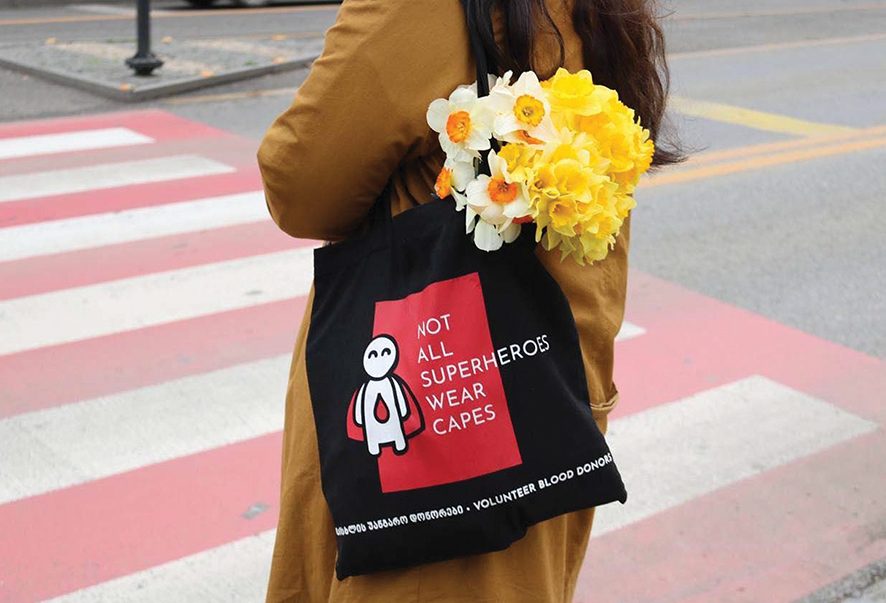
At a time when digital platforms are mostly associated with financial speculation, ride-hailing, or algorithmically curated entertainment, Georgia has introduced a different kind of platform economy: one built not on extraction, but on circulation. The recent initiative launched by Bank of Georgia in collaboration with Selfless Blood Donors and the digital creative agency Windforce transforms blood donation into a civic commons, accessible through a simple registration portal. What began as a project for 8,400 employees and their friends and families has expanded into a national experiment in altruism.
The platform, hosted at blooddonors.bog.ge, functions like an inverted dating app: instead of swiping for companionship, users register their blood type and location, waiting for the moment when their biological compatibility may save an anonymous other.
This is more than a medical utility. It is a reactivation of what anthropologist Marcel Mauss famously called “the gift economy”—a system where the value of exchange is measured not by money but by obligation, reciprocity, and social solidarity.
Blood donation has long carried symbolic weight far beyond the hospital. In many cultures, blood is life-force, a mystical essence binding the individual to the community. From the Aztec sacrifices to Huitzilopochtli, where human blood was offered to sustain the cosmos, to the Christian Eucharist, where the metaphor of Christ’s blood signifies redemption and community, the fluid has always operated as a form of social glue.
Modern transfusion medicine—pioneered in the early 20th century—secularized this symbolic economy.
Yet even in hospitals, blood retains a quasi-sacred status. To give blood is not merely to perform a biological transaction; it is to enter into an ancient continuum of shared vulnerability and survival.
In this sense, Georgia’s digital platform updates what the French philosopher Georges Bataille described as “expenditure without return”—acts of generosity that resist commodification. Unlike the marketplace, where transactions are closed by payment, blood donation opens a cycle of indebtedness: the recipient owes their life not to a particular individual, but to the anonymous collective.
Such models echo other historical experiments in civic altruism. In postwar Japan, for instance, the Red Cross mobilized millions of citizens in a mass blood donation campaign framed as an act of national rebuilding. In Scandinavia, voluntary blood banks became institutionalized as expressions of the welfare state, reinforcing the notion that the body of the individual contributes to the health of the collective.
The Georgian platform, however, introduces a crucial 21st-century element: the logic of the platform society (as theorized by José van Dijck and Thomas Poell). Here, data-driven infrastructures mediate acts of care, transforming altruism into a networked resource. While Uber coordinates cars and Airbnb distributes apartments, this platform orchestrates veins and arteries.
Blood donation platforms reveal a paradox of modern life: the digital systems often blamed for isolation, distraction, and commodification can also generate forms of solidarity that echo the deepest anthropological structures of society.
Georgia’s experiment resonates with a broader trend. In China, the “Mutual Help” app connects patients with rare blood types to potential donors, functioning like a grassroots insurance mechanism. In the United States, initiatives like “Blood4All” emerged during the COVID-19 pandemic to coordinate volunteers amid shortages. Each of these reflects an attempt to reimagine the commons in a digital key—a shared resource sustained not by the state or market alone, but by networked citizens.
Anthropologist David Graeber once argued that debt and obligation are the primordial glue of societies, more fundamental than markets. Blood, circulating outside monetary exchange yet binding individuals through life-debt, may be the most visceral example.
If Georgia’s platform succeeds, it may point toward a new model of digital humanism—technologies designed not only to extract value but to facilitate solidarity. It also raises difficult questions: How far should corporations be involved in managing the flows of human life? Can altruism scale without being absorbed into metrics and branding? And what does it mean to entrust our most intimate biological exchanges to databases and algorithms?
What is clear is that this initiative touches something elemental. To give blood is to recognize the fragility of the self and the dependence on others. To build a platform for it is to ritualize that recognition in code and infrastructure.
In an era where “sharing” is too often reduced to retweets and likes, Georgia has offered a reminder of an older, deeper kind of sharing: the literal circulation of life.
By Ivan Nechaev