In the global imagination, safety tends to be measured in statistics, plotted in sober graphs, and narrated through the language of risk. Yet, in Tbilisi, safety after dark unfolds less like a dataset and more like a choreography: subtle, social, and deeply embedded in the rhythms of everyday life.
A recent international survey conducted by the research company GORBI places Georgia at the top of a striking list: around 89% of women respondents report feeling safe walking alone at night. The country appears alongside China and Vietnam as one of the three environments where nocturnal mobility does not automatically trigger anxiety. At the opposite end, Chile, Ecuador, and Mexico emerge as spaces where women most frequently report vulnerability after dark.
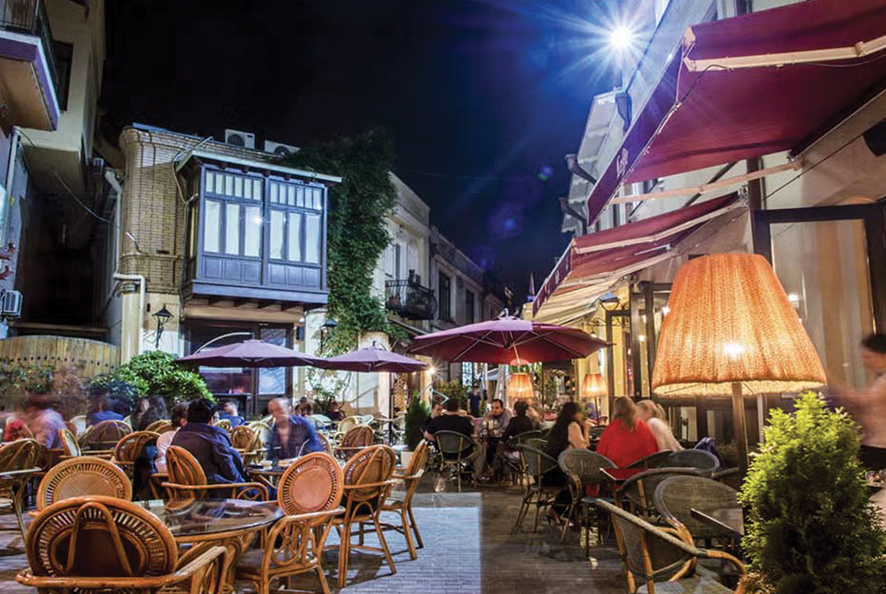
Numbers, however, flatten experience. To understand what “89%” feels like on the ground, one has to walk, preferably without purpose, through the layered geographies of Tbilisi at night: the luminous façades of Rustaveli, the dim stairwells of Sololaki, the semi-private courtyards where conversations hover between balconies like improvised arias. What emerges is a form of safety that is less institutional than relational.
Georgia’s urban fabric produces a particular kind of visibility. In older districts, the architecture itself, shared courtyards, open balconies, porous thresholds between private and public, creates what might be called an ambient watchfulness. People notice. Not in the disciplinary sense of cameras or patrols, but in the quieter, more persistent way of neighbors who recognize footsteps, silhouettes, deviations.
This produces a paradox: the city feels open precisely because it is observed. Sociologists might describe this as a dense network of informal social control. Locals would frame it more simply: “everyone knows everyone.” The phrase recurs with such frequency that it risks sounding like folklore, yet it functions as an organizing principle. To move through Tbilisi at night is to move through overlapping circles of recognition: even when one remains anonymous.
Unlike cities where nightlife fractures into isolated zones, entertainment districts detached from residential life, Tbilisi sustains a more continuous nocturnal ecology. A wine bar spills into a sidewalk that still belongs, unmistakably, to its neighborhood. A techno club pulses beneath a stadium, yet its audience disperses into streets that remain busy, not abandoned. The effect is a night that feels inhabited rather than conquered.
This continuity matters. Safety here is not enforced solely through policing, but through presence: through the simple fact that the night is shared. The woman walking home at 2 a.m. is not alone in an emptied landscape; she is part of an ongoing, if quiet, social field.
The survey’s most delicate implication lies in its cultural substratum. Georgia’s social codes, often described as traditional, still carry a strong emphasis on family reputation. Actions rarely remain individual; they ripple outward, attaching themselves to surnames, to kinship networks, to collective identity.
This has contradictory effects. On one hand, it can generate conservative expectations and unwanted attention, particularly toward foreign women, who occasionally encounter persistent, if usually non-threatening, attempts at acquaintance. On the other, it imposes a boundary: behavior that risks public shame is carefully negotiated, often avoided.
In this sense, emotional expressiveness, so characteristic of Georgian masculinity, coexists with a tacit discipline shaped by communal judgment.
It would be easy, and perhaps comforting, to conclude here: to declare Georgia a rare haven of nocturnal safety. Yet such narratives demand caution.
Firstly, perception is not identical to reality. Surveys measure feelings, which are shaped as much by cultural expectations as by empirical risk. A society accustomed to strong social cohesion may report higher feelings of safety even where structural protections remain uneven.
Secondly, safety is not uniformly distributed. Central Tbilisi differs from peripheral districts; local women may navigate the night differently from migrants or visitors; experiences shift across class, age, and familiarity with the urban environment.
And finally, the very mechanisms that produce safety—tight-knit communities, reputational accountability—can also constrain, surveil, and exclude.
Still, something distinctive persists. Tbilisi at night offers a model that resists easy categorization: neither heavily securitized nor recklessly indifferent, neither anonymous nor oppressively controlled. It is a city that watches itself: through systems and through people.
To walk here after midnight is to enter a space where safety feels less like protection from above and more like a diffuse, collective agreement. An agreement sustained in glances from balconies, in the murmur of late conversations, in the quiet understanding that one’s presence is, in some small way, held by others.
The statistic—89%—lingers as a kind of shorthand. Yet the truth of it resides elsewhere: in the lived texture of the Georgian night, where visibility, familiarity, and social memory intertwine to produce a fragile, compelling sense of ease.
By Ivan Nechaev