As Brussels freezes Tbilisi’s EU accession, Arab capital fills the vacuum to underwrite the consumer economy.
An American logo and Kuwaiti capital. This special edition looks at the franchise ecosystem that carries Western brands into Georgia and tracks who really profits from that business model.
Caucasus Crossroads normally arrives as a weekly read on Capital, Corridors & Control across the South Caucasus. At the beginning of July, a single coffee shop opening told a bigger story than our usual format allows for. So this edition stays with one storefront and follows the money behind it.
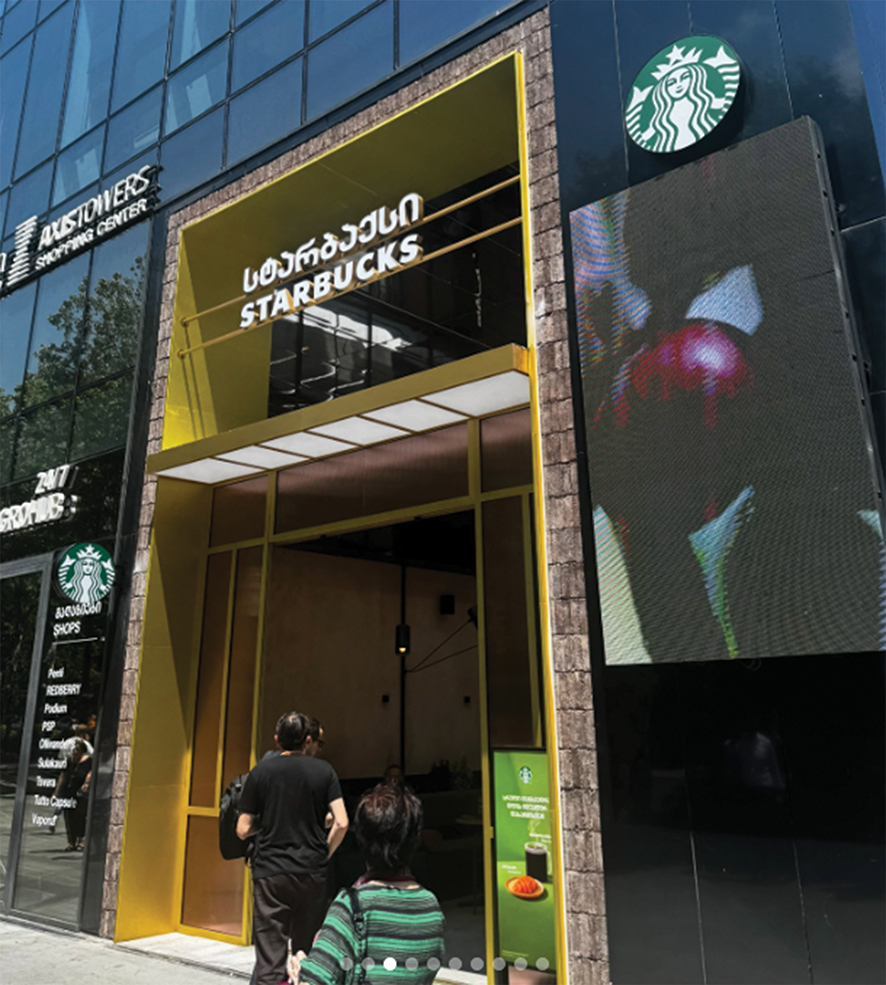
By mid-morning on July 3, a line had formed outside Tbilisi’s Axis Towers on Chavchavadze Avenue. People gathered to snap photos of the storefront on their smartphones. Local media outlets covered the opening as photographers filed images of Georgians queuing for their first cup of Starbucks.
Nobody in that line was desperate for the coffee per se. Tbilisi has no shortage of it — and better versions, dare I say, sit within the same building. What people were lining up for was the moment itself. It was the arrival, at last, of one of the most recognizable consumer brands on the planet, in a country that’s spent years being told its politics were closing doors to the West.
But to understand the full story, look beyond the American brand. The store actually belongs to Kuwait’s Alshaya Group. Lobbying for the deal ran through embassies in Kuwait City and Tbilisi, while the landlord is Georgian. Government officials banked the symbolism months before the state-of-the-art espresso machines were plugged in. Understanding why that unique mix is distinctively Georgian, and what it says about who actually finances the consumer economy here, takes a short detour through geography and one very large family business.
Today, the Arabs arrive by means entirely different from the past. Where once the region’s history was defined by sieges and punitive expeditions, now it is shaped by capital and consumer franchises. A specific risk appetite has made Gulf companies the doorway through which Western brands reach this market.
The biggest retailer you have never heard of
Alshaya Group is not a household name outside the Middle East, though it dominates regional malls. Founded in Kuwait in 1890 as a family trading house, it’s grown into one of the world’s largest brand franchise operators. It runs thousands of stores across the region for names such as H&M, Mothercare, Debenhams and American Eagle. The Starbucks business alone spans roughly 2,000 cafes in 13 markets.
It’s a relationship that began in the Gulf in the late 1990s, and the group already operates the brand in Turkey and, across the Caspian, in Kazakhstan and Azerbaijan. That footprint clearly made Georgia the next stop on the map.
I have spent a decade living and working across the Gulf, where Alshaya’s storefronts are everywhere. To me, the Starbucks announcement reads as that machine adding one more market to its growing portfolio. It’s a point worth pausing over because of the nuance it adds to the local framing. The truth is, Seattle didn’t discover Georgia so much as Kuwait decided to round out its Eurasia presence.
The model itself is standard Starbucks practice. Outside North America, the company has long expanded through licensing partnerships. HQ supplies the brand and standards, while a regional operator puts up the capital, leases the buildings, hires staff, sources dairy products and runs day-to-day operations, while paying royalties back to Seattle. In other words, Starbucks’ own exposure is merely a licensing contract as the real capital at risk actually sits in Kuwait City.
The effort behind the scenes was substantial. Enterprise Georgia, the state investment agency, says it negotiated the entry for years through Georgia’s embassy in Kuwait. Alshaya’s own release credits the Turkish Embassy in Tbilisi as a facilitator alongside the foreign ministry, while Deputy Economy Minister Irakli Nadareishvili has called the arrival a signal to other global investors. It’s an important message given the timing. Think about it: a marquee Western logo arrives in town at the exact moment Brussels starts treating Georgia’s EU candidacy as one in name only. That rupture has seemingly cost the country nothing.
A flag planted on the most aspirational address in town
The location of the first Starbucks branch carries its own message too. Axis Towers is a premier commercial address. Alshaya did not test the Georgian market from a suburban shopping center. Instead, the group planted its flag where the country’s spending power concentrates — a clear message about who the intended customer is. I’ve walked past Axis Towers countless times, and must admit seeing the brand there feels less like a global arrival and more like a regional consolidation of sorts.
It’s also landed right next to the competition, but in a market that already feels ahead of Starbucks’ offering. Coffee LAB, one of Tbilisi’s homegrown specialty chains, actually operates inside Axis Towers.
The wider specialty scene in the city, with roasters like Shavi, Grind, and Slow, matured years before multinationals arrived. These local coffee brands source single-origin beans, experiment with fermentation, and focus on the kind of artisanal precision that some believe isn’t compatible with global supply chains.
Tbilisi went from instant coffee to artisan brews almost overnight. My early media career in London and Abu Dhabi may have been powered by Starbucks, but my palate has officially matured. No offense to the green mermaid, but during my time in Georgia, you’ll find me strictly at Coffee LAB and Shavi. I’m not alone, either; evidence suggests local coffee aficionados are growing sophisticated enough to distinguish between a craft pour-over and an overpriced branded latte.
A large Starbucks latte currently runs about 13.5 lari. That’s broadly competitive with the specialty options at Coffee LAB or Shavi, suggesting the chain is not competing on price or quality but on the brand itself. The open question is what, exactly, those queueing on the opening day were actually buying into. It certainly wasn’t a superior roast. Social media posts suggest it was the familiarity of a globalized experience, the Starbucks effect, if you will, which many already understand as they enter the door. While the company’s answer is consistency at scale, the local market’s answer will likely show up in whether that queue is still there come November.
The shelves were Gulf-run long before the politics soured
Starbucks is just the latest in a long line of Gulf-operated Western brands that have entered this market. Carrefour, the French retail giant, has traded in Georgia since 2012 through Majid Al Futtaim, a Dubai conglomerate that holds the exclusive franchise rights for the brand across the Middle East, Africa, and Central Asia. It’s the sole operator here, and the French parent company has no equity in the local stores.
High street stores often answer to Riyadh through Cenomi Retail, the Saudi-listed group formerly known as Fawaz Abdulaziz Alhokair Co. It operates the franchises for the Inditex portfolio in Georgia, covering brands such as Zara, Bershka, Massimo Dutti, Pull & Bear and Stradivarius. Since September 2025, Cenomi has been part-owned by Al-Futtaim Group, which acquired a 49.95% stake in the business to drive regional growth.
These ownership systems often go beyond the Gulf too. Costa Coffee entered in 2022 through a Turkish airport caterer, with its city rollout franchised to Azerbaijan’s Sarda Group. Dunkin’ (previously Dunkin’ Donuts) runs through Wissol, a Georgian conglomerate that also holds the local rights for Wendy’s and Subway. While Wissol is local, its inclusion in this franchise model highlights how Georgia’s retail market has shifted toward high-volume, multi-brand models that prioritize rapid expansion over the slow-growth, direct investment of the past.
What distinguishes Gulf operators is their appetite for risk. They are structurally comfortable in frontier consumer markets, answer to no political constituency, and can commit while Western boards may be busy pricing headline risk.
The shopfront is running ahead of the statistics
Franchise operations, often facilitated by free trade deals and local partnerships, are a primary mechanism through which Gulf influence now travels. The trouble is that this economic activity is often invisible in standard FDI reporting, as the capital is booked locally rather than as a direct foreign inflow.
Yet, visible or not, Gulf capital has become the commercial bridge allowing Western consumer brands to enter Georgia, and now the wider South Caucasus, on terms set in Kuwait City, Riyadh, Dubai, and Abu Dhabi rather than in Europe or North America. The bridge has so far carried supermarkets, fashion floors, hotels, and now, a major coffee brand.
And if the shopfronts run ahead of statistics, there are signs the skyline might be about to catch up. Abu Dhabi-based Eagle Hills, sister company of the developer behind the Burj Khalifa, has committed 6.5 billion dollars to a massive 6-million-square-meter riverfront development in Tbilisi, paired with a yacht marina in Batumi.
It’s part of a pattern that predates the current political climate, with the precedent set long ago with Poti Port. In 2008, the Ras Al Khaimah Investment Authority bought control and built an adjacent free industrial zone, only to sell that asset years later. In other words, Gulf capital held Georgia’s main Black Sea gateway fifteen years before anyone read such purchases as a geopolitical play.
Zoom out, and the pattern is clear to me: the same strategy has been deployed to the consumer economy with Starbucks as just the latest asset to cross that bridge.
BY JIM STENMAN, Guest Writer
For more from Jim stenman, head over to Caucasus Crossroads on LinkedIn and Substack.