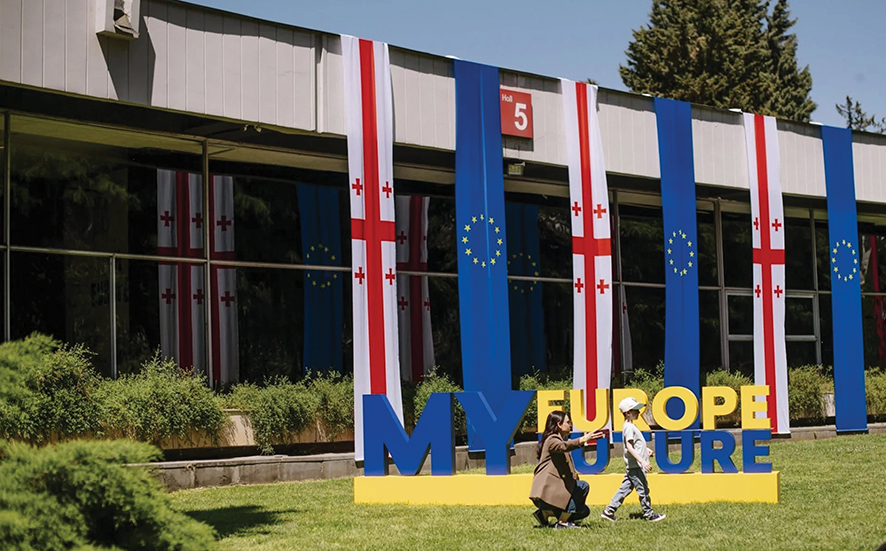
Public support for closer EU ties remains strong across Armenia, Azerbaijan and Georgia, with many citizens linking European integration to economic opportunities, investment and a better future. In Georgia, the European path continues to enjoy wide support, despite growing concerns over the country’s political direction.
Across the South Caucasus, many people still see the European Union as an important partner for their countries’ future. A new regional opinion survey shows that while Armenia, Azerbaijan and Georgia have different relationships with Brussels, citizens in all three countries continue to view EU cooperation as bringing practical benefits, from trade and education to economic development.
The findings come from the 2026 annual survey by the EU Neighbors East program, which asked people in Armenia, Azerbaijan, Georgia, Moldova and Ukraine about their views on EU relations. The research was carried out in January and February 2026 through face-to-face interviews with around 1,000 people in each country.
For businesses across the region, the results show the continuing importance of Europe as a source of investment, market opportunities and economic support.
Georgia: Support for the EU Remains High
Georgia continues to stand out as one of the most pro-European countries in the Eastern Partnership. According to the survey, 71% of Georgians support joining the European Union, while 79% believe EU membership would bring more advantages than disadvantages.
The EU is also the most trusted international actor among Georgians, with 67% of respondents saying they trust the bloc.
However, the survey shows a more complicated picture when it comes to the country’s current relationship with Brussels. The number of Georgians who believe relations with the EU are good has fallen slightly, from 63% in 2025 to 60% this year.
Many respondents feel that Georgia needs to do more to move closer to EU membership. Around 87% said further steps are needed on the European path, while 49% believe the country is currently not moving in the right direction.
Recent political developments have also influenced public opinion. More than half of respondents (56%) said recent laws affecting civil society organizations and media have had a negative impact on Georgia’s EU integration process.
Despite these concerns, many Georgians continue to associate European integration with economic opportunities. Around 76% believe EU membership would create new opportunities, while 75% say it would strengthen the country’s security.
The survey also shows that Georgians recognize the EU’s role in supporting the economy. Some 70% of respondents said they were aware of EU financial assistance to Georgia, and almost half (48%) considered this support effective.
When asked where the EU should play a bigger role, respondents highlighted education and lifelong learning (38%), economic development and trade (34%), and healthcare (33%).
For Georgian businesses, closer ties with Europe already have practical significance. The EU is one of Georgia’s largest trade partners, and the Deep and Comprehensive Free Trade Area (DCFTA), introduced in 2016, gives Georgian companies access to the European market while encouraging them to meet EU standards.
Georgia’s location between Europe and Asia has also increased its economic importance. The country is a key part of the Middle Corridor transport route, connecting China and Central Asia with Europe through the Caspian Sea, the South Caucasus and Türkiye. Infrastructure projects linked to ports, railways, logistics and energy are becoming increasingly important for Georgia’s future growth.
Armenia: Growing Interest in European Links
Armenia has seen growing public support for closer relations with the EU. The survey found that 72% of Armenians consider relations with the EU to be good, while 56% trust the bloc: higher than any other international actor included in the poll.
Around 45% of Armenians have a positive image of the EU, and support for EU membership has increased to 54%, nine percentage points higher than in 2025. Meanwhile, 63% believe joining the EU would bring more advantages than disadvantages.
The results come as Armenia has been seeking to expand its international partnerships. In recent years, the country has increased cooperation with the EU in areas including economic development, governance reforms, education and security.
For Armenian businesses, closer European ties represent opportunities for investment, technology cooperation and access to new markets.
Azerbaijan: EU Cooperation Driven by Trade and Energy
Azerbaijan’s relationship with the EU is shaped largely by economic cooperation, particularly energy and transport.
The survey found that 62% of Azerbaijanis believe relations between their country and the EU are good. However, public perceptions of the EU are more mixed, with 22% holding a positive view, 42% remaining neutral and 8% expressing a negative opinion.
71% of Georgians support joining the EU, 79% believe EU membership would bring more advantages than disadvantages
Awareness of EU financial support is relatively high, with 63% of respondents saying they know about EU assistance programs. Nearly half (45%) believe this support has been effective.
Azerbaijanis said they would like to see greater EU involvement in economic development (39%), education and exchange programs (33%), and easier visa procedures (29%).
Energy remains the main pillar of EU-Azerbaijan relations. Azerbaijan supplies natural gas to European markets through the Southern Gas Corridor, which has become an important route for diversifying Europe’s energy sources.
The country is also an important link in regional transport plans. Its location on the Caspian Sea makes it a key part of the Middle Corridor, which aims to improve connections between Central Asia and Europe.
Europe’s Role in the South Caucasus Economy
The survey shows that the EU remains an influential partner across the South Caucasus, but the reasons vary from country to country.
In Georgia, public support is strongly connected to hopes for EU membership and economic development. In Armenia, European cooperation is increasingly viewed as a way to diversify partnerships and strengthen economic opportunities. In Azerbaijan, energy, trade and connectivity remain at the center of relations.
For businesses, the region’s future opportunities will depend on how effectively countries can attract investment, improve infrastructure and adapt to international standards.
The survey also highlights the importance of information. In Georgia, only 40% of respondents said they had recently received information about the EU, while 86% identified disinformation as a national security threat.
As the South Caucasus becomes more important for trade routes, energy networks and regional cooperation, the relationship between Europe and the region will continue to be impacted not only by politics, but also by economic interests and everyday opportunities for citizens.
By Team GT