Samegrelo is arguably one of the greenest regions in Georgia. Travelers are drawn here not only by its natural riches—magnificent canyons, waterfalls, and unique flora—but also by its profoundly rich historical and cultural heritage. It is impossible to truly know Georgia without visiting this land, where ancient myths of the Golden Fleece, the Argonauts, and Medea come to life at every turn, and where every path preserves the memory of centuries.
It is difficult not to fall in love with Samegrelo; it is not just a land of scenic landscapes, but a place where the food is incredibly delicious! In Samegrelo, the birthplace of adjika and elarji, the cuisine is spicy, piquant, and peppery: a unique fusion of passion and tenderness. I will share more about our gastronomic discoveries later.
First Impressions: From Martvili to Tuscany
Our acquaintance with the region began in Martvili. Shunning the main highways in favor of backroads, we discovered new charms at every mile. The hilly terrain and certain botanical features often reminded us of the Tuscan countryside. Our car glided smoothly from hill to hill, crossing one river after another, revealing more and more wonders, both natural and man-made. Here and there, the ruins of ancient fortresses and the silhouettes of old churches loomed on the hillsides. Samegrelo is filled with air, vastness, and a sense of freedom!
The Architecture of Hospitality
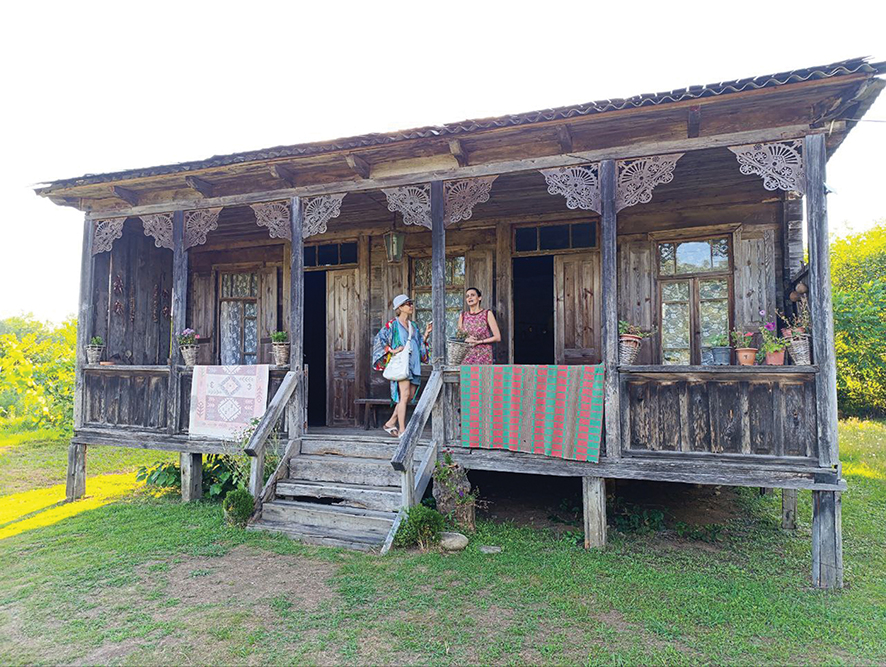
The spirit of a place lives in its architecture. In Samegrelo, every house feels like a distinct personality: large, spacious dwellings where there is always enough room for guests. Typically, Megrelian houses are built on stilts and adorned with intricate grand staircases. This “competition” in elegance and craftsmanship has become one of the region’s hallmarks. Some houses are antique timber structures, while others are stone with carved wooden balconies or elaborate mosaics. It felt as if every house was flirting with the traveler, winking warmly from its manicured garden or lawn, inviting us in. Because of this, it was quite hard to restrain ourselves from stopping every few yards to take photos.
A Garden of Eden
In the early 20th century, Arthur Leist, a German publicist and passionate admirer of the Caucasus, described Samegrelo as the region with the lushest vegetation in Georgia, noting that its lowlands resemble a magnificent garden while the highlands possess the diverse charm of southern mountain landscapes:
“Every village is encircled by a wreath of orchards planted with poplars, mimosas, mulberry trees, and acacias. Between them bloom massive rose bushes and wild grapes, while honeysuckle vines entwine the trunks and branches of trees rising above the flowering grass. In the forests stand mighty oaks, elms, boxwoods, beeches, and maples, alongside rhododendrons, azaleas, laurel, noble chestnuts, and ferns as tall as a man.”
Martvili Canyon: One of Georgia’s Wonders
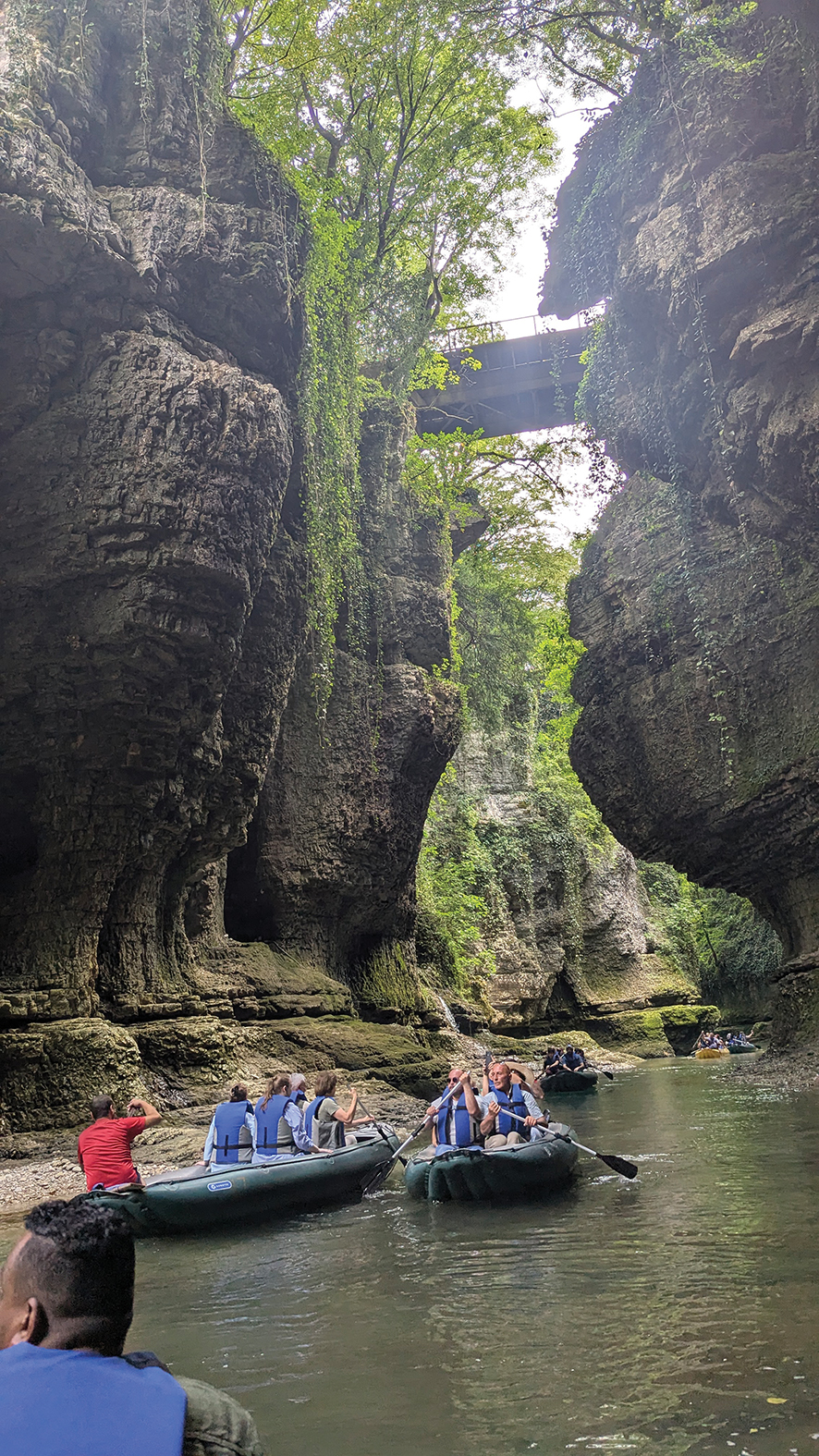
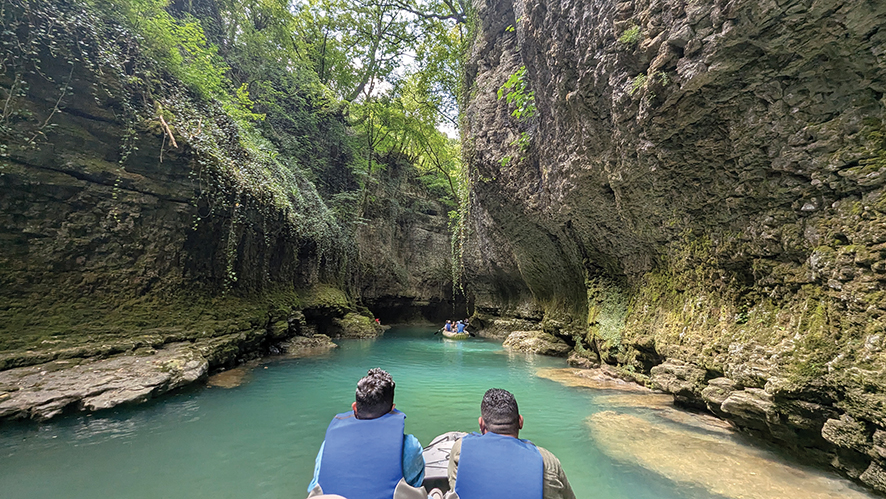
In Martvili, you will find one of the true marvels of Georgia: the picturesque canyon located in the village of Gachedili. This deep gorge, carved into limestone cliffs by the Abasha River, remains cool even on the hottest days, making it the perfect sanctuary from the summer heat.
The canyon is divided into two parts: the upper and the lower. In the upper section, you can take a boat ride, admiring the sheer cliffs covered in moss and vines, as well as the cascading waterfalls. The total length of the canyon is 2,400 meters, with a 700-meter hiking trail and a 300-meter boat route. The lower part is equipped with walkways, bridges, and observation decks that offer stunning views of pristine nature, lush greenery, and abundant water.
They say that in prehistoric times, the nature here looked exactly as it does in Martvili. And now it’s clear, without any exaggeration: this truly was a promised land! The canyon has yielded dinosaur tracks and the fossilized remains of ancient animals, making it a unique paleontological site as well.
The reserve was officially opened in 2018. Before that, these places were wild and known only to the “initiated.” Yet, in the last seven years, over 1.5 million people have visited! The canyon is now one of the top ten most popular tourist destinations in Georgia.
Ani Tsikarishvili, from the information service, told us how life for the locals changed after the canyon became a protected reserve: “Business took off for everyone here! All five hundred people living in the village are involved in tourism. Those who had been working abroad returned home and opened guest houses or restaurants. Usually, entire families work together: the older generation hosts guests and introduces them to our customs, while the younger ones work as guides or run shops right at the entrance to the reserve.”
It is clear that the economy in the Martvili district is thriving. But what is happening to the pristine nature? Those who remember these places before their “commercialization” shrug sadly: “The Martvili Canyon has lost its original charm!” It is the eternal dilemma: how to find a compromise between development and the preservation of unique natural treasures.
Fortunately, there are still many other, less explored places around this canyon.
“Big Oak” Monastery
In pre-Christian times, mercy was a foreign concept (though we modern people are gradually returning to that). On Mount Chkhundidi (which means “big oak” in Megrelian), where the Martvili Monastery now stands, there grew a massive tree. Beside it, every mother was obliged to sacrifice her firstborn son, who would be burned next to this oak. There was a belief that if this custom were broken, the oak would die, and the world would come to an end. Naturally, the “bloodthirsty” oak flourished on the ashes of infants. However, the tree was particular about its offerings; it was only considered accepted if the smoke rose in a straight line.
When Andrew the First-Called came to preach in Martvili in the 1st century AD, he showed the people the folly of their superstitions: the oak was cut down, but the end of the world did not come. “The Christian faith sought, first and foremost, to go where customs and morals were particularly cruel,” Albert Khuntselia, from the Martvili Local History Museum, explained to us.
“When Strabo sailed to Colchis, he thought he would encounter savages, but it turned out that they even had currency in circulation!” our guide told us proudly, pointing to a display of numismatic findings from archaeological digs. “Colchian tetri, silver coins, were in use as early as the 6th century BC! Roman and Greek money were also found here, which speaks to the close trade ties Colchis had at that time.”
Khuntselia gave us a tour through the history of his homeland. Having worked here for 35 years, he knows the museum collection, with its extensive ethnographic corner, by heart. On the old geographical maps, we could clearly see how, in prehistoric times, the sea in the South Caucasus gradually receded, freeing up more land where human settlements began to appear much later.
We took a cable car up to the Martvili Monastery, a place of blissful rest for the mind and soul, offering peaceful views of the surroundings. On the mountain where the “bloodthirsty oak” once stood, there is now a beautiful Orthodox church, which serves as the burial vault for the masters of this region, the Dadiani princely family. We were lucky enough to arrive at the monastery in the evening, when there wasn’t a single visitor. An ideal island of silence, peace, and harmony!
The Colchian Lowland visavis Colchian Mentality
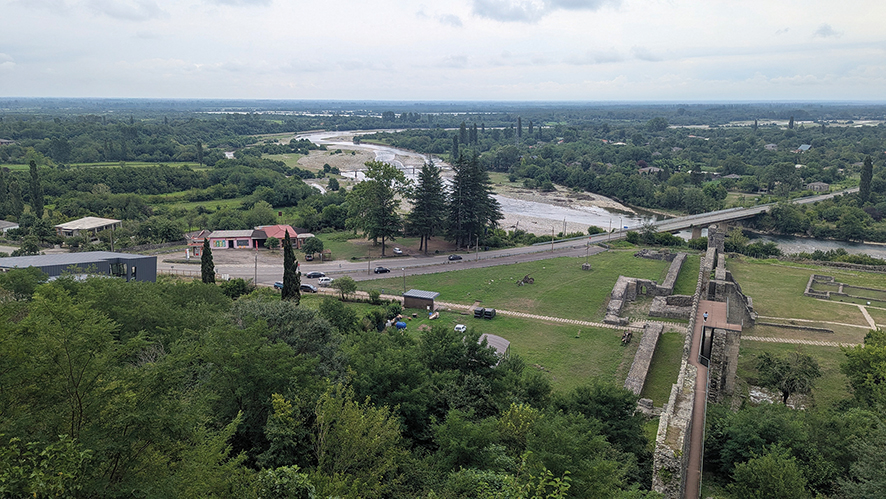
Enjoying the views of the endless Colchian Lowland, it is easy to transport yourself back to antiquity and imagine this region as the Greek Argonauts might have seen it (in the 13th-12th centuries BC): dense, ancient forests, impassable swamps, and severe, mysterious, and independent people. The Colchians were famous for their timber and flax. They traded with Hellas, supplying ship timber, ropes, canvas, honey, and wax. The Colchians had many unusual traditions. In particular, they buried their dead in leather sacks suspended between trees. Is this why the funeral traditions in Samegrelo are still so different from other places?
The Colchians possessed the Golden Fleece, and perhaps that is why the ancient Hellenes, unlike many other neighbors, did not consider them barbarians. Historian Lasha Jikia from Zugdidi explained to us: “The Golden Fleece is not necessarily gold in the literal sense. The fleece is more likely the knowledge of how to mine gold and silver, and how to produce metals, bronze, and iron.”
In reality, Ancient Colchis was known for its metals, precious, and semi-precious stones. Consequently, the Colchians’ jewelry-making was at a high level.
The ancient Hellenes embodied the most striking traits of the ancient Colchians in the figure of King Aeetes: steadfastness, severity, and impressiveness. It is no coincidence that only his own daughter, Medea, a sorceress and servant of the goddess Hecate who fell hopelessly in love with the leader of the Argonauts, Jason, could defeat him. But more on that later.
Colchians loved to prove their courage to others, for example, by stealing someone else’s horse. This was an act of bravado and, simultaneously, a testament to their fearlessness. A horse was a subject of pride and wealth for every family, a symbol of prosperity, and a horse skull was an amulet protecting the house from misfortune and the “evil eye.”
Of course, the poor stole horses from the rich, which speaks to a desire for justice that has long been inherent in the people of these parts. It is no coincidence that the Georgian national hero, the abrek Data Tutashkhia, a protector of the weak and an eradicator of evil, hails from these parts.
The Art of Kidnapping a Bride and Making Her Happy
If a young daredevil was lucky enough to steal a horse, he could safely move on to the next stage: getting married. But first, the bride also had to be… kidnapped. To us, coddled representatives of the “enlightened era,” it might seem that bride theft is a purely symbolic act, where a guy and a girl simply agree on the upcoming wedding. But in most cases, that is far from the truth.
In a picturesque village near Martvili, we visited a large, friendly family whose head proudly told us that 25 years ago, he had stolen his future wife with his own two hands! “Previously, in seventy percent of cases, weddings were held after the bride was kidnapped,” admitted the spirited Goga (name changed). “But, back then, it wasn’t considered a crime, and even the police sometimes helped with the affair. My friends helped me.”
“And did your beloved not resist at all?” “Oh, she resisted plenty: she cried, screamed, and cursed everything under the sun!” Goga recalled. “But, later, she accepted it, and look how well we live together now!”
We asked Nana (name changed) if her husband was telling the truth. “Yes, at the time of my kidnapping, I didn’t know Goga at all, I had only seen him a couple of times from afar. He kidnapped me in front of the cinema, where I’d gone with a friend. I cried, I screamed, and then for a long time I was upset and depressed. The first few years were difficult for me, while I adapted to the new family, the new home, and a strange man, but now, really, look: Goga and I have a large, friendly family, three children and grandchildren, and I am happy. And I am not complaining!”
It seems Nana was exceptionally lucky! I suggest leaving this topic without comment, as everyone can draw their own conclusions. I will note only one thing: times have changed. When we asked his eldest son, Giorgi, if he intended to kidnap a bride for himself, he replied: “No. Actually, I’m waiting for someone to kidnap me!”
Who knows, maybe the tradition of kidnapping everything in sight was brought to Colchis by the ancient Hellenes themselves, who committed the “kidnapping of the millennium” there: stealing away the Colchian princess along with the Golden Fleece!
Blog by Tatjana Montik
Tatjana Montik – journalist, author, and passionate admirer of Georgia – has spent the past 15 years living in and reporting on this captivating South Caucasus country. See more of her experiences in her new travel diary and cultural guide, Georgia: A Tapestry of Time and Space.