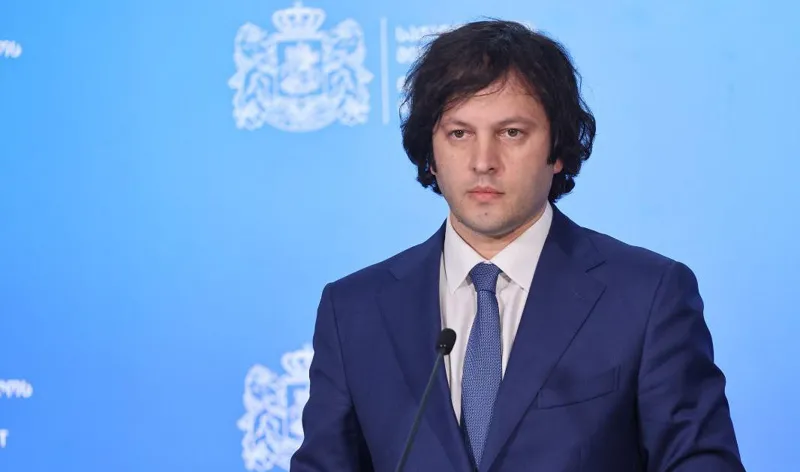
Georgia’s Prime Minister, Irakli Kobakhidze, has announced plans to significantly strengthen the country’s migration policy, stating that the government aims to reduce illegal migration to zero.
Speaking during an interpellation session in Parliament, the Prime Minister said that preserving Georgia’s national and religious identity remains a core state priority, and that stricter migration control forms part of this broader objective.
“We aim to tighten our approach as much as possible and to reduce illegal migration to zero in our country,” Kobakhidze declared.
The Prime Minister claimed that the migration strategy adopted in 2020 relied largely on less tangible or indirect measures. He indicated that the government is now preparing an updated strategic document that will introduce more effective enforcement mechanisms and clearer operational tools for combating illegal migration.
As part of the government’s current plan, approximately 4,000 individuals residing in Georgia without legal status are expected to be expelled this year. Kobakhidze suggested that if such measures continue consistently, illegal migration could be fully eliminated within the next few years.
The Prime Minister also pointed to growing public interest in the migration policy, both domestically and within European Union member states. He noted that several EU countries are experiencing demographic shifts due to increasing migrant populations, implying that Georgia seeks to avoid similar trends.
“You can observe how the proportion of migrants in the population is increasing in certain EU member states,” he stated, emphasizing that Georgia must act proactively to protect its demographic and cultural balance.
Migration management has become a politically sensitive issue in Georgia in recent years, particularly amid broader regional instability, shifting transit routes, and evolving relations with the European Union. While Georgia has maintained visa liberalization with the EU since 2017, the government has repeatedly stressed the importance of demonstrating effective border management and internal migration controls.
Kobakhidze dismissed circulating rumors and speculation regarding the government’s policy, calling them politically motivated. “From start to finish, these are driven by political interests,” he said, insisting that the measures being implemented are part of a coherent and transparent state strategy.
The updated migration framework is expected to clarify enforcement procedures, strengthen institutional coordination, and define clearer legal grounds for expulsion and status regulation, as the government seeks to balance international commitments with domestic policy priorities.