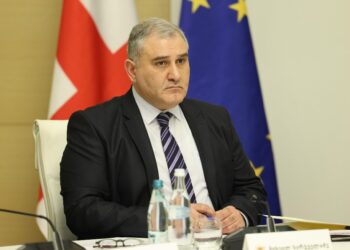

Shalva Papuashvili, Speaker of the Parliament of Georgia, says recent developments linked to Venezuela highlight what he describes as the irreversible decline of the European Union’s influence as a global geopolitical player.
In a statement posted on social media, Papuashvili reiterated that Georgia’s government has two “unchanging” priorities: restoring the country’s territorial integrity and ensuring the welfare of its citizens. He stressed that, in matters of territorial integrity, there is no room for “political sentiments or illusions,” adding that any state that does not recognize Georgia’s territorial integrity “can never be a friend of the Georgian people.”
Papuashvili claimed that international law has traditionally been the main safeguard for small states like Georgia, but its role is now steadily diminishing. He argued that the international order established after World War II has effectively collapsed, a reality that Georgia, as an ancient nation, has long understood through historical experience and survival amid repeated geopolitical upheavals.
Commenting on internal political dynamics, Papuashvili accused certain opposition groups of relying on foreign influence after failing to secure popular support at home. He claimed that recent global events have “removed masks,” exposing what he described as unpatriotic forces hoping for external intervention to gain power.
Papuashvili also pointed to what he called a “brief operation” in Venezuela as further confirmation that the European Union no longer functions as a guarantor of international order. He alleged that Brussels selectively exploits breaches of international norms when it serves its own interests, citing EU actions toward Georgia as evidence.
He concluded by saying that ongoing global turbulence has reinforced the ruling Georgian Dream party’s commitment to its 2026 plan, centered on maintaining peace and avoiding involvement in external geopolitical scenarios. “Behind us stands a people who want peace and prosperity in an independent and unified Georgia,” Papuashvili wrote, adding that no external pressure would divert the government from this course.
Georgia has faced ongoing challenges to its territorial integrity since the conflicts of the early 1990s and the 2008 war with Russia, which resulted in Moscow’s recognition of Abkhazia and South Ossetia as independent states. In recent years, relations between the Georgian government and the European Union have grown increasingly strained, particularly amid debates over democratic standards, foreign policy alignment, and Georgia’s EU integration prospects.
Image: 1TV