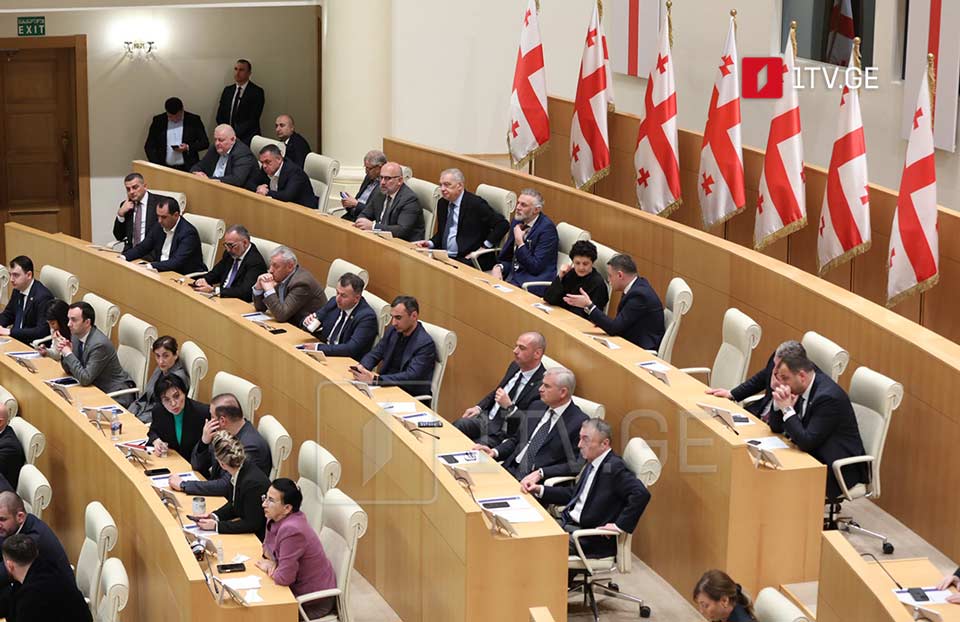
Georgia’s Parliament has approved a package of legislative amendments that further tighten regulations related to receiving grants, political activities, and political engagement.
The amendments were adopted in the third reading, with 78 MPs voting in favor and 9 against.
The legislative package introduces changes to several laws, including the Law on Grants, the Criminal Code, the Administrative Procedure Code, the Code of Administrative Offenses, the Organic Law on Citizens’ Political Associations, and the Law on the State Audit Service. The amendments were prepared by the ruling Georgian Dream faction.
Under the amendments to the Law on Grants, the definition of a grant is expanded.
Based on the new provisions, a grant will include monetary or in-kind funds transferred by certain entities that are intended or may be used to influence Georgian authorities, state institutions, or any part of society. This includes activities aimed at shaping, implementing, or changing Georgia’s domestic or foreign policy, as well as actions connected to the political or public interests of a foreign government or foreign political party.
Foreign-registered legal entities whose activities relate to Georgia will also be considered grant recipients. Such entities will be required to obtain prior consent from the Government of Georgia before receiving a grant.
If a foreign legal entity operating in Georgia through a branch, representative office, or other structure receives a grant without government approval, it will face legal liability.
Individuals or organizations that received grants before the law enters into force will have one month to apply to the government for approval, while the government will have **one month to issue its decision.
The amendments introduce criminal liability for violations of the Law on Grants. Offenses may be punished by a fine, community service of 300–500 hours, or imprisonment of up to six years.
An additional aggravating circumstance has also been added to the money laundering provisions of the Criminal Code. Money laundering carried out for the purpose of influencing political processes in Georgia will now be punishable by nine to twelve years in prison.
The legislation also establishes criminal liability for political party leaders who receive foreign funding, with penalties including fines, community service, or imprisonment of up to six years.
The amendments also criminalize foreign lobbying. The direct or indirect transfer of money, securities, property, or other benefits to a foreign citizen or legal entity in exchange for activities related to political issues in Georgia will be punishable by a fine, community service of 300–500 hours, or imprisonment of up to six years.
A new article has been added to the Criminal Code — Article 316¹, titled “Extremism against the Constitutional Order.”
The provision establishes criminal liability for systematic public calls to violate Georgian legislation, mass disobedience toward state institutions, or attempts to create alternative governing bodies. It also covers actions aimed at portraying Georgia’s constitutional order or state institutions as illegitimate in ways that could harm the country’s interests.
Such actions will be punishable by a fine, community service of 400–600 hours, or imprisonment for up to three years. Legal entities may face fines or liquidation.
The amendments introduce new rules regarding public political activity by business entities. Companies engaging in political activities unrelated to their core business may face an administrative fine of 20,000 GEL, with repeated violations potentially leading to criminal liability.
The amendments to the Organic Law on Citizens’ Political Associations also introduce new restrictions on party membership.
Individuals employed in organizations where more than 20% of annual revenue comes from a foreign power will be prohibited from joining political parties for eight years.
Additionally, the legislation replaces the term “entity with declared electoral goals” with “entity with declared party-political goals”, expanding its scope. All restrictions that apply to political parties will also apply to such entities.
The amendments further establish criminal liability for leaders of political parties or political entities that receive foreign funding in violation of the law.
Image source: 1TV