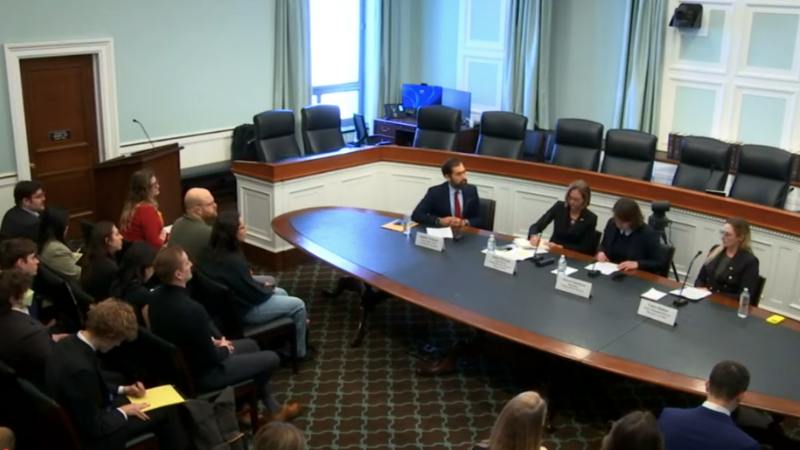
An informational briefing on what was described as harsh measures taken by Georgia’s ruling party against dissent was held at the US Helsinki Commission.
Speakers at the session included Laura Thornton, Senior Director of Global Democracy Programs at the McCain Institute; Claire Kaiser, Senior Managing Director at McLarty Associates; and Olesya Vartanyan, a researcher at George Mason University.
Based on a press release by the US Helsinki Commission, since October 2024 Georgia’s ruling party has drawn the country into what it described as the most severe human rights crisis since independence. The statement said more than 20 new laws had been adopted expanding state power to suppress dissent and weakening judicial independence, while repression had targeted civil society, journalists, and the political opposition.
The briefing examined what participants described as the deterioration of the human rights situation, tactics used to punish and demoralize critics of the ruling party “Georgian Dream,” and possible future responses.
In her remarks, Laura Thornton spoke about what she described as growing authoritarianism under the “Georgian Dream” government, noting that she had been observing democratic backsliding in Georgia since 2014, when she was appointed director of the National Democratic Institute’s office in the country.
Thornton recalled that the peaceful transfer of power from the former United National Movement government to the Georgian Dream coalition had initially been viewed as a promising period marked by reform and renewal. She noted that Georgia had hosted and led the Open Government Partnership and had been advancing democratic reforms while moving toward European Union and NATO membership.
However, she said this period proved short-lived, arguing that signs of democratic regression had appeared long before recent developments.
Thornton claimed that the Georgian Dream government had a “fatal flaw” from the outset in the influence of billionaire Bidzina Ivanishvili, whom she described as an oligarch with ties to Russia. She claimed that the ruling coalition soon fragmented and that pro-Russian narratives, disinformation, and anti-Western rhetoric followed, accompanied by attacks on civil society, media, and state oversight institutions.
Thornton also argued that Russia’s full-scale invasion of Ukraine marked a turning point, describing it as the moment when Georgia began to drift away from the West and move toward authoritarian governance. She further claimed that Georgia remains a major route for circumventing sanctions against Russia and criticized the government’s rhetoric toward Ukraine, Europe, and the United States, while noting its engagement with countries such as China and Iran.
She described Georgia’s 2024 elections as “irreparably rigged,” alleging that the ruling party retained power through force, withdrew from the European integration process, and announced plans to ban the political opposition.
Thornton stated that protests have been ongoing in response to these developments and claimed that civil society leaders, journalists, and politicians have been detained. She also referred to what she described as political prisoners in Georgia and criticized ongoing legislative initiatives as violating international and constitutional standards related to freedom of expression and assembly.
Thornton claimed that independent media, civil society, and the Georgian public represent the “last bastion” of the country’s democracy, which she claimed the authorities seek to weaken. She also suggested that the government had calculated that Russia would prevail in its war against Ukraine and that Western countries would not intervene, adding that developments in Ukraine could influence political regimes such as Georgia’s.
George Mason University researcher Olesya Vartanyan said that members of the Georgian Dream government would continue to face instability unless they demonstrate readiness for a fair political process in which they could potentially lose power.
She stressed that no political process could succeed without a credible opportunity for all political groups to access power equally and without a genuine mechanism for peaceful transfer of authority following elections.
Vartanyan noted that discussions about electoral legislation, procedural reforms, or technical changes would have little impact if the ruling leadership does not show willingness to share power or step down after electoral defeat. According to her, political participation lacks meaning without a credible path to peaceful change of government.
She also emphasized the importance of strong external guarantees for political processes and highlighted the role of the United States. While the European Union had previously used Georgia’s EU integration prospects as leverage, she said the current leadership has indicated it does not intend to pursue that path in the near future.
Vartanyan suggested that sanctions linked to Bidzina Ivanishvili could serve as a potential mechanism to advance political dialogue in Georgia, noting that sanctions are most effective when combined with diplomatic engagement. Without diplomatic follow-up, she warned, sanctions could have unintended consequences, including increased pressure on opposition activists, civil society representatives, and journalists.
Claire Kaiser, Senior Managing Director at McLarty Associates, stressed that punitive sanctions had not produced results so far. She expressed regret that the so-called “MEGOBARI Act” has not yet been adopted and underscored the importance of supporting the Georgian people.
Kaiser also highlighted the need for what she described as a more “creative approach,” particularly regarding Georgia’s participation in regional security and economic platforms.