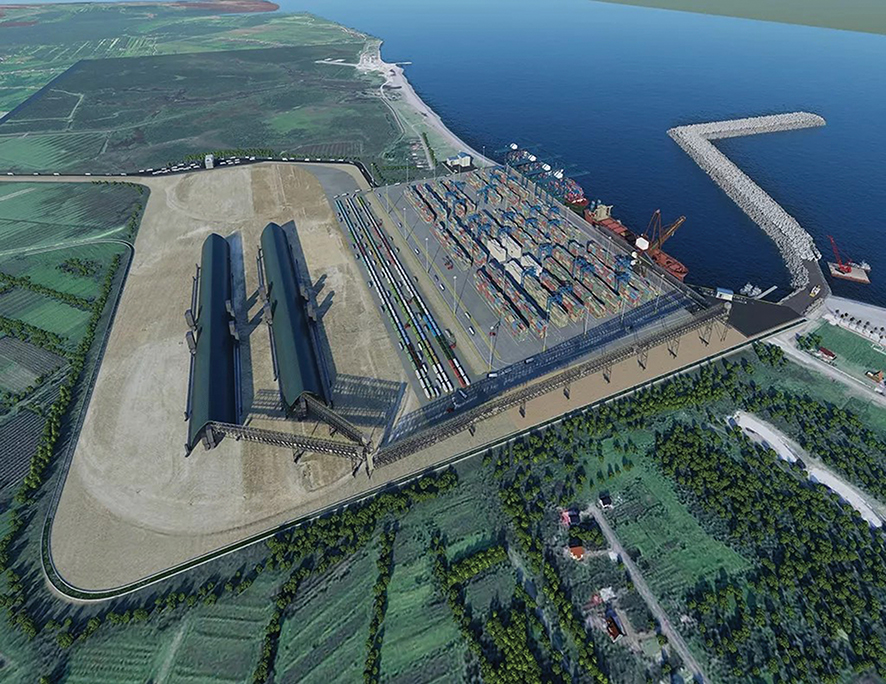
The Georgian government has decided that the Anaklia Deep Sea Port will be developed under a fully state-owned “landlord port model,” with the state retaining ownership of the core maritime infrastructure while international companies and investors participate in the construction and operation of individual terminals.
The decision was announced by Mariam Kvrivishvili, Georgia’s Minister of Economy and Sustainable Development, who said the new approach replaces the previously planned model based around a single private lead investor. According to the minister, the landlord model will allow Georgia to cooperate simultaneously with multiple countries and companies, creating better conditions for attracting cargo flows and ensuring more efficient port operations.
“The Government of Georgia has decided to construct the Anaklia Deep Sea Port using the globally proven ‘landlord’ model,” Kvrivishvili said. Under this system, “the state will retain ownership of the core maritime and port infrastructure” and ensure its development and management.
Under the new structure, Georgia will own 100% of the port’s main infrastructure. International companies will not receive ownership shares but will be invited to invest in and operate specific facilities, including container, bulk cargo and logistics terminals, through long-term agreements.
“This will be a Georgian port,” Kvrivishvili said, adding that international companies’ involvement would be limited to managing terminal infrastructure and would not affect ownership of the project.
From a Single Investor to Multiple Partners
The decision marks a change from the previous investment structure, under which Georgia had sought to develop Anaklia with a single strategic private partner. In 2024, the government selected a consortium led by China Communications Construction Company (CCCC) as the preferred private partner, with the state expected to retain a majority stake. However, the agreement was not finalized, and the government has now moved to a different development model.
The Georgian government argues that the new approach will reduce dependence on one investor and allow participation from a wider range of countries and companies. Kvrivishvili specifically highlighted potential cooperation with countries involved in the Middle Corridor, including China, Azerbaijan and Central Asian states.
Uzbekistan Emerges as a Potential Partner
Uzbekistan has recently expressed interest in participating in Anaklia’s development. During a July 2026 visit to Georgia, Uzbekistan’s Minister of Investment, Industry and Trade Laziz Kudratov and other officials inspected the Anaklia port project and discussed possible Uzbek involvement.
According to Uzbekistan’s Ministry of Investment, Industry and Trade, discussions focused on the potential participation of Uzbek companies in the development of the port, as well as expanding Uzbekistan’s export-import routes through Georgia. The visit also examined Anaklia’s role in connecting Central Asia with Black Sea trade routes, including links related to the China-Kyrgyzstan-Uzbekistan transport corridor.
Uzbek interest reflects the wider importance of Anaklia for landlocked Central Asian economies seeking reliable access to European markets through the Trans-Caspian International Transport Route, commonly known as the Middle Corridor.
Why Anaklia Matters
Located on Georgia’s Black Sea coast, Anaklia is designed to become a major deep-water port capable of handling large vessels and increasing Georgia’s role as a regional logistics hub.
The project is considered strategically important because it could strengthen Georgia’s position between Central Asia, the Caspian region, Turkey and Europe. The government has presented the port as a key element of the Middle Corridor, which has gained importance as countries seek alternative trade routes connecting Asia and Europe.
The landlord model chosen by Georgia is widely used internationally. Under this system, governments or public port authorities retain ownership of strategic infrastructure, while private operators manage terminals and commercial activities. Kvrivishvili said similar approaches operate in countries including the Netherlands, the United States, Singapore and Belgium.
For Georgia, the challenge will now be attracting sufficient investment and experienced operators to turn Anaklia from a strategic vision into a functioning international port. The government says the new structure is designed to allow multiple partners, including countries along the Middle Corridor, to participate in the project.
By Team GT