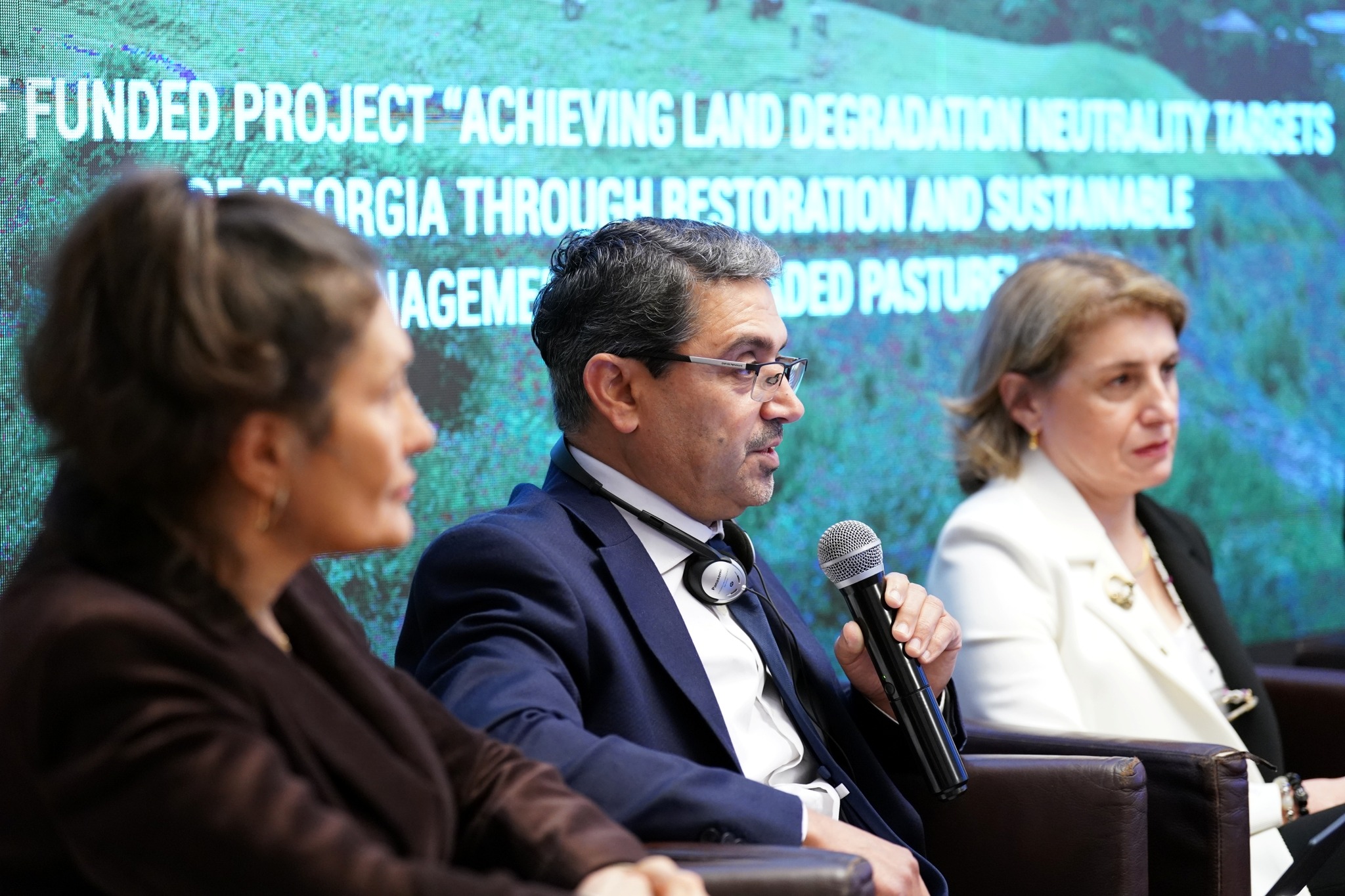
A five-year national project to restore degraded pastures and advancing sustainable land management in Georgia has been successfully completed, establishing a long-term framework for achieving the country’s Land Degradation Neutrality (LDN) targets.
The initiative, titled ‘Achieving Land Degradation Neutrality (LDN) Targets of Georgia through Restoration and Sustainable Management of Degraded Pastures,’ was implemented under the leadership of the Food and Agriculture Organization of the United Nations (FAO) and Georgia’s Ministry of Environmental Protection and Agriculture. The project was financed by the Global Environment Facility (GEF) and carried out in cooperation with the Regional Environmental Centre for the Caucasus (REC Caucasus) and the Caucasus Environmental NGO Network (CENN).
Over the course of five years, the project delivered both policy-level and practical outcomes. A national policy framework for sustainable pasture management was developed while modern land monitoring tools and local governance mechanisms were introduced to support evidence-based decision-making and long-term protection of grassland ecosystems.
On the ground, more than 530 hectares of degraded land were restored through rotational grazing practices and anti-erosion plantations. The project also strengthened community-based pasture user associations.
Although the project officially concludes in December, the institutions, methodologies and technical knowledge established through the initiative are expected to guide future land restoration efforts nationwide, providing a scalable model for sustainable land management in Georgia.