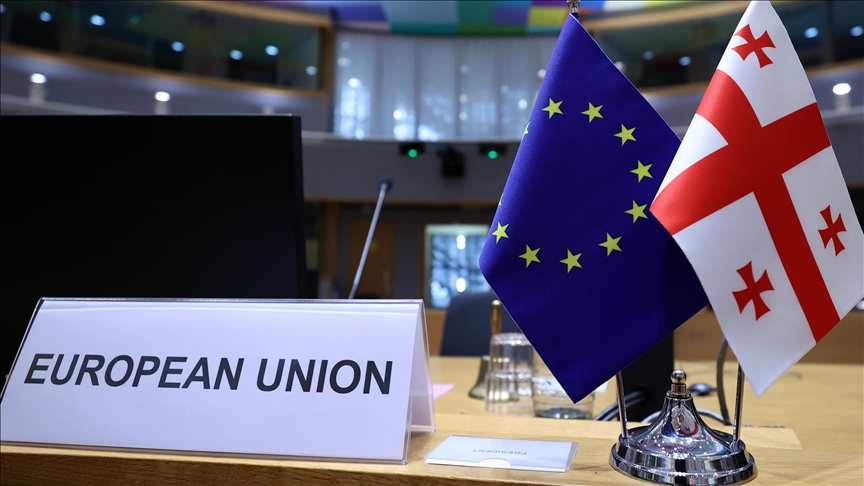
The EU Council Presidency published its conclusions on enlargement this week, including an assessment of Georgia’s EU accession path. The document was issued on behalf of the Presidency after the proposed draft received support from 26 EU member state delegations while one delegation withheld support, preventing full consensus.
In the conclusions, the Council reiterates its strong support for the European aspirations of the overwhelming majority of the Georgian population. However, it states that the current actions of the Georgian authorities fall short of the standards and expectations placed on an EU candidate country.
As the text stated, the Council expresses serious concern over what it describes as a broad democratic backsliding in Georgia. This includes setbacks in democracy, human rights and the rule of law, as well as the adoption of repressive legislation that undermines fundamental rights and freedoms. The Council also highlights the political instrumentalization of the judiciary, persecution of opposition figures, arbitrary arrests of protesters and journalists and the continued shrinking of civic space.
The Council further condemns the spread of disinformation and anti-EU narratives by the Georgian authorities, calling for such practices to end. It notes with regret that Georgia has backslide across the nine reform steps on which EU candidate status was granted, concluding that the country’s accession process has effectively come to a standstill until authorities demonstrate a clear commitment to reversing course and returning to the EU integration path.
As initial steps toward re-engagement, the Council calls on the Georgian authorities to release all arbitrarily detained politicians, journalists and activists; repeal repressive legislation; adopt democratic, comprehensive and sustainable reforms in line with European integration principles; and cease aggressive rhetoric directed at the EU, EU ambassadors and the Head of the EU Delegation.
Despite its criticism, the Council reaffirms the European Union’s support for Georgia’s sovereignty, independence and territorial integrity within its internationally recognized borders. It underlines the EU’s continued commitment to peaceful conflict resolution and its policy of non-recognition and engagement, including through the EU Monitoring Mission in Georgia.
The conclusions also express regret over Georgia’s ongoing non-compliance with recommendations outlined in the seventh visa suspension mechanism report. The Council urges the authorities to fulfil these recommendations promptly and meet visa liberalization benchmarks without delay.
Finally, the Council reiterates its strong expectation that Georgia align more closely with the EU’s Common Foreign and Security Policy, particularly by joining EU restrictive measures against Russia and Belarus in response to Russia’s war against Ukraine. It calls on the Georgian authorities to avoid actions or statements that contradict EU foreign policy positions while encouraging continued cooperation to prevent the circumvention of EU sanctions.