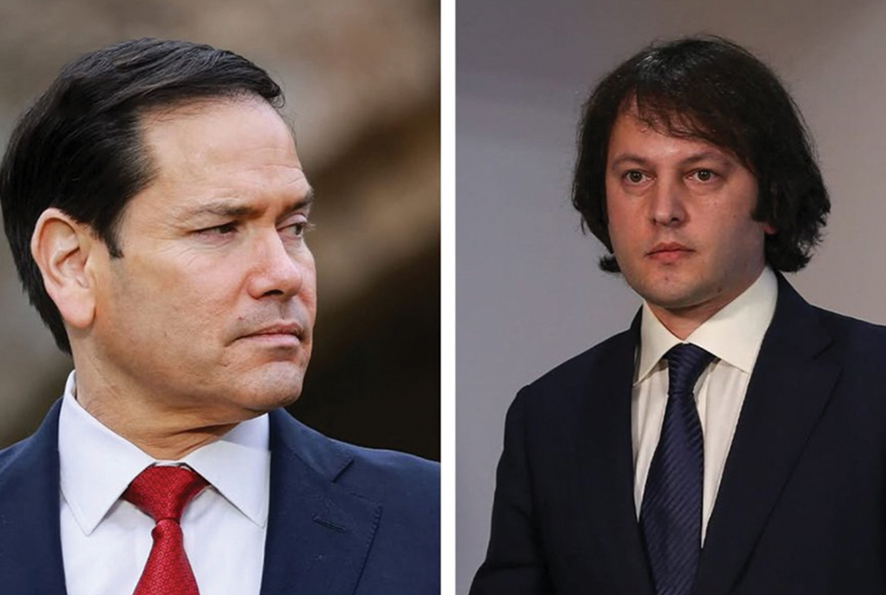
The cobblestone streets of Tbilisi have long been a stage for the Great Game’s modern iterations, but the events of late March 2026 suggest a shift from diplomatic chess to a desperate, multi-front survival struggle. When US Secretary of State and National Security Advisor to the President of the United States Marco Rubio dialed Prime Minister Irakli Kobakhidze on March 30, the conversation was ostensibly about “security concerns.” In reality, it was a flare sent up over a region increasingly squeezed between a Western alliance seeking a reliable corridor and two wounded giants, Russia and Iran, fighting to prevent their own strategic encirclement.
For the Kremlin, the stakes could not be higher. Reeling from a grueling standoff with the West and a Ukrainian campaign that has evolved into a precision-strike war against Russian oil infrastructure, Moscow’s traditional hard power is frayed. As refineries smolder and export revenues tighten, Russia has reverted to the weaponization of faith. The Russian intelligence extraordinary public broadside against the Ecumenical Patriarchate is a preemptive strike on the soul of Georgia. By labeling the looming succession of the Georgian Patriarch as a Western intelligence plot, Moscow is attempting to anchor its influence in the one institution Georgians trust more than their government. For a Russia under siege, a pro-Western Patriarch in Tbilisi would represent the near collapse state of its “soft power” southern flank.
Tehran’s entrance into this geopolitical drama is equally frantic. Currently engulfed in a high-intensity war with the United States and Israel, Iran views any American footprint in the South Caucasus as a direct threat to its northern security perimeter. The Iranian Ambassador’s pointed warning that Georgia would pay a “price” for hosting external interventions is the rhetoric of a regime that cannot afford another front. To Iran, the South Caucasus is no longer just a neighbor, it is a vital escape valve for a country whose maritime routes are and most probably will be under constant threat for some time.
This “hybrid encirclement” places the Georgian government in a harrowing position. The Rubio call offers a tantalizing lifeline of Western security and investment, particularly as the Black Sea becomes the primary artery for energy bypassing a sanctioned Russia and a volatile Iran. Yet, the price of that lifeline is becoming clear: Georgia must navigate a minefield of Russian subversion and Iranian intimidation.
On the one hand, we have an opportunity for high-stakes opportunism, while on the other hand, we are facing existential dread. As Georgia prepares to choose a new spiritual leader, it is not just electing a Patriarch, it is deciding whether to remain a bridge for regional revisionists or to solidify its role as the West’s indispensable Black Sea fortress. Expect the coming months to be defined by a surge in “active measures,” designed to fracture Georgian society along religious lines, while Tehran and Moscow might coordinate to ensure that any “reset” with Washington remains a dangerously expensive proposition for Tbilisi. In this New Great Game, the pews of the Sioni Cathedral have become as strategically significant as the pipelines of the Caspian.
Author’s bio: George Katcharava is the founder of eurasiaanalyst.com, a geopolitical risk and advisory firm.
Op-Ed by George Katcharava