Blue Sky Academy began its journey at Kladno Airport in the Czech Republic as part of the Cessna Pilot Center network, focusing from day one on high-quality pilot training. Offering courses for both aspiring airline pilots and private enthusiasts alike, the academy has earned a reputation for safety, modern equipment, and student-centered instruction.
Students train on well-maintained Cessna aircraft equipped with advanced avionics, supported by online theory courses accessible worldwide. The addition of an Airbus A320 FNPT II MCC simulator, fully EASA-compliant, cemented Blue Sky’s status as one of Central Europe’s most respected flight training providers.
Expansion into Georgia
Two years ago, Blue Sky Academy expanded to Georgia, establishing a base at Natakhtari Airport just outside Tbilisi. The move proved both strategic and practical. Under the leadership of General Manager Artem Kuzmenko, Deputy Head of Training and Flight Instructor Georgii Neverov, and Theory Instructor Artem Timoshin, the academy quickly grew into a hub of mentorship, technical instruction, and inspiration.
“In Prague, winter weather isn’t perfect—low visibility, low clouds,” Georgii explains. “Georgia has perfect weather, easy visa access for students from Eastern countries, and a beautiful landscape. Honestly, I have the best view from my office.”
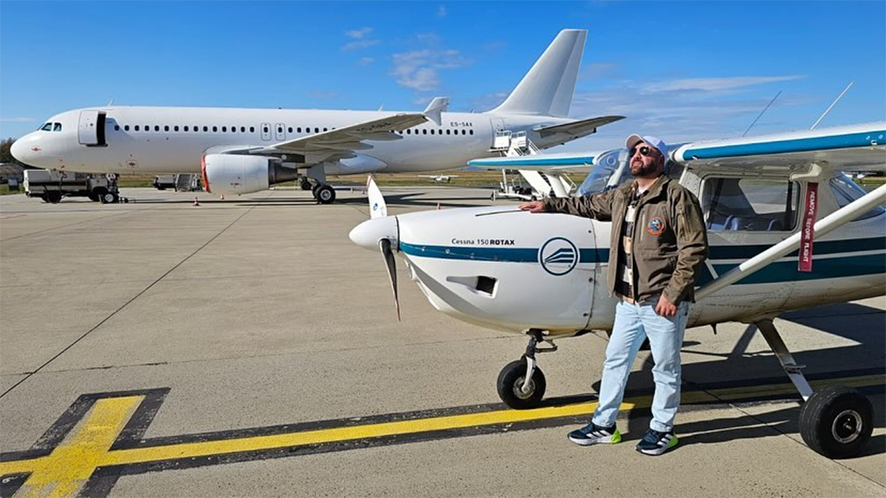
Opening the academy was straightforward thanks to supportive authorities. While infrastructure challenges exist, the environment has proven ideal for both flying and learning. Currently, the academy operates two Cessna 150 two-seaters, with a four-seater Cessna 172 set to join by year’s end. “The 172 allows students to accompany flights as observers, which some airlines require for potential pilots,” Georgii explains.
Who Are the Blue Sky Students?
Blue Sky attracts a diverse mix of students, from young adults to lifelong dreamers. “The majority of our students are over 30,” Georgii notes. “They always wanted to fly but life got in the way. Some are starting as a hobby, some with a serious career goal.”
Age is no barrier, though. Students as young as 18–19 train alongside those in their fifties or older. One remarkable student became a pilot at 67 after a lifetime of dreaming about it, bringing a career in engineering to precision in the cockpit. Another licensed Blue Sky pilot is a young prodigy who began at 17 and is already completing her flight instructor training at 20.
Alexander, a current Georgian student at Blue Sky, reflects: “Once your wheels leave the runway, all your problems are behind you. Flying is pure enjoyment. I’d never come back down if I could get away with it!”
The academy attracts local trainees as well as international students—most often coming from Azerbaijan, Kazakhstan, Ukraine, and the US. Blue Sky’s EASA compliance ensures that flight hours logged with them in Georgia count across Europe. “If a student flies 10–15 hours here, they can continue in Prague seamlessly. No extra paperwork,” Georgii says. Weekend lessons also accommodate those with full-time jobs, while Tbilisi’s affordable living allows students to settle comfortably for the duration of their training.
Learning to Fly: Discipline, Confidence, and Fun
Blue Sky’s training philosophy emphasizes safety, skill, and experience. Students start visually, learning to navigate in the Cessna with minimal traffic, and gradually progress to more advanced maneuvers and instrument training. Georgia’s low-traffic skies provide an ideal environment for new pilots. “It’s like learning to drive in an empty lot before moving into heavy traffic,” Georgii notes.
“A student may arrive with zero experience, and after just 15–17 hours of practice, you find yourself on the ground with a radio in hand, watching them take their first solo flight—a moment that’s both nerve-wracking and deeply proud,” Georgii says. “Because they don’t yet have a license, the law would normally require a qualified pilot beside them, but an instructor can instead endorse the student to fly under the instructor’s own license, placing a real sense of responsibility on both sides.”
The first solo flight is done in perfect conditions near the airport, giving students a huge confidence boost before the advance to complex maneuvers, longer routes, and solo cross-country flights. “Each decision to send a student solo is a delicate balance—the instructor must judge when eagerness is masking unreadiness, or when fear simply needs a gentle push—and in that balance lies one of the most rewarding parts of teaching someone to fly,” Giorgii says.
Simulators also play a key role. While the Prague base has a fixed-wing simulator and the Georgia branch currently offers a helicopter simulator, many students arrive with experience on home simulators. Alexander, for instance, has logged over 800 hours online. “It takes away a lot of the fear of that first takeoff,” he says.
For beginners without such experience, Blue Sky offers Aviation English Courses to strengthen speaking, listening, reading, and phraseology skills, ensuring the new pilots and air traffic controllers will be able to communicate safely in international airspace.
Aviation as a Career Path
Since opening in Georgia, Blue Sky has grown from a single student to over 80. Students usually begin with the Private Pilot License (PPL(A)) for airplanes or PPL(H) for helicopters—achieved after a minimum of 45 hours of real flying. Theory lessons are flexible, available online or in person. As confidence grows, students can pursue a Night Rating, IR(A), CB-IR(A), or advanced avionics training on systems such as the GARMIN G1000, supported by eLearning and practice tests.
For those aiming for to fly professionally, the ATPL(A) Theory Course lays the foundation, CPL(A) opens doors to commercial flights, and FI(A) allows students to build hours as instructors. “Technically, you could move straight from getting your license to flying for an airline,” Georgii says, “but it’s always better to build confidence in smaller aircraft first.”
Courses in 2025 range from roughly 3,120 GEL (1,160 USD) for PPL/BIR courses to 7,640 GEL (2,845 USD) for ATPL Theory. The academy emphasizes quality over shortcuts, ensuring that students progress safely and effectively.
Students can also rent aircraft once licensed, and Blue Sky offers an Aircraft Purchase Service for those interested in buying planes in Europe or the USA, assisting with the process from market research to legal checks.
Looking Ahead: Helicopters in Georgia
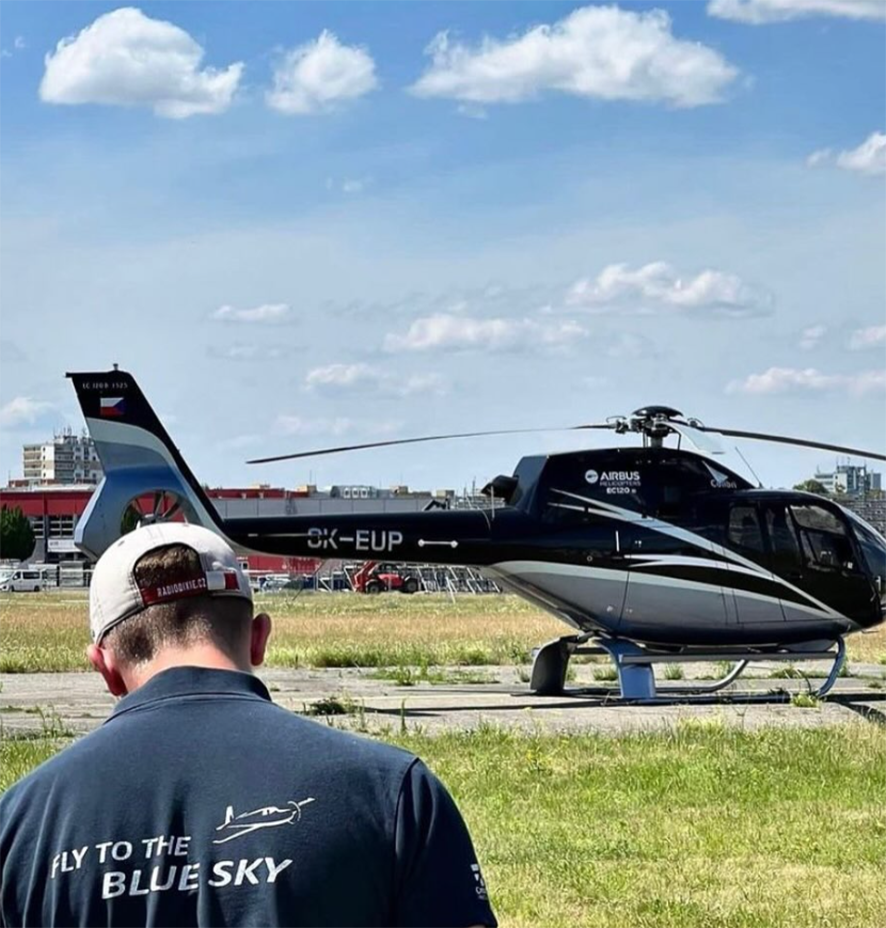
Helicopters are set to play a major role in Georgia’s aviation future, and Blue Sky is ready. The academy has secured EASA-compliant validation for the Guimbal Cabri G2 and also offers a validated program for the Eurocopter EC120, enabling full PPL(H) training locally. “Helicopters will be a big business in Georgia,” Artem predicts, while Giorgii adds: “Beautiful Georgia is true helicopter country!”
Training in Georgia: A Unique Opportunity
Georgia offers favorable weather, low air traffic, challenging yet safe terrain, and affordable living.
“From my experience flying in the US, EU, and Cyprus, I expected a big adjustment coming here, but the transition has been surprisingly smooth,” Georgii says. “Air Traffic Control speaks perfect English, so it feels just like Europe. The main difference is procedural—you need to file flight plans and report delays. It’s a bit of a Soviet-era approach, but I see Georgia gradually moving toward a no flight-plan system.”
Georgia’s skies challenge pilots with shifting crosswinds, gusty mountain winds, and dramatic terrain. “If you learn to fly in Georgia, you can fly anywhere,” Alexander says. “It’s like driving—if you can handle the roads here, the rest of the world feels easy.”
On flying itself, he adds: “Up there, you don’t just admire the scenery—beautiful as it is. Flying a single-engine aircraft means staying sharp. You’re always thinking ahead, scanning for safe landing spots, planning for the unexpected. Some stretches, like approaching Kutaisi over that seemingly endless forest, give you nowhere to put the aircraft down. You learn to trust your training, read your instruments, and stay calm.”
Learning to fly in Georgia is demanding, but that’s clearly what makes it transformative. It doesn’t just teach you to be a pilot—it teaches you to be a capable one.
Inspiring the Next Generation
Blue Sky isn’t just about producing pilots—it’s about building a community. From young students to lifelong dreamers, locals and internationals alike, the academy nurtures passion, discipline, and confidence. “Meeting so many people single-mindedly chasing the goal of a pilot’s license is incredibly rewarding,” Artem says. Giorgii adds: “You guide them from their first flight to that moment when they can take the controls alone. That’s when you know you’ve made a difference.”