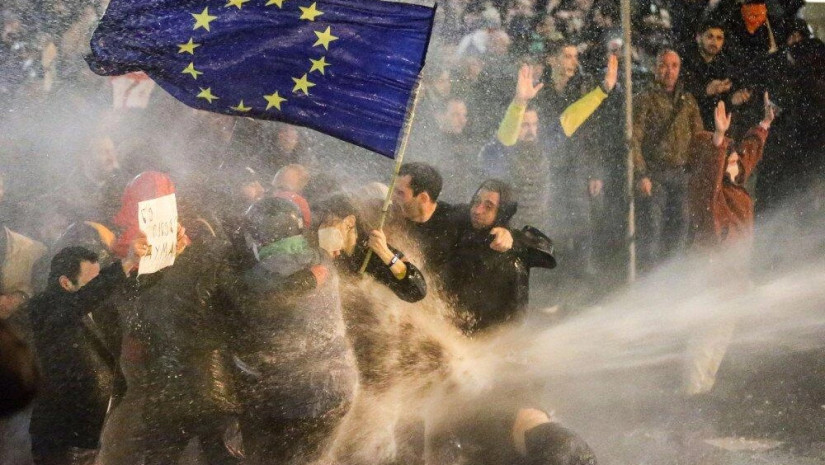
The BBC reports that evidence it gathered suggests the Georgian Government may have deployed a discontinued, First World War–era crowd-control agent to suppress anti-government protests last year.
As the report stated, demonstrators opposing the Government’s suspension of EU accession complained of severe symptoms, including burning eyes, shortness of breath, coughing and vomiting, which in many cases persisted for weeks. The BBC states that expert analysis indicates these clinical signs align with bromobenzyl cyanide, also known historically in French military terminology as ‘cammite’ or ‘camite’.
Camite was developed by Allied forces and used by France in the First World War against Germany, but was reportedly discontinued in the 1930s due to its long-lasting health effects, and was later replaced by CS gas, commonly known as tear gas.
The BBC says it obtained a December 2019 inventory list from Georgia’s Special Tasks Department that referenced two unnamed substances: ‘Chemical liquid UN1710’ and ‘Chemical powder UN3439’, with mixing instructions. A former high-ranking riot police officer reportedly confirmed the document appeared authentic, and suggested both chemicals would have been deployed via water cannons.
The BBC identified UN1710 as trichloroethylene (TCE), a solvent used to dissolve substances in water. UN3439, an umbrella classification for industrial hazardous chemicals, required further forensic analysis. The BBC states that the only chemical under that code historically documented as a riot-control agent is bromobenzyl cyanide (camite). Professor Christopher Holstege, a toxicologist and chemical-weapons expert consulted by the BBC, reportedly stated that the symptoms described by witnesses were consistent with exposure to bromobenzyl cyanide.
The allegations drew condemnation from UN Special Rapporteur on Torture, Alice Edwards, who said the effects described exceed what could be accepted as temporary, proportionate crowd control under international law. She further told the BBC that such deployment resembled the use of an ‘experimental weapon’, stressing that populations must never be subjected to experiments. She added that incidents meeting these criteria should be investigated as possible torture or ill-treatment.
The BBC also quoted Alice Edwards calling the findings “consistent with violations of human rights law”, and UN expert Alice Edwards described chemical gaps in regulation around water cannons as a priority she wants to address.
UN Special Rapporteur on Torture Edwards had previously written to the Georgian Government regarding protest-related police violence claims. The BBC attributed direct quotes to Edwards confirming that incidents of this nature require full investigation under torture-prevention frameworks.
Responding to the BBC’s publication, the Georgian Government described the allegations as ‘deeply unfounded and absurd’, insisting that law-enforcement acted within Georgia’s Constitution and domestic law when dealing with violent offenders.