The Catholicos-Patriarch of the Georgian Orthodox Church, Ilia II, died on March 17, at 93 years of age. He had held his position for 49 years, thus taking Georgia from the Soviet period to today. He was also the longest-serving Georgian Orthodox Patriarch ever, in over 1500 years of the church’s existence.
Born Irakli Gudushauri-Shiolashvili in Orjonikidze (now Vladikavkaz), in the Russian North Caucasus, he studied at the Moscow Theological Seminary in the late 1950s; was tonsured a monk in 1957, choosing his name from the Old Testament prophet Elijah; then he held bishoprics in Georgia until his election as Patriarch in 1977. In 1990, he succeeded in having Georgia’s Orthodox Church recognized as auto cephalic (self-governing) by the Ecumenical Patriarch of Constantinople. He was consistently chosen as the most trusted person in the country in polls, and did much to unite Georgia as a primarily Orthodox nation. He was present during Georgia’s dark day of murderously quashed anti-Soviet protests, April 9, 1989.

In my 27 years in Georgia, I have seen many new Orthodox churches built in regions of Tbilisi which were Soviet-built, and thus previously churchless. Also, many churches across the country have been rebuilt, restored and returned to the fold after various ignominious atheist uses; and many monasteries and nunneries everywhere have been reopened or newly begun. Even my home village of Etseri, Svaneti, home to about seven ancient churches and chapels, has seen three new ones built in the last few years. Similar things have happened right across Svaneti and elsewhere in Georgia’s furthest regions. Some of my foreign friends, too, formerly Protestants, have converted to Orthodoxy here in Georgia. So, the Orthodox revival is in full swing.

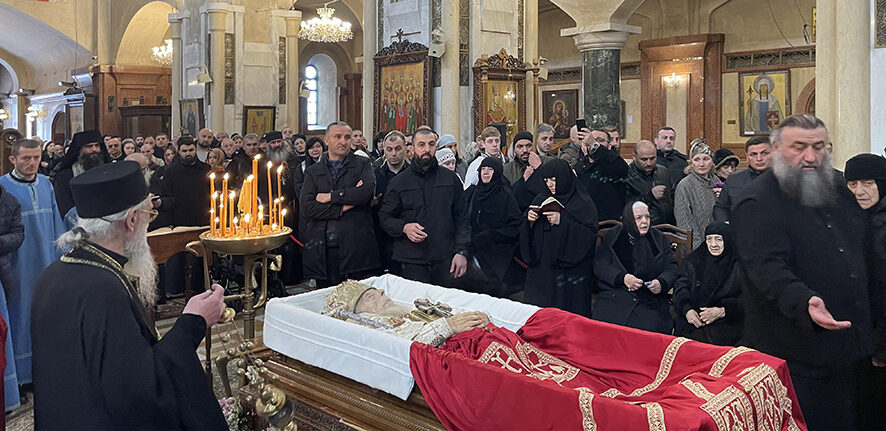
I dressed in my best somber gray Harris tweed and dark Svan cap to attend the late Patriarch’s wake in huge Tsminda Sameba (Holy Trinity) Cathedral today. When I was in line about 10m from the entry doors, they were closed: for half an hour, we were told, though this doubled. The line meanwhile swelled to thousands, filling the massive courtyard; and the police presence in and outside the church grounds could also easily be counted at more than a thousand. Then the doors were reopened, and in we went.

I had taken my large DSLR camera as well as my cellphone, but in the end decided to use only the latter for both photos and video, to be less conspicuous and noisy. At least things moved quite fast, with no checking of bags or restrictions on using cellphone cameras in general. My new GEORGIA TODAY press card was put to use for the first time ever, allowing me to request to spend a few more minutes not moving away but stopping and working as most people were urged on. Only a very few were allowed inside the roped-off area where Ilia’s body lay in its coffin, with candles, masses of flowers and priests surrounding it. I quickly took my shots and footage and moved out with the slowly exiting crowd.

The mood was solemn, quiet; the cathedral packed with people of all ages coming to pay their respects to the great man. It will stay open 24/7 until his funeral, which will be in a few days. I was glad that crowd control was working well: any chaos could have turned crushingly deadly. But people were calm, everyone expecting to get in. I imagine that a large proportion of the national population will pass through those doors in the next couple of days.
My Georgian friends tell me that the new Patriarch’s election (the first post-Soviet one) will begin after the ormotsi (traditional 40-day mourning period), and must be concluded by the 60th day after Ilia’s passing. There may be candidates already years in the waiting, his health having been poor for quite a long time now. The new Patriarch has a vastly different nation to deal with than that of the 1970s, in many ways. The world has changed. I wish him success and blessing.
Blog by Tony Hanmer
Tony Hanmer has lived in Georgia since 1999, in Svaneti since 2007, and been a weekly writer and photographer for GT since early 2011. He runs the “Svaneti Renaissance” Facebook group, now with over 2000 members, at www.facebook.com/groups/SvanetiRenaissance/
He and his wife also run their own guest house in Etseri: www.facebook.com/hanmer.house.svaneti