Writing this while on a Batumi-Tbilisi train, one of several journeys possible within this country. Iran will, no doubt, give me much more dark inspiration to write in coming days and weeks; but that later.
In the UK, rail travel was, for me, usually too expensive; but buses did the job fairly well too. Plus, rail there is plagued with failures of timing and schedule, given the density and complexity of the system. In Georgia (as in the other eastern European countries where in the 1990s rail was my choice of movement), it continues to function like clockwork. A sign proudly announces its start as having been in 1872.
There is the one-two-three-FOUR; one-two-three-FOUR clack of the wheels from rail to rail, a slight gap left for expansion and contraction as temperatures change. The whistle of the train. The changing speeds.
These latter have a beautiful side effect when you’re filming the neighboring rails going by. The combination of certain speeds, the perfect regularity of the railway ties, and the frame rate of the camera, causes the ties to appear to be moving at quite their own speed, backwards like everything else, perversely forwards, or even, at perfect lineup, standing still. Strange and marvelous.
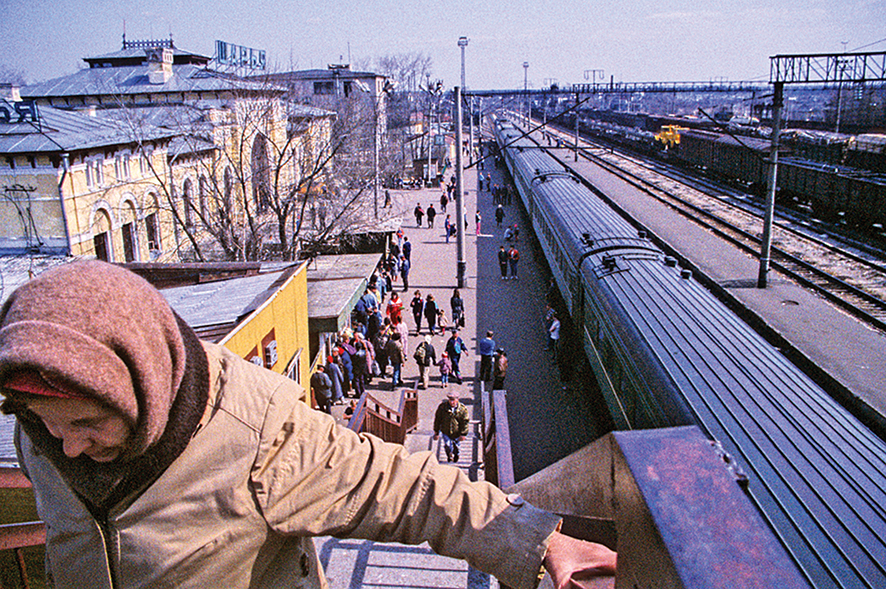
Our journey gives a glimpse into the backyards of countless houses, as we whizz or glide past them. Just enough to take in something or someone before we move on.
The landscape, in any season, offers new vistas every second. Almost always there are Georgia’s ever-present mountains in the background, hardly moving by at all due to their distance from the movie screen of my window. Closer, and thus moving ever faster the closer they get, are ponds, puddles, streams and rivers, fields, cars keeping up or doubling their speed in the opposite direction, people going about their daily lives, livestock.
The first flowering fruit trees (in this season) put on brilliant displays of pink or white. I hope a frost won’t come late and spoil the future crops. And grimace at the creepers which too often are growing over trees and strangling the life out of them, cowards, too weak to rise on their own, parasites.
We only stop at Kobuleti, Ureki and Kutaisi airport; so this is a fairly fast train, the total trip five hours. Nice modern carriages, with two stories, good bathrooms, plugs for charging at every seat, even some rudimentary Wi-Fi.
Buses or minivans don’t give this amount of calm and comfort. Driving oneself forces you to concentrate on the road and doesn’t allow the freedom to notice the passing vistas.
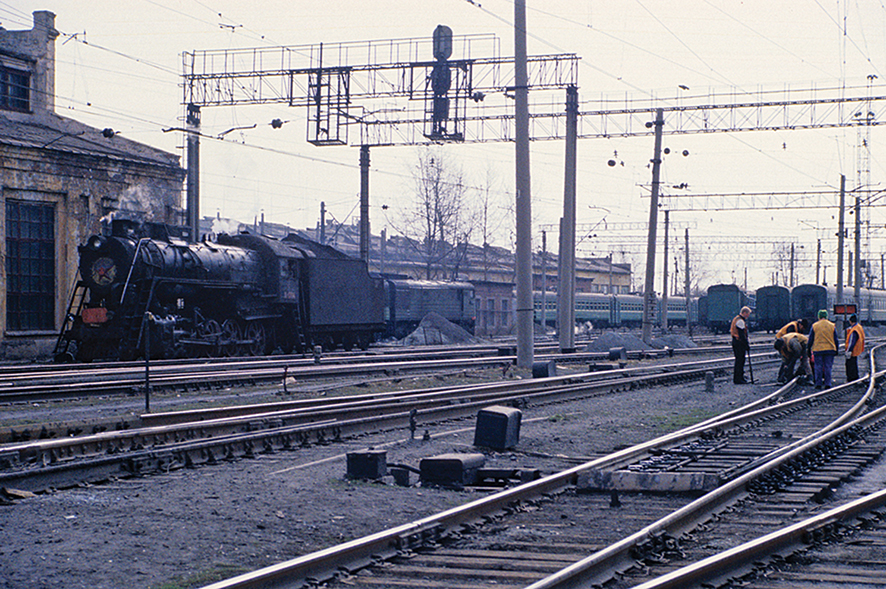
After the 60-km Rikoti Pass between west and east Georgia, we see the difference between these two halves. West is warm and moist; east, warm and dry.
I film a lot with my phone, trying to capture some of the love I feel for this mode of transport.
Spring is about erupt from the little death of winter; buds are coming on the slower trees. Soon this will all blush green, then briefly be dominated by all shades and hues of this color, for which eye and heart have thirsted all winter long, before browns and yellows of mid- to late summer dry things up, especially in the east. Of course, the mountains’ altitude keeps them cold for longer, their spring driving much later. But their distance from the train mostly obscures this gradation of seasonal differences.
At least I know that the slower speed of rail travel, compared to flying, won’t leave my soul stranded somewhere to have to catch up later. I arrive in Tbilisi with all faculties together and intact, rested and calm. It’s the only way (where the steel road allows) to travel.
Blog by Tony Hanmer
Tony Hanmer has lived in Georgia since 1999, in Svaneti since 2007, and been a weekly writer and photographer for GT since early 2011. He runs the “Svaneti Renaissance” Facebook group, now with over 2000 members, at www.facebook.com/groups/SvanetiRenaissance/
He and his wife also run their own guest house in Etseri: www.facebook.com/hanmer.house.svaneti