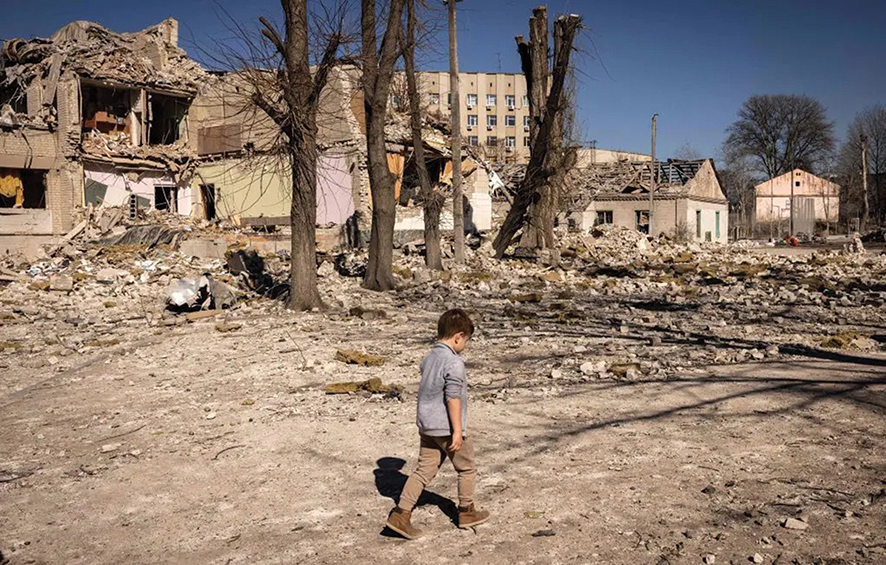
As Russia’s full-scale invasion of Ukraine enters its fifth year, the human and territorial toll remains severe. Verified United Nations figures show at least 15,000 civilian deaths and more than 41,000 injuries since February 2022, with children among the casualties and roughly 19,500 documented Ukrainian children abducted by Russian forces. Of those, only about 1,800 have been returned through negotiated efforts. More than 10 million people have been displaced, including 3.7 million refugees abroad, and repeated strikes on electricity, heating, water, and transport infrastructure have left hundreds of thousands enduring harsh winter conditions without basic services.
On the battlefield, Russia continues to hold parts of Donetsk, Luhansk, Kherson, and Zaporizhzhia, while Ukraine has made localized counteroffensives to regain villages and reduce Russian footholds in Zaporizhzhia, Dnipropetrovsk, and northern Kharkiv. Despite these gains, frontlines remain largely contested and advances incremental rather than decisive.
This week, US-mediated talks in Geneva involving Ukraine, Russia, and Washington concluded without a breakthrough on the war’s most sensitive political issues. President Volodymyr Zelenskyy described the negotiations as tough, noting that “positions differ because the negotiations were difficult.” He criticized Russia for attempting to delay progress, saying, “Russia is trying to drag out negotiations that could already have reached the final stage.” Zelenskyy also addressed pressure to make concessions, emphasizing that “it is not fair if Ukraine is asked to make concessions that Russia has not earned,” and underscored that any deal must respect Ukraine’s sovereignty and internationally recognized borders.
From the US side, mediators described progress on military and technical issues, particularly mechanisms for monitoring a potential ceasefire. One American official stated that the talks “led to substantial progress” on some military tools and monitoring arrangements, even as the political and territorial disputes remain unresolved. Russia’s negotiators, meanwhile, called the discussions “businesslike,” but offered no optimism about achieving substantive political agreements.
The Geneva talks unfolded amid intensified Russian attacks on Ukrainian infrastructure. On February 17, hundreds of drones and missiles targeted energy and transport networks across multiple regions, leaving tens of thousands without heat or power and killing three energy workers. Zelenskyy condemned the strikes as deliberate attempts to undermine diplomacy, stating that Russia’s actions should be held accountable and calling infrastructure attacks a major barrier to peace. Ukraine responded with long-range drone strikes against refineries and port facilities inside Russia, aiming to disrupt fuel supplies and force Russia to divert air defense resources.
International support for Ukraine this week focused on air defense and energy resilience. NATO and European allies pledged additional weapons and interceptors, while funding through the Prioritized Ukraine Requirements List reached $35 to $38 billion for 2026. These efforts reflect the recognition that protecting civilian infrastructure is now central to sustaining Ukraine’s defense.
As the conflict comes to its fourth anniversary, Ukraine faces intertwined challenges. The country must manage a staggering humanitarian crisis, contest incremental territorial gains and losses, and pursue diplomacy that so far has fallen short of resolving the core political disputes. The coming months will test Ukraine’s endurance and the international community’s ability to sustain support amid ongoing frontline pressures and attacks on civilian infrastructure.
Ukraine: The Humanitarian and Territorial Impact (Feb 2022–Early 2026)
Human Toll
• Civilians killed: 15,172+ (verified by UN HRMMU; actual numbers likely higher due to limited access in occupied areas).
• Civilians injured: 41,378+ (includes thousands of children).
• Children killed or injured: 766+ killed, 2,540+ injured.
• Displaced persons: ~10.6 million (approx. 6.9 million internally displaced, 3.7 million refugees abroad).
• Children displaced: ~2.5 million.
• Children abducted by Russia: ~19,500 documented, with ~1,859 returned via negotiated returns.
• Kidnappings and rights violations: widespread reports of abductions, torture, and unlawful detentions of both civilians and children in occupied territories.
• Infrastructure and humanitarian strain: repeated strikes on electricity, heating, water, hospitals, schools, and shelters, leaving hundreds of thousands of civilians without basic services, particularly in winter.
Military and POW Data
• POW exchanges: At least 64 confirmed swaps, with 4,757 Ukrainians returned since the start of the invasion.
• Large-scale exchanges: Some swaps involved hundreds to over a thousand personnel on each side (e.g., 1,000-for-1,000 deal in Istanbul).
• Ongoing captivity: Thousands of Ukrainian soldiers and civilians remain in Russian custody, with verified returns representing only part of total detainees.
Territorial Dynamics
• Russian-held areas: Parts of Donetsk, Luhansk, Kherson, and Zaporizhzhia regions remain under Russian control.
• Key contested areas: Pokrovsk, Myrnohrad, northern Kharkiv, and parts of Zaporizhzhia and Dnipropetrovsk.
• Ukrainian counteroffensives: Localized gains in Zaporizhzhia and Kharkiv, reclaiming villages and reducing Russian footholds.
• Frontline pattern: Shifts are incremental rather than decisive; no side has achieved a rapid, large-scale breakthrough.
By Team GT